PointsBet announced that MIXI Australia (MIXI) has successfully obtained written confirmation from the Alcohol and Gaming Commission of Ontario (AGCO) regarding its suitability for the proposed acquisition of shares in PointsBet.
In a dispatch, PointsBet informed that following an extensive review process, AGCO has expressed no concerns about MIXI’s acquisition, and received approval from iGaming Ontario (iGO) concerning this transaction. With this approval, the prerequisite condition related to Ontario approvals has been met.
MIXI’s proposed takeover bid is now only subject to a few remaining conditions, including a requirement for a minimum acceptance of 50.1 percent of the proposed MIXI Offer.
Additionally, PointsBet confirmed that Australia’s Northern Territory Racing and Wagering Commission granted its approval for MIXI’s acquisition on March 24th 2025, meaning the takeover bid is no longer contingent on any gaming regulatory approvals.
The competition for control of PointsBet escalated when the company officially received MIXI’s off-market all-cash takeover offer of AU$1.20 ($0.78) per share. This offer follows provisions of a bid signed earlier this month, which stipulated a takeover if the previous scheme was not approved.
The PointsBet board has unanimously recommended shareholders accept MIXI’s offer, arguing it provides greater value and fewer risks compared to a competing all-scrip proposal from Betr Entertainment. The board stated, ‘MIXI’s offer delivers certainty in the form of cash,’ while emphasizing the speculative nature of Betr’s proposal.
MIXI has garnered strong shareholder support, with over 95 percent of votes cast—excluding Betr—favoring its scheme. The offer represents a 44.6 percent premium over PointsBet’s pre-announcement price.
Rival bidder Betr Entertainment recently claimed that its vote was improperly excluded from a key shareholder meeting, potentially setting the stage for legal challenges. Betr has warned that if its vote is not counted before a crucial court hearing, it will contest the outcome in court.
PointsBet rejected Betr’s accusations, stating they were ‘factually inaccurate and without basis,’ and confirmed that the vote was overseen by an independent share registry.
Good Morning. Fighting the urge to ban. The Philippines should enhance regulations to combat illegal online gambling rather than impose a ban, Marie Antonette Quiogue, founder of Arden Consult, argues, emphasizing the need to distinguish between legal and illegal operators while advocating for data-driven legislative approaches. Meanwhile, the Macau government has proposed a comprehensive amendment to its advertising law, prohibiting advertisements that directly or indirectly promote any type of gambling activity. At the same time, investment bank CLSA has raised its 2025 forecast for Macau’s gross gaming revenue to $30.1 billion, reflecting a 7.6 percent year-over-year growth, driven by a strengthening Chinese renminbi and strong second-quarter performance.
The path to success for the Philippines lies not in banning online gaming but in enhancing existing regulations to combat illegal gambling while balancing individual freedoms with public interest, according to expert Marie Antonette Quiogue, founder of Arden Consult. In her recent article post-conference at the International Association of Gaming Advisors (IAGA) in Berlin, Quiogue argues that proposed legislation targeting the online gaming sector may be misguided. She emphasizes the importance of distinguishing between legal Philippine Inland Gaming Operators (PIGOs) and illegal Philippine Offshore Gaming Operators (POGOs), which have been outlawed.
Winning Trust, Stopping Fraud. Asia Pacific’s iGaming market is expanding extremely fast, and a new wave of digital-savvy players is pushing demand through the roof. But the rise in adoption has outpaced regulation in many markets, and fraudsters have taken notice.
With over 30% of global gaming revenue projected to come from Asia soon, the window of opportunity is wide open. Bettorify’s white-label and turnkey solutions deliver what most platforms miss: sharp execution backed by real local expertise.
The route to success for the Philippines is not an outright ban on its online gaming industry, but rather leveraging and improving existing frameworks to stomp out illegal online gambling and striking ‘the better balance between individual freedom and public interest,’ notes an expert.
Marie Antonette Quiogue, Founder, Arden Consult
Top gaming lawyer Tonet Quiogue, CEO and Founder of Arden Consult, delivered a concise and highly compelling case for why proposed legislation aimed at taking down the online gaming sector in the Philippines may not be the best course for the nation.
Following a conference at the International Association of Gaming Advisors (IAGA) in Berlin, the lawyer published a piece entitled ‘Outright Ban vs Smart Regulation: A Legal Perspective on Online Gambling in the Philippines’.
While only a portion of that is outlined below, the entire piece is very much worth the time. Here are some of the select takeaways.
Legal vs Illegal
Legislation introduced in recent weeks has caused a tumble in the share price of Philippine operators in the online segment. These Philippine Inland Gaming Operators (PIGOs) differ significantly from the Philippine Offshore Gaming Operators (POGOs), which have been outlawed since January 1st.
But public perception can be easily skewed, as the conversation around bad actors in the POGO space, particularly when referenced by legislators, failed to distinguish between those operating legally – being licensed under the regulator PAGCOR, and those operating illegally.
This prompted not only the closure of all offshore gaming operations in the country – whether they did anything wrong or not – and has now led to the focus on PIGOs.
‘Lawmakers must ground their legislative proposals in accurate and relevant data,’ notes the expert. ‘The real enemy, as any seasoned observer knows, is illegal gambling’.
What can be done?
Illegal gambling operators ‘bypass all regulations, pay no taxes, and offer no player protections. If the goal of lawmakers is to eliminate the social ills of gambling […] then the logical approach is to surgically strike at these illicit operations, not to outlaw the entire industry and penalize legitimate stakeholders’.
Quiogue presents some key suggestions for a possible bill aimed at improving the sector’s regulation instead of eviscerating it.
These include better regulations for B2B providers which focus on the ‘broader ecosystem of support services that enable these platforms to operate’. The lawyer notes that PAGCOR has already identified this and ‘issued specific rules requiring the accreditation of gaming affiliates and support service providers’. These encompass everything from ‘marketing agencies, social media managers, and public endorsers that promote gaming platforms’ – making sure they ensure the clients are licensed or face penalties.
Furthermore: ‘increase the penalties for those who organize or profit from unauthorized online gambling.’ The legal expert argues that the entities that ‘deliberately evade regulatory oversight, bypass KYC protocols, and often target vulnerable communities through aggressive marketing and influencer-based promotions’ pose a much higher threat than PAGCOR-regulated entities that pay taxes, create jobs, and have responsible gaming policies.
Further options include possible mandates for Internet Service Providers (ISPs) and payment providers – cutting off the means for illicit gambling websites to accept payments or move money; streamlining the process for taking down or seizing illicit domains; improving inter-agency coordination; looking at more mature international jurisdictions ‘for guidance’; and improving funding for public education and rehabilitation programs.
‘By focusing on these targeted measures, lawmakers can attack the core of the problem – the lawless operators’.
‘The real problems are addiction and criminality, which thrive in the shadows, not in the regulated daylight’.
Keep it legitimate
“The growth of the Philippine Inland Gaming Operator (PIGO) model should not be misinterpreted as a rise in gambling addiction. On the contrary, it signals a positive migration from the grey market into a regulated and accountable space.”
Tonet Quiogue
Quiogue notes that ‘today over 55 percent of online activity is now channeled through legal, tax-paying PIGOs – a dramatic shift towards legitimacy and protection. This shift enhances consumer protections, introduces responsible gaming tools, and brings significant revenue to the state – all outcomes that would be impossible in an unregulated setting’.
‘The growth in regulated platforms is a policy win, not a warning sign,’ states the lawyer.
And total prohibition has a history of failure. Quiogue points out how blanket bans in numerous countries have since challenged law enforcement in keeping up with the ever-shifting black market operators that not only are technologically savvy, but also have no qualms about their customers’ well-being.
Not only this, but regulators can’t get a real understanding of the scope of the underground market, what tax dollars they’re missing out on, and who is being harmed.
Protect the consumer
One particularly concerning aspect of proposed legislation is that contained in a bill by former Senate majority leader Joel Villanueva, which would effectively criminalize the act of placing a bet over the internet.
‘It turns ordinary players into criminals, without clearly addressing how the law intends to catch them. This approach is legally unsound and impractical […] The bill provides no realistic mechanism for identifying and apprehending thousands of individual bettors in the privacy of their homes’.
The move also ‘misdirects enforcement toward the lowest rung of the gambling chain (the players), while ignoring organizers and operators’.
The expert noted that ‘the proposal fails to recognize a fundamental enforcement problem: demand for gambling will persist despite criminalization’.
The framework has been improving
Quiogue notes that some statements contained in the recent proposed changes to legislation involve ‘alarmist claims,’ that ‘do not withstand scrutiny when applied to regulated online gambling operations’.
She refers in particular to claims of “fraud, cybercrime, money laundering, and even human trafficking”.
‘There is scant evidence that licensed online gaming platforms’ – under PAGCOR’s oversight – ‘have been hotbeds of such crimes’, she notes.
‘Under PAGCOR’s existing regulatory framework for online gambling, operators are subject to rigorous audits and compliance checks, and transactions are traceable […] Every licensed online platform’s software and hardware must be independently certified for fairness and security […] before launch’.
All personnel working in the gaming operations ‘must be registered and vetted’ and ‘allegations of rigged games or defrauded players, common in unlicensed schemes, are practically unheard of under PAGCOR’s watch’. IT security reaches the tier of the banking and fintech sector, and those themselves will only work with online gaming systems after conducting due diligence and security audits.
This, and much more which Quiogue gets into further detail on, draws a conclusion.
“Enforcement tools to combat illegal online gambling already exist – what is needed is the political will and resources to use them.”
Tonet Quiogue
Quiogue highlights that there might not be a need for the newly proposed Online Gambling Control Task Force (OGCTF). Efforts such as strengthening PAGCOR’s authority to take down illegal gaming websites on its own could highly improve the mechanism instead of aiming for more confusing inter-agency operations.
Seek the light
‘The real enemy is not the internet, nor gambling per se – it’s the unchecked, unregulated exploitation that flourishes when we turn off the lights and pretend a problem has gone away,’ she opines.
‘Legislate with eyes wide open. In the realm of online gambling, banning the light will only let the shadows grow. Let us instead shine that light brighter through sensible regulation and steadfast enforcement of the laws that truly matter’.
In a social media post sharing her insights into the matter, Quiogue appealed: “We hope that we don’t act impulsively and dismantle progress, only to open the door to greater harm. This is a crucial moment—and it deserves thoughtful, data-driven action”.
Amongst a call for a total ban on online gambling in the Philippines, the nation’s gaming regulator, PAGCOR, has indicated that it will comply with any regulations signed into law by the nation’s President.
In a statement on Friday, the Philippine Amusement and Gaming Corporation (PAGCOR) noted that ‘PAGCOR is duty-bound to follow any and all relevant regulations once they are passed by Congress and signed into law by the President’.
The group further noted that ‘it is the prerogative of our lawmakers to propose laws which they think will be beneficial to the public’.
While the nation has already outlawed Philippine Offshore Gaming Operators (POGOs), certain members of Congress have now called for an outright ban on any online gambling – including the Philippine Inland Gaming Operators (PIGOs), which saw a boom during the pandemic as in-person play was limited.
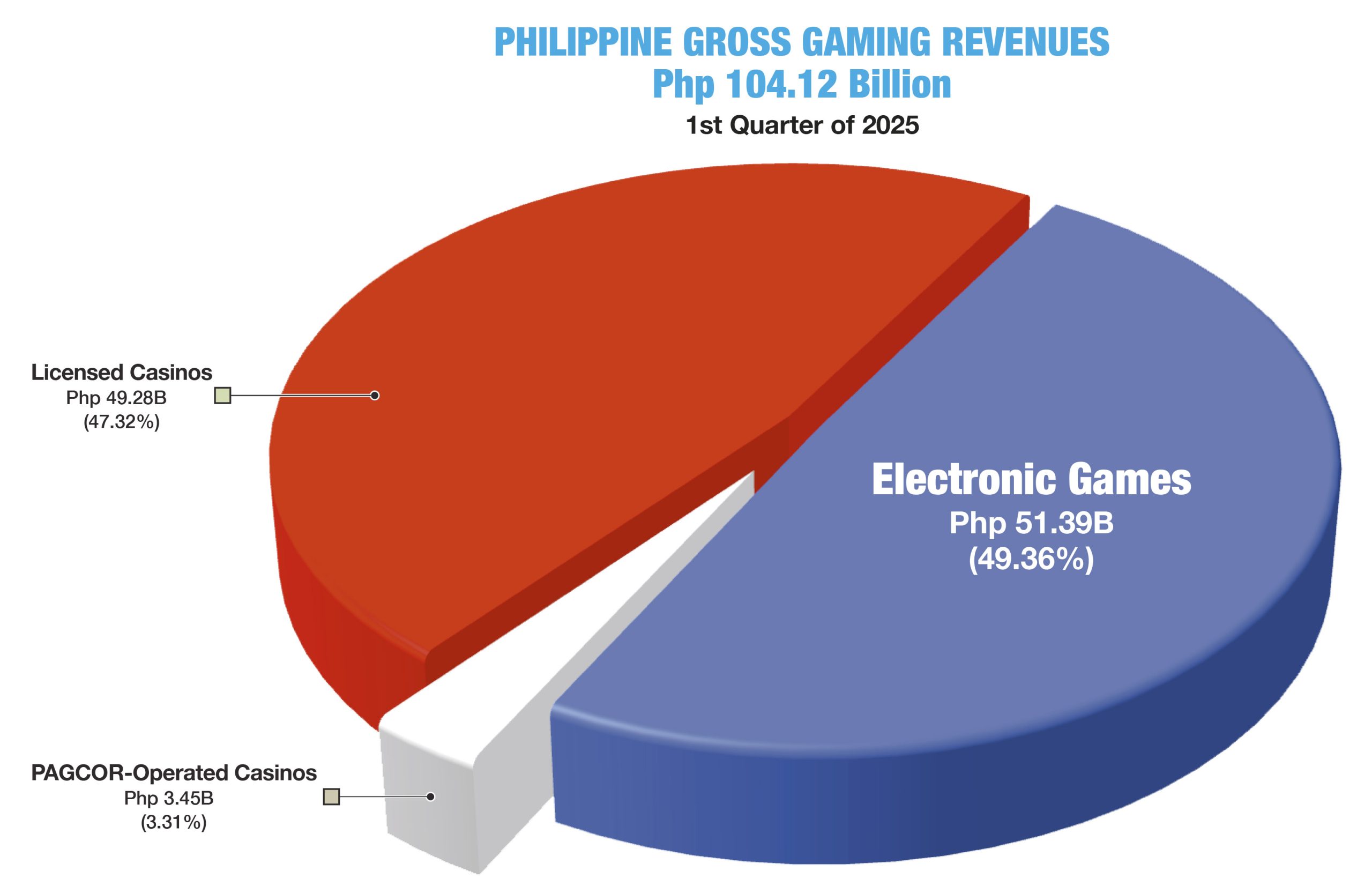
The eGames sector in particular has been lauded by PAGCOR’s Chairman as driving the nation’s gaming revenues, with 1Q25 results from the electronic games and e-bingo segment making up over half of all gaming revenue.
On Friday, the nation’s former Senate president Juan Miguel Zubiri indicated he had filed the ‘Anti-Online Gambling Act of 2025’, saying essentially that any form of online gambling is detrimental to the nation.
The proposed measure would ban online betting platforms, apps and websites allowing bet placement through digital means. It also proposes that Internet Service Providers (ISPs) block access to gambling websites or apps after receiving notice from either the Department of Justice or PAGCOR, or face fines or license revocations.
Online gaming operators, such as the highly-successful DigiPlus Interactive Corp saw sharp drops in their stock prices amongst the ongoing battle against the online sector.
In a Thursday note, the company indicated that it was aware of the filing of various bills aimed at the online sector. ‘We highlight that the bills are still in the early stages of the legislative process and has not been enacted into law’.
The company furthered that ‘DigiPlus remains fully operational and committed to delivering value to our customers and shareholders. We continue to conduct business as usual and remain confident in the long-term growth potential of the company’.
SOFTSWISS, a top tech company that provides software for the iGaming industry, has announced its support for F1: The Movie as a reflection of its commitment to innovation, performance, and teamwork.
With former Formula 1 driver Rubens Barrichello serving as the company’s Non-Executive Director for Latin America, SOFTSWISS draws a meaningful parallel between the high-speed world of racing and the fast-moving, data-driven nature of online gaming.
SOFTSWISS joined the momentum by hosting exclusive premiere screenings for its partners and clients in São Paulo and Malta. Guests experienced the adrenaline of Formula 1 and Hollywood glamour, with red carpets, champagne towers, and photo zones setting the scene for a celebration that bridged entertainment and technology.
The highlight of the event was a personal video greeting from Rubens Barrichello, who shared his emotional response to the film and reflected on how closely it mirrors both his racing legacy and his current work in tech.
Ahead of the event, SOFTSWISS released a “react video” in which Barrichello watched and commented on the movie trailer. In the video, he draws a compelling parallel between Formula 1 and the iGaming industry, emphasising the role of precision, teamwork, and real-time decision-making in both worlds.
“In the world of iGaming, we also deal with large amounts of data, adjust solutions in real time, and rely on teamwork. Just as a driver trusts engineers and mechanics, we trust our developers and analysts. Both worlds share the same values, and I am happy to be part of each of them,” said Rubens Barrichello.
Rubens Barrichello has been a SOFTSWISS partner since 2024, when he was appointed as Non-Executive Director for Latin America. Known for his analytical approach and data-driven mindset on the track, Barrichello now supports the company’s business growth across one of the world’s fastest-growing iGaming markets.
His presence bridges two industries deeply rooted in Latin American cultural passion – motorsport and digital entertainment.
By partnering with figures like Barrichello and aligning with major cultural moments like the F1 movie premiere, SOFTSWISS demonstrates its commitment to innovation, regional relevance, and storytelling that resonates with players and partners alike.
The former CEO of SkyCity Entertainment is among eight executives and members of the board named in a lawsuit over AML failures, which led to the company facing a AU$67 million ($44.6 million) fine from Australia’s financial watchdog.
The nation’s Federal Court ordered the Australia and New Zealand-based gaming operator to pay the proposed fine to the Australian Transaction Reports and Analysis Center (AUSTRAC) last year, primarily due to failings in due diligence.
According to the Australian Financial Review, SkyCity shareholder Stephen Wright has now filed with the New South Wales Supreme Court to attempt to recover some of the funds from those named, claiming the failings occurred under their oversight.
The possible compensation would be paid out to SkyCity.
According to the AFR, those named by Wright include former SkyCity Chief Executive Graeme Stephens, his successor Michael Ahearne, former deputy chair Bruce Carter and numerous other officials.
The defendants have yet to file their defense.
SkyCity had an independent review of its SkyCity Adelaide casino property put on hold until after Australian courts had approved the AUSTRAC fine. The review was set to finish in May of this year.
Blask, a data-driven analytics ecosystem that is transforming the iGaming industry landscape, has been named ‘Best Tech’ at the prestigious iGB Affiliate Awards 2025 in London.
Launched publicly in May 2024, Blask has already secured two major accolades: SiGMA Asia Startup Pitch 2024 and Startup of the Year at the Starlet Awards, making this the third milestone in its brief yet impressive journey. The win underscores the platform’s transition from a promising startup into an industry mainstay.
Max Tesla, CEO of Blask
“Winning this award proves that Blask has outgrown its startup roots and become a data-first iGaming institution,” said Max Tesla, CEO and co‑founder of Blask. “We’re continuing to build out the platform, and with the recent launch of Blask Games, we now offer Game Visibility Rank across casino titles. No guesswork, just transparent, repeatable insights.”
Blask is now used by some of the biggest operators, affiliates and suppliers in the iGaming industry, providing real-time, data-driven market intelligence as well as a competitive edge in more than 60 markets worldwide.
The platform is regularly updated with new features and functionality. Last month, Blask Games was added, giving operators, affiliates, and analysts access to granular intelligence around game placement within casino lobbies.
Cape Verde’s Minister of Internal Affairs, Paulo Rocha, announced that the government is giving Macau Legend one final opportunity to present an alternative plan for the unfinished hotel-casino project in Praia.
According to news agency Lusa, the developer has been under scrutiny, and the government has initiated a process to revert the project, which includes a site on Santa Maria islet and the Gamboa seafront.
Macau Legend Cape Verde project render
Rocha stated that the government has allowed 60 days for Macau Legend, founded by David Chow Kam Fai, to submit a new proposal, although he was uncertain when this period began. If no proposal is received, the government will finalize the reversion process and seek other potential investors.
The construction site, covering approximately 160,000 square meters, has been inactive for a long time, prompting the government to prioritize its resolution. The project is considered strategic for Praia and Cape Verde, and the government is eager to find a solution.
In 2015, Macau Legend committed to a $294.3 million investment, with the first phase expected to finish in 2021.
However, recent losses and significant debts have raised concerns about the company’s viability. The operator is exploring options to challenge the government’s decision on the project’s reversion.
Macau Legend has reported a significant increase in loss for 2024, totaling HK$667.23 million ($85.78 million), causing concerns about its financial sustainability.
The company recently stated it has secured agreements with its lenders to restructure its debt, in a dispatch issued to clarify its auditors regarding the company’s ability to continue.
The operator is also set to lose its satellite casino operations in Macau, under the concession of SJM, at the end of this year, prompting further concerns over its financial sustainability.
Realistic Games has taken a significant step forward in its offerings with the launch of Real Rewards, an innovative promotion suite meticulously designed to revolutionize player engagement and elevate the gaming experience.
Debuting with operator partner BetGoodwin, Real Rewards Tournament is the initial feature to go live. This plug-and-play solution enables operators to set up dynamic tournaments effortlessly, with no integration required. Its key strengths include the potential for fully automated payouts, flexible formats, and live leaderboards, all designed to boost engagement and foster unparalleled player retention. Players will enjoy instant, automatic prize delivery and a truly immersive competitive experience.
The broader Real Rewards suite signals Realistic Games’ commitment to innovation and a pivotal moment in its evolution. It signifies a bold step from an established roadmap of titles into a future where player interaction and gratification are paramount. As a brief teaser of what’s to come, Real Drops and Real Missions are also in development, with more details to follow in due course.
With BetGoodwin as a premier launch partner, Real Rewards Tournament is set to roll out to a broader network of operators, anticipating significant growth and a new standard for player engagement across the industry.
Amy Brewis, Head of Account Management at Realistic Games, said: “We’ve dedicated significant time and passion to curating and perfecting Real Rewards. We’re genuinely thrilled to launch this tool alongside our fantastic partners at BetGoodwin. This launch isn’t just about a new product; it marks the beginning of a fascinating period for Realistic Games, showcasing our journey and commitment to pushing the boundaries of player engagement with multiple innovations and new tools like Real Missions and Real Drops already in the pipeline.”
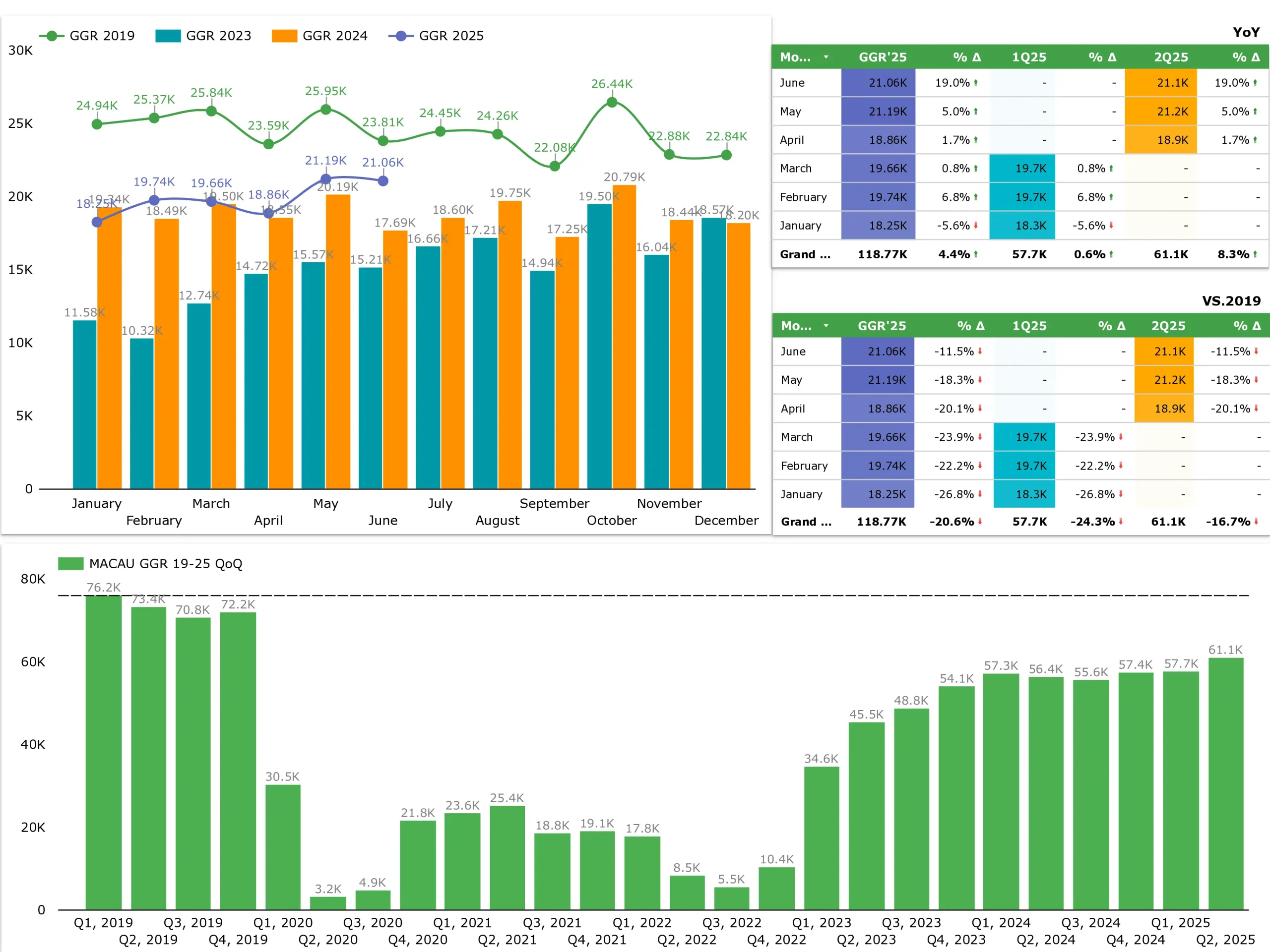
Investment bank CLSA has increased its forecast for Macau’s gross gaming revenue (GGR) in 2025, projecting 7.6 percent year-over-year growth to reach $30.1 billion, up from previous estimates.
The upgraded forecast reflects accelerated recovery assumptions, with CLSA moving its timeline for full recovery forward to 2025 from 2026. Macau gaming concessionaires are expected to deliver 6.9 percent year-over-year growth in second quarter 2025 sector EBITDA to $2.05 billion, supported by 8.3 percent yearly GGR growth.
CLSA’s analysis indicates Galaxy Entertainment and Sands China gained market share sequentially during the quarter, while Wynn Macau and SJM Holdings faced challenges defending their positions. The shift coincided with new property openings, including Sands China’s Londoner Macao Phase 2 and the Capella at Galaxy Macau, which launched in late April and early May 2025, respectively.
Galaxy’s momentum continued into June, bolstered by Jacky Cheung‘s nine-night concert series, with six performances held in June.
The Chinese renminbi strengthened against the US dollar by 1.4 percent from the beginning to the end of the second quarter 2025, providing additional support for gaming revenue.
Visitation recovery supports growth
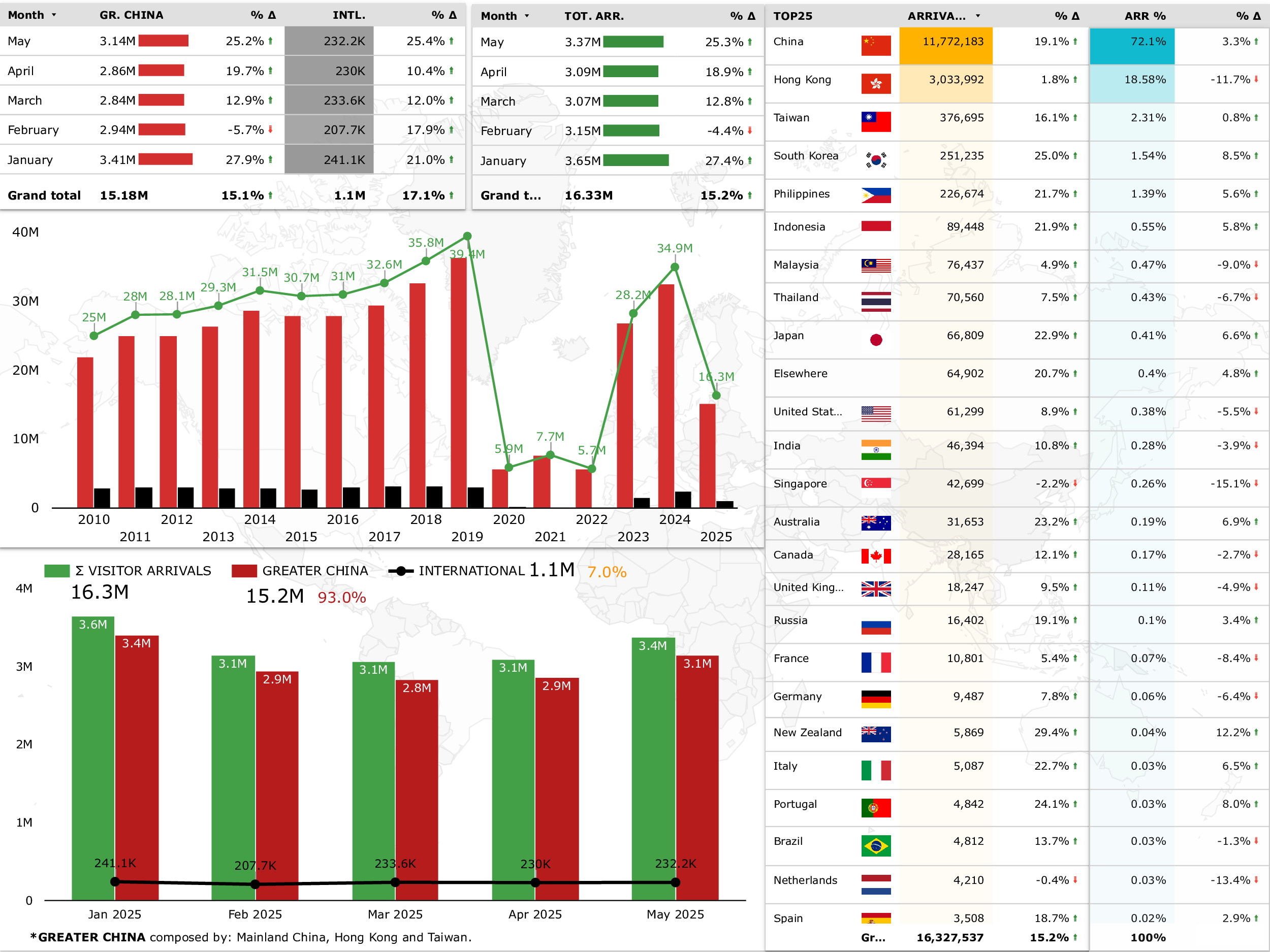
From April to May 2025, total visitations to Macau grew 22 percent year-on-year to 6.46 million, representing 95 percent of the same-period level in 2019. The strong visitor numbers, combined with new property openings and entertainment events, contributed to sustained gaming revenue growth.
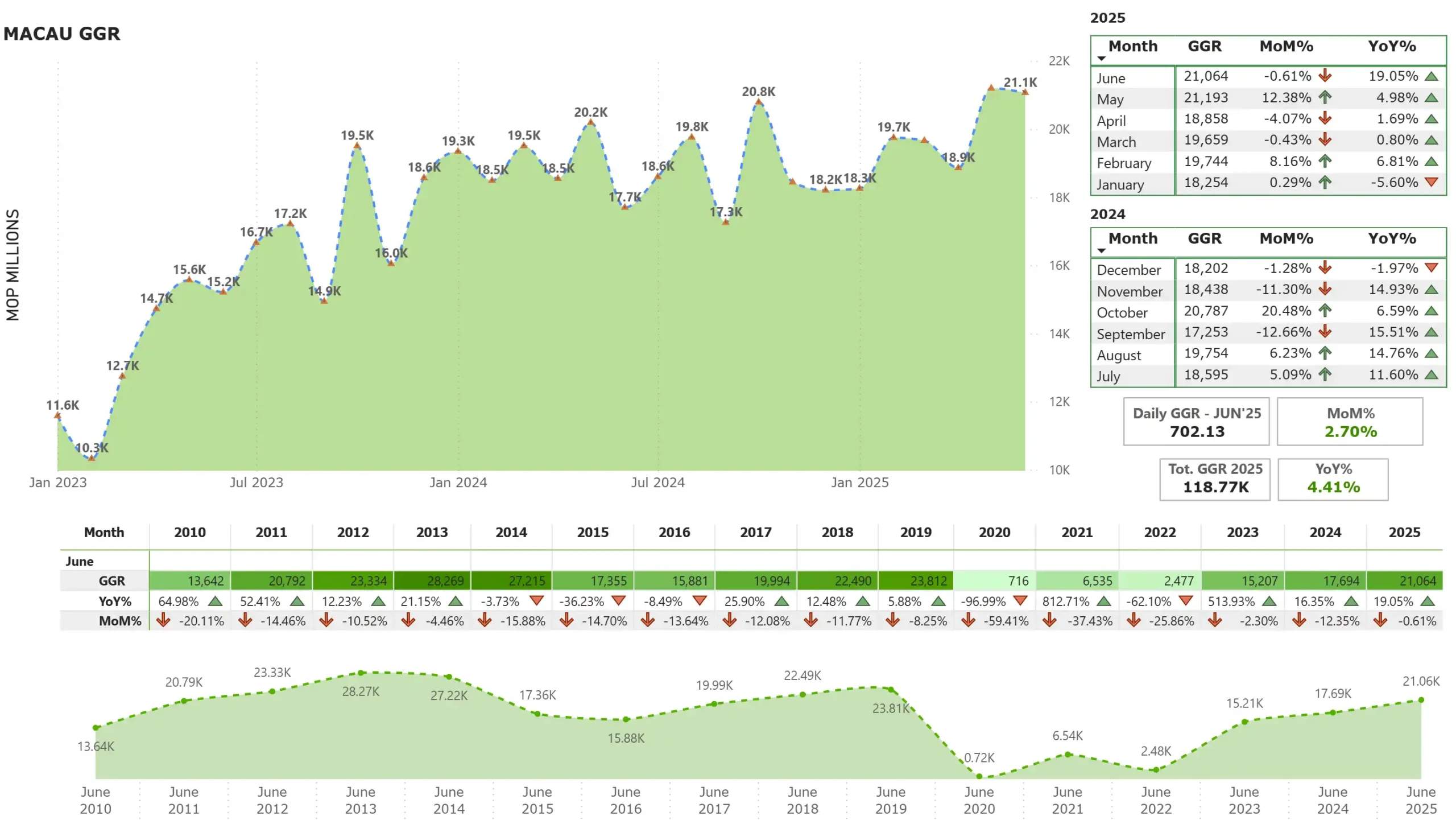
For the second quarter 2025, Macau’s GGR grew 8.3 percent year-over-year to MOP61.1 billion ($7.6 billion), with notable strength in June as daily revenue reached MOP684 million ($85 million) per day.
Forecast adjustments reflect currency strength
The analyst lifted the 2025 GGR forecast by 5.6 percent while trimming the 2026 projection by 2.2 percent. CLSA expects 2026 GGR to grow 2 percent to HK$239.7 billion ($30.7 billion) following the stronger 2025 performance.
CLSA noted that the sustainability of June‘s strong daily revenue rate remains uncertain, but believes it will be aided by the recent appreciation of the renminbi against the US dollar, new property openings, and entertainment events in Macau including concert performances and the return of House of Dancing Water shows at City of Dreams.