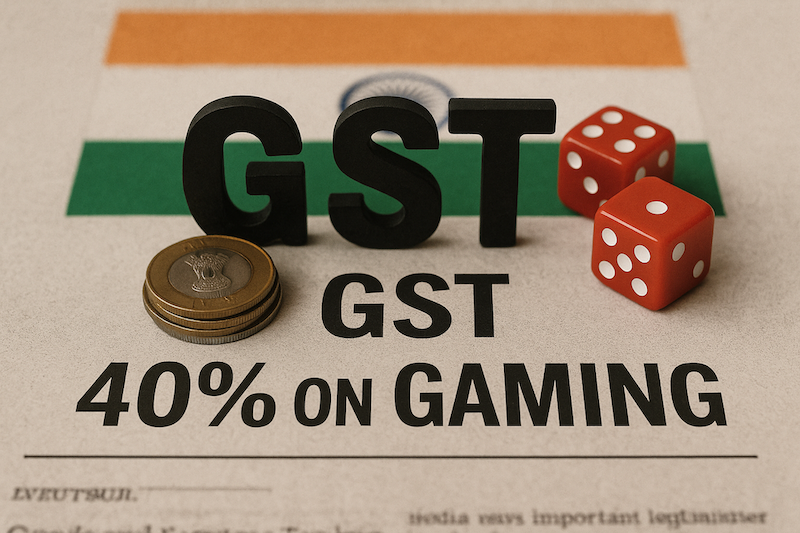
India’s decision to raise the Goods and Services Tax (GST) on casino gaming from 28 percent to 40 percent has sparked strong criticism from an industry observer, who warns the move could cripple the sector while enriching government coffers.

Financial consultant David Pinto, in an interview with AGB, described the change as “a clear case where the government is the only winner,” likening the tax policy to that imposed on so-called “sin goods” such as tobacco.
Under the new rate, effective since September 22nd, both casino entry fees and gaming chip purchases will attract a 40 percent GST, split equally between the central and state governments. This marks one of the most significant tax increases on the gaming industry since the GST’s introduction in 2017. The Ministry of Finance says the revision aligns with its broader reform of indirect taxes and its goal to standardize rates for gaming and betting activities.
However, Pinto says the impact on operators and players will be severe. “If a player buys $100 worth of chips, he actually pays $140 after including the 40 percent GST,” explained the expert. “If he then doubles his money to $200, another $62 will be taken as income tax. The gambler ends up with just $138, while the casino loses $100. The big winner in this equation is clearly the government.”
Pinto added that, while the GST is charged at the initial buy-in stage, “the chances of players consistently winning are slim, so the government’s revenue remains protected regardless of outcomes.”
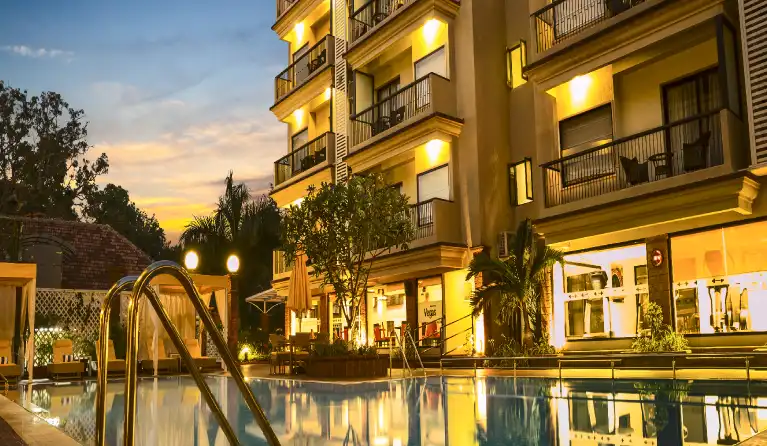
Delta Corp halts IR project in Goa
The new tax burden has already forced India’s largest listed casino operator, Delta Corp, to suspend its planned $280 million integrated resort project near Mopa International Airport in Goa. The 90-acre project, slated for completion in 2027, was expected to generate around 10,000 jobs and significantly boost local tourism.
Delta Corp Chairman Jaydev Mody warned that the new tax regime could make the casino business “unviable,” noting that the company already faces retrospective GST demands of $2.6 billion—roughly ten times its current market capitalization. “A 40 percent GST rate will not only destroy profitability but also erode investor confidence,” Mody said previously.

Goa IR project and local impact
Goa has long been regarded as India’s casino hub, with riverboat and onshore casinos drawing millions of domestic tourists each year. The proposed integrated resort near Mopa Airport was envisioned as a cornerstone of Goa’s next-generation tourism strategy—combining gaming, hospitality, and entertainment within a single destination.
Local stakeholders had anticipated the project would create up to 10,000 direct and indirect jobs, attract premium tourists, and spur growth in allied sectors such as hotels, transport, and retail. Its suspension is now seen as a major setback to the state’s efforts to expand tourism beyond its traditional beach economy.
The analyst noted that the move could also dampen investor sentiment in Goa’s broader hospitality and leisure sectors. The project was strategically aligned with the new Mopa Airport growth corridor, where air traffic has risen sharply since 2023. Without the integrated resort, the expected multiplier effects from increased visitor arrivals—such as higher hotel occupancy, local spending, and tax revenue—may not fully materialize.
Government’s perspective
The government justifies the higher GST under its broader “sin goods” framework, arguing that such items—like tobacco, alcohol, and now gaming—carry social costs that warrant higher taxation. Officials maintain that the increased rate will help discourage excessive gambling while generating steady revenue for public welfare programs.
Pinto, however, argues that gaming demand is relatively price-inelastic, meaning players are unlikely to stop altogether despite higher costs. “The government’s revenue will rise, but it will come at the expense of legitimate business operations and employment,” he said. “In the end, the house doesn’t win—the government does.”