Home Blog Page 16

DigiPlus joins Brazil’s responsible gaming institute IBJR

0

DigiPlus Interactive Corp. has joined the Brazilian Institute of Responsible Gaming (IBJR), an association whose members account for more than 60 percent of Brazil’s regulated betting market, as the Philippine digital entertainment company continues investing in the country under its BingoPlus brand.

DigiPlus, which also operates ArenaPlus and GameZone, will participate in the group’s efforts to promote responsible gaming, strengthen regulatory compliance and combat illegal betting.

Carlos Lima, IBJR’s chief executive, said DigiPlus’ entry reflected the sector’s growing maturity and its commitment to regulation. He added that the association would continue prioritizing player protection while taking a firm stance against the unregulated market.

“Joining the IBJR reflects DigiPlus’ expansion in Brazil, where we already operate the BingoPlus brand and continue to invest in growing our presence in the country,” said Graham Tidey, managing director of DigiPlus in Brazil.

Tidey said the company would draw on more than 25 years of entertainment industry experience and its digital expansion in the Philippines to grow in Brazil “in a responsible manner and in full compliance with regulatory requirements.”

Founded in 2023, IBJR brings together local and international betting companies and bases its work on two priorities: tackling the clandestine market and promoting responsible gaming. DigiPlus joins members including bet365, BetMGM, Betsson Group, Entain, Flutter Brazil, Kaizen Gaming and KTO Group.

The IBJR release referred only to BingoPlus operating in Brazil and gave no update on the status of GamePlus, the platform DigiPlus paused on October 10th, 2025, three weeks after its soft launch began. The company at the time described the trial as a ‘live learning laboratory’ for understanding local player behavior and cultural preferences.

DigiPlus said the findings would support the development of a more localized product, with a full-scale relaunch planned for early 2026.

Light & Wonder holds FY26 AEBITDA growth outlook ahead of 2Q26 results

Light & Wonder has reaffirmed its full-year earnings guidance, telling investors on Tuesday that it remains on track to deliver ‘mid-to-high single-digit Consolidated AEBITDA growth’ for 2026, unchanged from the outlook issued earlier this year.

The ASX-listed games supplier stood by the target ahead of its second quarter results, a signal it does not see the June quarter having knocked it off course.

Alongside the guidance, the company gave an update on capital returns. It repurchased around $134 million of its own stock during the June quarter, leaving roughly $180 million still available under the buyback program. Purchases were paused on June 29th, ahead of the blackout period tied to the results, in line with its securities trading policy.

On the balance sheet, Light & Wonder said, ‘We are committed to deleveraging our balance sheet towards the mid-point of our targeted net debt leverage ratio range over the course of 2026 and below 3.0x during the first half of 2027.’ The 2026 leverage target, however, assumes the buyback resumes.

The company also flagged the risks attached to its outlook, including the possibility that it may not achieve the earnings momentum it expects in the second half, the timing of its own investments, customer capital expenditure cycles and any shift in capital allocation strategy.

Second quarter results are due after U.S. markets close on August 4th, landing before the ASX opens on August 5th, Sydney time.

Asia Gaming eBrief: MGM China positions for independence amid parent-level turmoil

0
Good morning. Build the firewall before the fire. MGM China is doing exactly that, a Macau gaming lawyer tells AGB, reading Pansy Ho’s exit from MGM Resorts and a $20 million mainland acquisition as a deliberate move to ring-fence the Macau operator from whatever Barry Diller’s take-private bid brings next. Meanwhile, CLSA cut its 2026 Macau GGR growth forecast to 2.3 percent after June’s 12 percent slide, warning consensus looks too rosy. Looking to Korea, foreign-only casinos are banking on accelerating Chinese group travel, with brokerage naming Paradise Co., Lotte Tour, and Grand Korea Leisure as beneficiaries.

What you need to know

On the radar


AGB Intelligence

MGM Macau, MGM China Holdings

MGM China moves to a defensive split from parent turmoil

Recent actions by MGM China suggest a defensive strategy to shield the Macau concessionaire from uncertainty surrounding parent MGM Resorts. Lawyer Sofia Linhares said Pansy Ho’s exit from the parent company eliminates potential conflicts and reinforces her commitment to MGM China, while the $20 million acquisition of MGM Asia Pacific strengthens the operator’s regional presence and prepares it to operate more independently if the parent undergoes a takeover or restructuring.

Industry Updates


Corporate Spotlight

How Crypto Adoption in Asia is Changing iGaming Payments

Yevhen Krazhan, CSO for GR8 Tech

Yevhen Krazhan, CSO at GR8 Tech, explores how surging crypto adoption across Asia is revolutionizing iGaming payments, stating: “When I look at what’s changing fastest in Asia, it’s payment behavior,” as wallets, stablecoins, and seamless cross-border transfers become deeply ingrained in player habits. The winning operators will be those that offer fast, reliable, and local deposits and withdrawals. To make sense of it, Yevhen breaks Asia into two crypto realities.


INTELLIGENCEASEAN | AWARDSCAREERS | EVENTS

Aristocrat Interactive deploys 40 titles for Alberta’s iGaming market launch

Aristocrat Interactive, the online Real Money Gaming (RMG) arm of Aristocrat, has officially entered Alberta’s newly expanded commercial iGaming market. This launch coincides with a landmark change in the province, as Alberta moves from a government-controlled monopoly to an open, regulated, multi-operator gaming model.

Hitting the ground running, Aristocrat Interactive just dropped nearly 40 fan-favorite games across a massive network of operators. This rollout is a natural next step following their successful run on the provincial site, PlayAlberta.ca, which has hosted their titles since July 2024.

“Our Day One presence in Alberta is an exciting milestone and testament to our team’s operational excellence and our commitment to providing our customers with the industry’s best content the moment a market opens,” said Elena Jaacks, VP Commercial Rest of World for Aristocrat Interactive. “By launching almost 40 of our most popular titles simultaneously, we are ensuring that our customers and their players have immediate access to the high-quality, regulated gaming experiences they expect.”

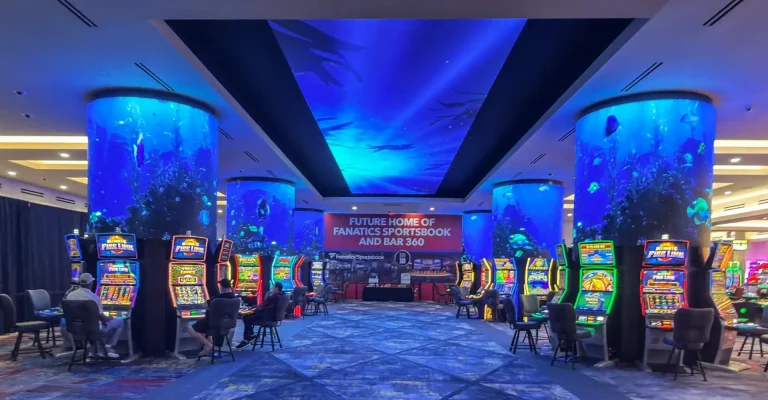
The initial wave of Aristocrat Interactive’s games includes global player-favorites such as Buffalo™ and Mo Mummy™. Additionally, the fan-favorite Lightning Link™ is scheduled to go live in the Alberta market on July 23, 2026. All games have been purpose-built for Alberta’s evolving regulated market, delivering localized content and thoughtfully adapted metamorphic gameplay to create a tailored player experience aligned with regulatory requirements.

Aristocrat Gaming’s Lightning 10 Year Storm debuts at WinStar World Casino

This expansion further strengthens Aristocrat Interactive’s significant Canadian footprint, which includes established operations in British Columbia (BCLC), Atlantic Canada (ALC), Ontario (OLG and commercial operators), and Québec.

As a provider of choice for regulated online gaming markets worldwide, Aristocrat Interactive delivers innovative, omnichannel solutions designed for scalability, while maintaining a steadfast commitment to responsible gameplay and rigorous regulatory compliance.

Curacao issues wind-down rules for gaming license holders

0

The Curacao Gaming Authority (CGA) has published new instructions setting out how licensed operators and suppliers must wind down their operations or discontinue online gambling domains under the island’s new regulatory framework.

The guidance establishes procedures for businesses voluntarily surrendering a license, those subject to enforcement action, applicants whose license applications have been rejected, and operators seeking to discontinue individual domains or other online interfaces. The instructions apply to holders of both B2C online gaming licenses and B2B supplier licenses issued under Curacao’s National Ordinance on Games of Chance (LOK).

According to the CGA, the framework is designed to ensure “an orderly and controlled cessation or partial discontinuation of activities” while protecting players and maintaining regulatory oversight throughout the process. The regulator clarified that “wind down” refers solely to the orderly cessation of gaming operations and does not constitute the legal liquidation or dissolution of a company. Businesses remain responsible for meeting all civil law obligations, including settling outstanding player claims and other liabilities, even after the wind-down period has ended.

For operators wishing to voluntarily surrender their license, the CGA requires a letter signed by the company’s local managing director explaining the reason for the surrender, together with the exact date and time the business stopped or intends to stop accepting new customers and wagers. A completed wind-down report must accompany the request before the regulator will consider revoking the license.

Curacao, online gaming, igaming

The guidance also makes clear that license holders whose licenses are revoked as an enforcement measure face immediate restrictions. Such operators must immediately cease using the CGA seal, stop accepting new business, stop servicing existing contracts, and prevent both new and existing players from placing wagers while the wind-down process is underway. They must also submit a signed wind-down report detailing the closure process.

Where the CGA rejects either a second-term provisional license or an application for an indefinite license, affected companies will be granted six weeks from the date of the rejection letter to complete an orderly wind down. During that six-week period, operators are likewise prohibited from using the CGA seal, accepting new business, continuing existing contracts, onboarding new players or allowing existing players to continue wagering. At the conclusion of the period, they must submit a completed wind-down report for review by the regulator.

The guidance also covers situations where a licensed operator wishes to discontinue a single gambling website, domain or other online interface, such as a mobile application, while retaining its overall license. In such cases, the operator must notify the CGA through a letter signed by its local managing director, stating the reason for the discontinuation, the date and time new players stopped or will stop being accepted on the relevant platform, and providing a completed wind-down report. Once the CGA acknowledges the request, the operator may remove the domain from the regulator’s licensing portal.

The CGA also stressed that license revocation or rejection does not entitle companies to refunds of licensing fees already paid, nor does it remove their obligation to settle any outstanding amounts owed to either the regulator or the Government of Curacao.

In addition, the regulator warned that operators are not permitted to leave debts outstanding, including player claims. Where liabilities remain unpaid, the CGA said it will take all actions within its authority and cooperate with domestic and international authorities, including law enforcement agencies, to pursue the matter.

Timor-Leste crackdown snares 90 more in Dili and Liquiçá raids

0

Timor-Leste’s Criminal Investigation Police detained 90 foreign nationals on Monday in two separate operations targeting suspected online scam operations, the latest in a widening crackdown that has followed the country’s decision to scrap its offshore online gambling regime.

The operations took place in the Comoro area of Dili and in Ulmera, in the administrative post of Bazartete in Liquiçá municipality, about 17 kilometers from the capital. Police said the raids were intended to locate and dismantle fraud schemes run out of call centers.
“Today, we carried out two operations. One was in Dili, where we arrested 14 Chinese nationals caught in the act. The other took place in Liquiçá, where we arrested 75 Indonesian nationals and one Chinese national. In total, the two operations resulted in the arrest of 90 people,” Chief Superintendent João Belo dos Reis, spokesperson for the National Police of Timor-Leste (PNTL), told Lusa.

Belo dos Reis said the raids followed intelligence gathered by the police’s own investigation service with input from community leaders in the two areas, which pointed to potential fraud activity at the sites. Those detained were taken to the Criminal Investigation Headquarters in Kaikoli for identification and investigative procedures, and police were examining seized cash, equipment and documents. He said further details would be provided the following day, citing judicial secrecy.

The 90 arrests come days after Timorese authorities detained around 200 people, mostly nationals of China, Cambodia and Indonesia, on suspicion of involvement in illegal online activities centered on illegal gambling and fraud. A separate case involving 27 defendants tied to a scam call centre in Metiaut is already before the courts.

The enforcement wave traces back to a September 2025 threat alert from the United Nations Office on Drugs and Crime (UNODC), which warned that criminal networks were taking root in Oecusse, the Timorese enclave surrounded by Indonesian territory, and that the region risked becoming a hub for cyber fraud, drug trafficking and human trafficking. The UNODC assessment drew explicit parallels with scam center operations in Cambodia, Laos, Myanmar, the Philippines and Malaysia, and flagged the Oecusse Digital Centre free trade zone as a point of vulnerability exploited by organized crime posing as legitimate investors.

The warning prompted a rapid policy reversal. Timor-Leste had entered the offshore online gambling market only in April 2025, issuing its first license to Golden River Universe, a subsidiary of Grand Dragon Lotaria (GD Lotto), which had signaled plans to relocate operations from Cambodia and the Philippines to the country.

In October 2025, the Council of Ministers approved a resolution canceling all existing online gambling and betting licenses, halting pending applications and prohibiting new permits, citing risks to national security, social stability, economic integrity and international reputation. Golden River Universe said it respected the decision.

Timor-Leste became a full member of ASEAN in October 2025, a step the UNODC had cautioned could heighten the cross-border risk of scam networks expanding into the country.

Macau GGR to recover from August as World Cup drag fades: Jefferies

0

Macau’s gross gaming revenue is set to rebound from August once the FIFA World Cup ends, Jefferies said in a note on Monday, after the tournament, capital controls, and tough year-earlier comparisons left second-quarter revenue essentially flat.

Gross gaming revenue reached MOP66 billion ($8.2 billion) in 2Q26, down 7.4 percent quarter-on-quarter and 0.1 percent lower year-on-year, according to the brokerage. The quarter started well, with April and May up 5 percent and 7 percent, respectively, before June revenue slid 12.1 percent as the tournament diverted spending away from the gaming hub.

Despite the weak quarter, first-half revenue still grew 6.8 percent year-on-year to MOP126.9 billion ($15.7 billion).

Cotai Strip, Macau

July still under pressure

Jefferies expects July revenue to fall 8 percent year-on-year, with the World Cup, which runs from June 11th to July 19th, continuing to weigh on the month.

From August, however, the brokerage forecasts a recovery, with growth of 2 percent in 3Q26 and 4 percent in 4Q26. That would take full-year revenue to MOP260 billion ($32 billion), up 5 percent, slightly below the market consensus of 6 percent growth.

The firm noted that the ‘wealth effect from new IPOs remains a catalyst’ for the market, as gains from Hong Kong listings have been feeding luxury sales and gaming spend since mid-2025, though this also creates tougher comparisons for the rest of the year.

Jefferies turned more selective on the sector, naming Galaxy Entertainment as its top pick on strong execution and balance sheet, and removing Sands China from the position.

The brokerage estimates Sands China was the only major operator to lose ground in the second quarter, with its share falling 2.5 percentage points from 1Q26 to 24 percent. Galaxy (21.1 percent), MGM China (16.7 percent), Wynn Macau (13.8 percent) and SJM (10.3 percent) are all seen gaining share.

Jefferies rates Galaxy, Sands China, MGM China and Wynn Macau Buy, while SJM Holdings is rated Hold on lower visibility over its profitability outlook.

MGM China moves signal “pre-emptive insulation” from parent turmoil: legal expert

MGM China’s recent flurry of corporate activity, from chairperson Pansy Ho’s exit from parent company MGM Resorts to a $20 million mainland acquisition, amounts to a deliberate strategy of insulating the Macau operator from turbulence at group level, a Macau-based gaming lawyer told AGB.

MGM China
Sofia Linhares, Senior Legal Counsel at SL Lawyers Macao

“MGM China’s future will be determined in Macau, not in Las Vegas,” said Sofia Linhares, Senior Legal Counsel at SL Lawyers Macao, in an interview with AGB, describing the timing of the moves as deliberate and “defensive.”

The moves come as MGM Resorts weighs a take-private proposal from Barry Diller’s People Inc. The media conglomerate, which already holds 26.1 percent of MGM Resorts, offered $48.30 per share on June 1st in an all-cash deal valuing the operator at more than $18 billion including debt.

Pansy Ho aligns with Macau

The first shift came at the top of the shareholding structure. Ho sold her entire remaining 1.2 percent stake in MGM Resorts across five transactions between May 28th and June 3rd, cashing in approximately $140.1 million, while retaining her 22.49 percent holding in MGM China.

Pansy Ho, MGM China

Linhares reads the divestment as “a clean strategic decoupling” that eliminates potential conflicts of interest between Ho’s dual shareholdings and strengthens her position as “the dominant force in MGM China’s future.”

“By retaining her full stake in MGM China while exiting MGM Resorts, she aligns herself unequivocally with the Macau entity, not the parent,” she said, adding that Ho’s concentrated holding gives her enhanced influence over strategic direction, board composition, and any future capital or M&A decisions.

Ho’s positioning carries weight beyond governance. Seaport Research Partners has described MGM China and the MGM Osaka project as the two most prominent ‘non-core’ assets under a People-controlled MGM Resorts, as Diller could seek to shrink the group’s bricks-and-mortar footprint in favor of digital gaming. The firm named Ho as ‘the natural buyer’ for MGM Resorts’ 56 percent stake in the Macau operator, though she would likely need partners for a holding CBRE Equity Research valued at $3.3 billion.

The market’s initial reaction to the disposal was nonetheless cautious: MGM China shares fell more than 6 percent on June 8th, leading declines among Macau gaming stocks.

MGM China
MGM Shenzhen

A $20 million insulation play

Weeks later, MGM China completed the $20 million acquisition of MGM Asia Pacific Limited on June 30th, taking over an asset-light hotel management platform with eight operating hotels in mainland China from a company indirectly wholly owned by MGM Resorts.

“Injecting the Asia-Pacific hospitality platform into MGM China achieves two objectives: it ring-fences the Asia business from potential parent-level restructuring, and it strengthens MGM China’s standalone value proposition ahead of any group-level changes,” Linhares said. “It is a pre-emptive insulation play.”

The lawyer noted, however, that the deal’s structure as a connected transaction between parent and subsidiary places the burden on MGM China’s board to show the price reflects fair market value, “not a related-party sweetheart deal.”

Under Hong Kong Listing Rules, she said, such transactions require full transparency, including independent audit committee review and fairness opinions, and “any omission or aggressive valuation could attract regulatory scrutiny or shareholder dissent.”

According to the Hong Kong Stock Exchange filing, MGM Asia Pacific reported audited net assets of HK$90 million ($11.5 million) as of December 31st, 2025, while its operating unit posted revenue of RMB80.6 million ($11.9 million) and a net loss of RMB7.7 million ($1.1 million) last year.

“It looks clean, strategically sound, and well-priced,” Linhares told AGB, “but the devil will be in the valuation methodology and whether the market buys it as arm’s length.”

Taken together, Linhares argues, the moves position MGM China as “a self-governing entity, not a passive subsidiary,” and complicate any unfriendly takeover or asset stripping at parent level.

Whether the insulation strategy succeeds, she said, “depends on how the take-private process unfolds. But the message is clear: MGM China is preparing to stand on its own.”

Chinese tourism recovery lifts Korea’s foreigner-only casinos: brokerage 

0

Korea’s foreigner-only casinos are gaining momentum as inbound tourism recovers and Chinese group travel is expected to accelerate during the second half of the year, The Korea Times reported, citing an analysis by Shinhan Securities.

Chinese visitor arrivals reached about 2.56 million between January and May, up roughly 25 percent from the same period last year, according to Korea Tourism Organization data cited in the report.

Shinhan said casino performance is more closely linked to inbound visitor flows than other tourism segments, which tend to move with domestic consumption. The pace of Chinese tourism growth will therefore be a key factor for casino operators during the remainder of the year.

“Inbound indicators such as arrivals, foreign spending and foreigner-only casino earnings are now numerically confirming what the market is feeling as an inbound boom,” Shinhan analyst Ji In-hae said.

Korea introduced a temporary visa-free program for Chinese group tourists last September to support inbound tourism and regional economies. Most casinos in the country are restricted to foreign customers, while Kangwon Land is the only casino permitted to serve Korean nationals.

Shinhan expects earnings to improve across the sector, although the pace of recovery will vary by location, customer mix and operators’ exposure to hotels and entertainment facilities.

Paradise Co., Lotte Tour Development and Grand Korea Leisure (GKL) were identified as potential beneficiaries of recovering Chinese and international demand.

Ji said Korea’s casinos retained their “full China-facing positioning,” adding that Busan could benefit most from visa-free group travel if the recovery continues.

From Regulation to Responsibility: The 1xBet global strategy for the iGaming industry 

A decade ago, an umbrella gaming license was enough for an international operator to run a global business. Today, that model alone is no longer sufficient — and the shift explains why «The One Standard» has become the defining challenge for the entire iGaming sector. 


One License Used to Be Enough 

Historically, international gaming licenses issued in jurisdictions such as Curaçao enabled operators to serve multiple markets where no local licensing framework existed. It lets operators run legal businesses, enter unregulated markets, build cross-border infrastructure, and launch products in countries without a domestic gambling framework. 

This approach worked precisely because so few jurisdictions had built their own regulatory regimes. That simplicity, however, was a product of a specific moment in the industry’s history — one that has since evolved significantly. 

The First Wave: Europe Sets the Precedent 

Europe was among the first regions to break from this model. France introduced a comprehensive online gambling law in 2010, creating a national regulator (initially ARJEL, later ANJ) and requiring operators to hold a French-issued license to legally serve French players. 

The United Kingdom followed with its point-of-consumption regime in 2014, cementing a principle that has since spread globally: operators targeting local consumers should hold a local license, regardless of where the company itself is registered. 

Over the following years, dozens of other European markets adopted similar frameworks, each with its own advertising, taxation, and player-protection rules.

The Second Wave: Latin America and Africa 

The same pattern later reshaped Latin America. Colombia was among the first countries in the region to introduce a full licensing scheme for online operators through its regulator Coljuegos in the mid-2010s. 

Peru followed roughly six years later, in 2022, with its own comprehensive framework. Brazil completed the picture on 1 January 2025, when its regulated betting and iGaming market officially launched under Law No. 14,790/2023. 

Within a year, millions of Brazilians were placing bets through licensed operators, and dozens of companies had obtained federal licenses. African markets are following a comparable trajectory, gradually moving from basic authorisation toward more structured regulation and player-protection standards. Over roughly fifteen years, this progression — from unregulated to nationally licensed markets — has become one of the defining trends in global gambling. 

From One License to Many Regimes 

The practical consequence of this trend is a fundamental change in how compliance works. Where a market has its own regulator, operators must satisfy both their international license requirements and those of the local one, layering additional obligations on top of a company’s global infrastructure: 

  • Global operational infrastructure;
  • International license;
  • Local licenses per regulated market;
  • Local rules for advertising, payments, KYC, AML, and responsible gambling.

So when a brand states it holds licenses in dozens of jurisdictions, that number does not represent dozens of copies of the same document — it represents dozens of distinct regulatory systems, each with its own obligations. 

Licensing as a Management System, Not a Milestone

This is the more mature conversation the industry now needs to have. A decade ago, obtaining an international license was effectively the finish line for market expansion. Today it is closer to the starting point. As more countries build their own regulated markets, international operators must simultaneously satisfy dozens of licensing regimes, each imposing distinct rules on advertising, KYC (Know Your Customer), AML (Anti-Money Laundering), player protection, and affiliate partnerships. 

Licensing has stopped being a one-time decision and has become an ongoing system for managing multiple regulatory relationships at once — a shift that turns «how many licenses does a company hold» into a much less relevant question than «how well does it manage all of them together.» 

Managing Complexity as the New Core Skill 

This is precisely the paradox at the heart of «The One Standard»: a brand maintains one internal operating standard while navigating dozens of external regulatory regimes. Global Standards. Local Compliance is not a slogan so much as an operational necessity — every jurisdiction demands product and process adaptation without compromising the underlying consistency of the brand’s controls. 

1xBet offers a useful illustration of how this plays out in practice. Licensing requires adapting the product to each country’s specific requirements, and 1xBet operates across several dozen licensed jurisdictions, adjusting its KYC, payment, and responsible-gambling processes market by market while keeping its core compliance framework unchanged. 

The company’s approach reflects a broader industry reality: managing regulatory complexity — not simply accumulating licenses — has become the real competitive differentiator for international operators, and the foundation of what the campaign frames as Built on Trust, Stability and Long-Term Growth.