



Seaport Research Partners has revised its 2025 gross gaming revenue (GGR) forecast for Macau upwards to 7 percent year-on-year growth, citing stronger-than-expected performance in the second quarter and a positive outlook for the second half of the year, where growth could reach as high as 9 percent.
The research firm expects the reacceleration to continue into 2026 and beyond, projecting a multi-year growth trajectory for Macau that could support a compound annual EBITDA growth rate of 9 percent.
The revised projection reflects growing investor confidence in Macau’s secular recovery, even as broader concerns around China’s macroeconomic outlook and softness in the U.S. gaming market persist. In its latest gaming sector note, Seaport said that while 2025 began on a slower footing, signs of a summer pickup are now ‘bearing fruit,’ with momentum expected to carry through the rest of the year.

‘Q2 turned out better than expected for Macau, and investors are now shifting focus to the second half to assess the sustainability of this higher growth,’ wrote senior analyst Vitaly Umansky. He acknowledged lingering macro headwinds, including muted consumer sentiment in China and a potential slowdown in Las Vegas, but emphasized that stimulus efforts, improving visitor sentiment, and targeted marketing strategies in Macau are helping offset those pressures.
The more optimistic outlook stands in stark contrast to the Macau government’s latest estimate, which lowered its full-year GGR target to MOP228 billion ($28.2 billion)—a nearly 5 percent downward revision from its original MOP240 billion forecast. The official figure implies just 0.5 percent growth for the year, far short of earlier expectations of 5.8 percent.

Major operators show diverging trajectories
Among the major gaming operators, Seaport highlighted strong momentum for Galaxy Entertainment Group, which posted a 130-basis-point year-over-year market share gain in the second quarter. The opening of the ultra-luxury Capella hotel and the ongoing ramp-up of Galaxy Macau Phase 3 contributed to the company’s 13% increase in revenue and a 14% rise in EBITDA. Seaport expects further upside as Phase 4 is slated to open in early 2027.
Sands China was also identified as a long-term beneficiary of Macau’s growth. Although it lost an estimated 20 basis points in market share in 2Q25, the company is positioned to regain ground with the continued ramp-up of the Londoner and the reopening of the Venetian Arena. Seaport also sees Sands China benefiting from improved marketing strategies and the likely reinstatement of its dividend.
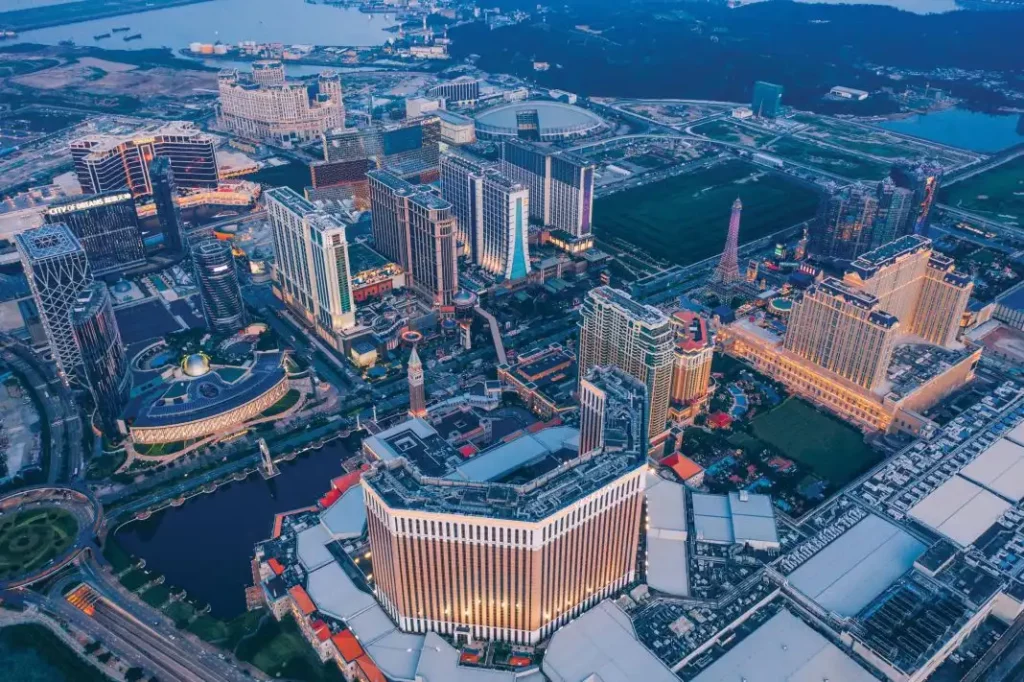
In the same investment memo, analyst notes that Melco Resorts & Entertainment delivered the strongest Macau EBITDA performance since 2019, gaining around 70 basis points of market share year-on-year, supported by operational improvements at City of Dreams and Studio City. Revenue grew 14 percent and EBITDA surged 23 percent year-on-year. Seaport continues to view Melco as undervalued, despite its recent share price gains.
Meanwhile, MGM China maintained strong momentum with over 70 basis points of quarter-on-quarter share gain—the largest among Macau operators. However, Seaport downgraded the stock to Neutral, citing limited upside after recent outperformance and growing competition targeting its elevated market share. The parent company, MGM Resorts, also received a downgrade due to softening U.S. cash flows and increasing capital expenditure in Japan and New York.