



Investment banks have substantially increased their gross gaming revenue (GGR) projections for Macau in 2025, with analysts expressing confidence that the territory’s gaming industry will sustain its recent momentum.
Morgan Stanley has raised its forecast for 2025 GGR growth to 10 percent year-over-year from 5 percent, while Seaport has upgraded its projection to 9 percent from 7 percent.
The upward revisions follow two consecutive months of strong performance, with July GGR reaching MOP22.125 billion ($2.7 billion), representing 19 percent year-over-year growth and marking the best monthly result since the COVID-19 pandemic. June and July combined tracked at 19 percent year-over-year growth, significantly exceeding earlier expectations.
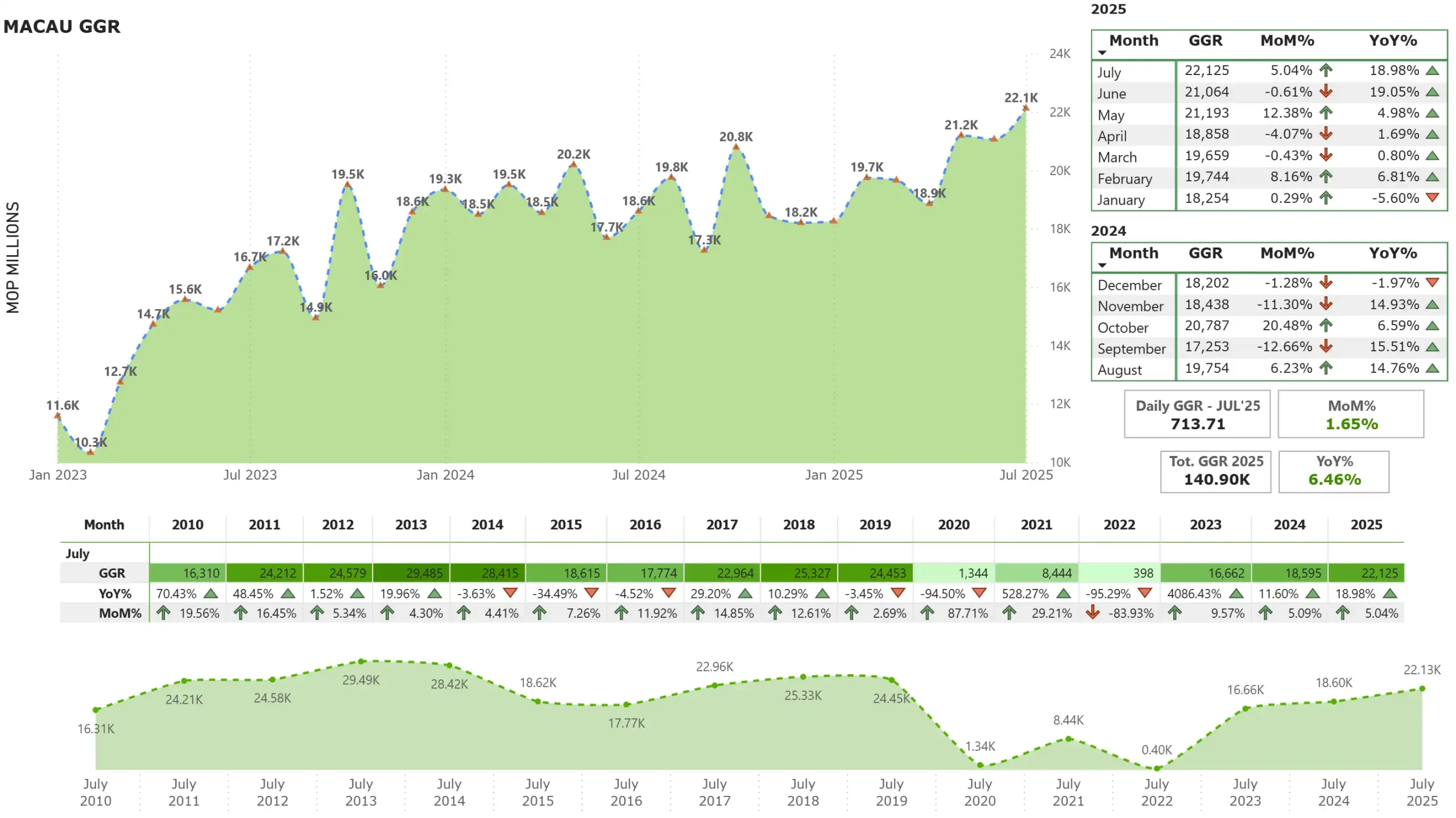
‘We forecast the inflection in growth to continue,’ wrote Vitaly Umansky, Senior Analyst at Seaport. The firm now projects 13.7 percent growth in the second half of 2025 compared to 4.4 percent in the first half, driven by increased marketing efforts and improving China consumer sentiment.
Morgan Stanley analysts Praveen Choudhary, Anson Lee and Stephen W Grambling noted that the recent performance represents ‘two consecutive monthly beats’ with GGR showing 19 percent year-over-year growth. Their revised forecast result from ‘notable positive operating leverage, less competition, and earnings estimate increases.’

Visa policy easing and travel shift fuel gains
Analysts point to several structural drivers behind Macau’s outperformance. Enhanced visa accessibility remains a key factor, with permanent residents of Zhuhai now eligible for ‘one trip per week’ permits allowing stays of up to seven days. Additionally, residents of the Guangdong-Macau In-Depth Cooperation Zone in Hengqin can use one-year, multiple-entry permits with no visit limits.
Macau has also benefited from shifting regional travel patterns, with mainland Chinese and Hong Kong visitors increasingly choosing Macau over traditional destinations like Thailand and Japan. This redirection of tourist flows has provided incremental support to visitor arrivals and gaming revenue.

Non-gaming as a footfall driver
The non-gaming segment, particularly concerts, has become a major contributor to footfall. Sold-out performances by popular Asian performers, including Jacky Cheung in June and the Eason Chan ‘Fear and Dreams’ tour at Galaxy Arena, have attracted both mass market and VIP players to the territory.
Unlike other discretionary categories, gaming remains relatively inelastic, Morgan Stanley analysts say. For mainland Chinese visitors, Macau offers ‘a legal and culturally proximate outlet for gaming entertainment with few viable alternatives in the region,’ reinforcing resilient demand.
There are signs of recovery in the VIP segment, driven by targeted capacity additions, entertainment-led direct VIP acquisition, and an uptick in licensed gaming promoters—though still below the government’s cap of 50 junkets. Operators are also investing in property renovations to better appeal to high-end clientele.
Amongst recent gains, Morgan Stanley argues the industry ‘deserves re-rating,’ noting that it still sees sector valuations as attractive if current growth is sustained. The firm has raised price targets across its coverage and maintains overweight ratings on Melco Resorts, MGM China, and Sands China.
Seaport’s Umansky points to rising hotel occupancy, stronger base mass recovery, and increased supply as drivers for Macau’s continued recovery. He adds that investor sentiment remains overly bearish, describing valuations as ‘still too low.’
The positive outlook extends beyond 2025, with analysts expecting continued improvement in China’s economic conditions and consumer confidence to support sustained growth. Recent retail sales data showing 4.8 percent growth in June, the fastest pace since December 2023, indicates improving consumer sentiment that could translate into stronger demand for Macau gaming.
However, risks remain, including the possibility that China consumption could remain weak and concerns that part of the GGR growth surprise stems from low-margin VIP business. Additionally, reinvestment rates remaining high could impact profitability despite revenue growth.