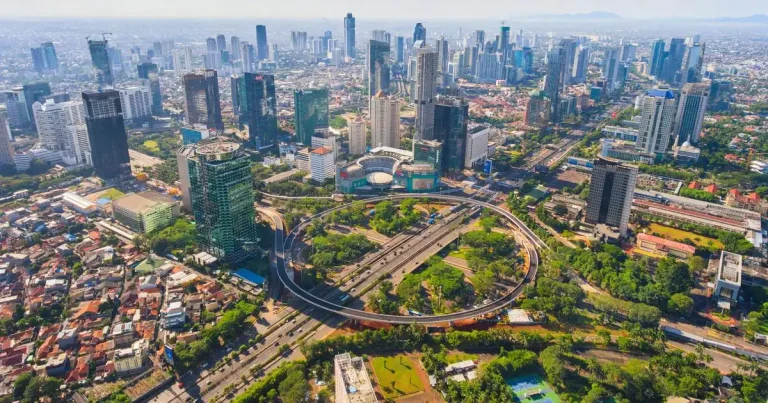
Indonesia is now mandating that network access point (NAP) service providers cut access to the internet lines that are based in the Philippines and Cambodia and are allegedly being used for online gambling within the nation.
This follows multiple moves by other regional jurisdictions to go after illegal online gaming in their country by focusing on the internet service providers, instead of clamping down on the platforms themselves.
According to Antara News, the nation’s Communications and Informatics Miniter, Budi Arie Setiadi, noted the move was part of “all viable measures for eradicating online gambling”.
The move was put into effect via an official Minister’s Letter issued on June 21st to the NAP Service Providers.
These providers have been given three days to comply with the instruction after acknowledging receipt of the letter.
The minister highlighted in particular internet lines suspected of being used in Davao, the Philippines, and Cambodia.
The Ministry further notes that it has already removed nearly 3 million pieces of online gambling content from mid-July of 2023 to mid-June of this year.
Aside from the NAP mandate, the group has also requested the blocking of e-wallets under Bank Indonesia, totaling 555 and the freezing of nearly 5,800 bank accounts via the Financial Services Authority.
Online and offline gambling is illegal in Indonesia, with participants and organizers subject to a prison sentence of up to 10 years and a $1,500 fine.
According to reports from the nation’s Financial Transaction Reports and Analysis Center, online gambling activity in 1Q24 in the nation amounted to a transactional value of about $36.4 billion, while those involved in online gambling totaled some 3.2 million.
The January-May period of 2024 saw 14,000 online transactions, reports Xinhua.
The Philippine Department of Labor and Employment (DOLE) has warned that approximately 22,000 Filipinos employed by legal Philippine Offshore Gaming Operators (POGOs) in Metro Manila may face unemployment if the online gaming companies are banned in the country.
According to a local media outlet, Labor Secretary Bienvenido Laguesma noted that inspections were conducted on all legally operating POGO firms in the National Capital Region (NCR) last year. Data collected from these inspections was used to evaluate the potential impact on the labor market.
Laguesma emphasized that shutting down operations of legitimate POGO firms would pose a significant challenge, impacting the employment of numerous workers.
He added that there are also POGO hubs in provinces, particularly in Central Luzon, but these are considered illegal as they are not registered with the Philippine Amusement and Gaming Corporation (PAGCOR).
Furthermore, Laguesma mentioned that assistance would be challenging for workers not listed with PAGCOR, contrasting with those previously listed, for whom there is a process to reach out. The Department of Labor and Employment (DOLE) has existing programs in place to support affected workers if their companies are closed down.
In addition to Filipino workers, Laguesma noted that thousands of foreign workers in the legal POGO industry might also be affected by the proposed ban.
From January to April 2024 alone, the Labor Department issued approximately 8,000 alien employment permits (AEP) to foreign workers employed by licensed internet gaming operators in the country.
Most of these foreign applicants were Vietnamese, followed by Chinese. There were also Indonesians, Thais, and nationals of other countries seeking permission to work in the online gaming industry in the Philippines.
Pressure on POGO investors
The uncertainty may affect not only POGO workers but also POGO investors and senior management officers.
The House of Representatives is currently investigating the influx of Chinese nationals working in illegal POGO firms. The investigation also covers their involvement in drug smuggling, acquiring Filipino citizenship using fraudulent documents, money laundering, fraud, kidnap-for-ransom, and other criminal activities.
According to the Philippine News Agency report, Surigao del Norte 2nd District Rep. Robert Ace Barbers urged his colleagues in Congress to amend and modernize the outdated Special Investor’s Resident Visa (SIRV) program.
Barbers stated that the country’s special visa is being exploited as a “ticket” by foreign drug syndicates, money launderers, and other criminal elements to establish their operations in the Philippines.
He noted that unscrupulous individuals are abusing the SIRV program of the Board of Investments (BOI), turning the country into a haven for their illegal activities.
According to recent reports, Barbers mentioned that the SIRV program was allegedly used as a means for Bamban, Tarlac Mayor Alice Guo and her parents to enter the country in January 2003 when she was 13 years old.
Records from the BOI and Bureau of Immigration reveal that Alice Guo’s real name was Guo Hua Ping, born on August 31st, 1990.
Alice Guo, also known as the “POGO mayor,” faces various accusations, including human trafficking.
Macau’s leading retailer, DFS Group, has implemented an unpaid leave plan across its Macau branches, emphasizing that the plan is voluntary and was made after careful consideration.
According to Allin Media, DFS has highlighted that the plan is designed to be collaborative. While managing operational expenditures, the firm aims to ensure job stability and protect employee welfare.
DFS stated there is no intention to enforce the plan, describing it as ‘the result of careful consideration’ of various options.
Despite market uncertainties, DFS remains optimistic about the future attractiveness of the Macau market and continues to invest. They have announced plans to open another shop in M8 shopping mall near Senado Square in the city center.
DFS Group, a Hong Kong-based travel retailer of luxury products, operates T Galleria stores across eight properties, mostly integrated resorts in the Cotai area, including City of Dreams, Studio City, Galaxy Macau, MGM Cotai, MGM Macau, Wynn Palace, and Londoner.
According to a previous report, DFS suggested that each employee take at least six days of unpaid leave during July and August. However, this period is typically the high season for tourism in Macau.
The decision to cut expenses is linked to a sharp decline in the company’s business. Reports indicate that the company’s revenue has plummeted by nearly 40 percent compared to last year and the pre-COVID period.
Additionally, the salaries of frontline employees have seen a significant reduction of nearly 50 percent, partly due to lower sales volumes of cosmetic products since the second half of last year.
Macau saw a 21.6 percent year-on-year increase in visitor arrivals in May, totaling just over 2.69 million, according to the city’s Statistics and Census Service.
This figure represents 79.3 percent of the visitor numbers from May 2019. Compared to April, May arrivals were up by 3.5 percent from just above 2.6 million.
May marked the labor-holiday season on the Chinese mainland, Macau’s primary tourism feeder market.
Visitors from mainland China increased by 25.9 percent year-on-year to 1,856,283 in May, with those traveling under the Individual Visit Scheme (893,373) rising by 6.3 percent.
Visitors from the nine Pearl River Delta cities in the Greater Bay Area (932,961) saw a 30.3 percent year-on-year increase.
Conversely, visitors from Hong Kong (582,083) decreased by 3.3 percent; those from Taiwan (68,971) surged by 118.7 percent. The number of visitors from Hong Kong returned to May 2019 levels, while visitors from mainland China and Taiwan rebounded to 76.5 percent and 78.5 percent of their corresponding levels in May 2019, respectively.
International visitors surged by 74.4 percent year-on-year to 184,854 in May, reaching 61.3 percent of the figure from the same month in 2019.
Regarding Southeast Asia, visitors from Indonesia (14,512) increased by 15.6 percent compared to May 2019. The numbers from the Philippines (35,852) and Malaysia (15,094) returned to 73.8 percent and 80.2 percent of their respective figures from May 2019.
For Northeast Asia, visitors from South Korea (33,999) and Japan (9,924) recovered to 51.7 percent and 29.4 percent of their corresponding levels from May 2019.
Among long-haul markets, visitors from the USA (10,027) rebounded to 58.9 percent of the figure recorded in May 2019.
Sri Lanka’s high casino taxation rates have helped bolster state finances and promote a more equitable distribution of resources, the country’s finance minister has stated.
According to local media, State Minister of Finance Ranjith Siyambalapitiya alleged that the government has succeeded in adding 60 percent of a casino’s turnover to state revenue under the current regime.
This represents a dramatic increase from the previous system, which only collected income tax from casino operators.
Currently, Sri Lanka is home to six casinos: Bally’s, Bellagio, Casino Marina, Stardust, Continental Club, and The Ritz Club.
Despite a 2010 law that required licensing for casino operations, no licenses had been issued until recently. A new regulatory framework will enforce licensing, with initial licenses being issued for up to 20 years, renewable every five years.
The new measures introduced by the government include a Rs.500 million ($5.9 million) license fee, an annual renewal fee of also Rs.500 million ($5.9 million) , and a 15 percent turnover tax. These stringent taxes are designed to both increase state income and discourage certain business activities, the minister explained.
“By targeting high-income earners and profitable industries such as casinos, the government aims to distribute resources more equitably and fund public services for the broader population,” Siyambalapitiya said during a parliamentary debate on tax amendments related to casinos.
The move comes as the country’s Committee on Public Finance (CoPF) revealed that despite legal prohibitions, online casinos continue to operate openly in Sri Lanka, depriving the government of potential revenue.
The CoPF has directed officials to expedite the implementation of necessary laws to establish a regulatory authority, which is crucial for attracting foreign investors and securing the government’s rightful revenue from the casino business.
The government’s efforts to reform the casino taxation system are part of a broader strategy to raise state revenue and implement fairer tax policies.
Sri Lanka is currently setting up a Gambling Regulatory Authority to oversee the industry. This move is intended to ensure proper tax collection, mitigate criminal activities, and address negative societal impacts associated with gambling.
The estimated revenue from casino taxes is significant, with projections around $7.4 million.
Good Morning. Regulation is key, and even more so as times change. The head of the International Gaming Standards Association says that regulators are facing an uphill battle as they try to balance industry growth with bad actors, with AI and cyber resilience as key factors. Meanwhile, in Macau, the tourism peak is lifting up all boats, but retail appears to be slacking.
What you need to know
Regulations are a key part of keeping the Asian gaming framework in place, with new moves in APAC fostering growth.
The gaming industry is at a crossroads, and the only ones who can figure out how to guide it have to be impartial. That’s where the International Gaming Standards Association comes in, with its new Chair, Nimish Purohit, laying out what is needed to keep the industry balanced and how to communicate with regulators across the world to make it happen.
The gaming industry is at a crossroads, and the only ones who can figure out how to guide it have to be impartial. That’s where the International Gaming Standards Association comes in, with its new Chair, Nimish Purohit, laying out what is needed to keep the industry balanced and how to communicate with regulators across the world to make it happen.
We’re joined today by Nimish Purohit, the Chairman of the International Gaming Standards Association (IGSA). Thank you for being with us.
Very excited to be here. Thank you, Kelsey.
You’ve stepped into some big shoes, you were appointed as the Chairman of the IGSA in early 2024, following Earle G. Hall, a good friend of ours. He’s lauded your previous partnership as Chairman and co-Chairman, calling it a two person package. But how do you feel then stepping into this new role?
Earle is a good friend of the industry. And really he’s provided a steady hand over the years as well. One good thing is, after the elections happened, I also have a very good Vice Chair, who has taken on my previous role as Vice Chair as well. So that new one-two punch is Martin Pedak, from Playtech. And he has done a very good job of providing the support that I was traditionally providing early as well.
So that’s kind of the one good thing that’s come in as well. And then the other thing is just from a stability standpoint, as the rest of the world is changing, there’s a good blend of stability that’s been provided by the other board members as well.
So, as an example, we have Syed Hussain, who’s from Oregon State Lottery, and he’s been there for at least as long as I’ve been there as well. And then finally, you know, we’ve had some changes at the staff level as well. So we have the incoming president with Mark Pace, but he’s not a stranger to the industry, or to the organization. So it’s a good blend of continuity, fresh thoughts. But then, people like Earle are only a phone call away. And so are others if you ever want to call on them.
You guys together bring together a lot of gaming industry experience from various different fields as well. It’s good to see that comprehensive approach towards something which is a standard setting association. Speaking of the the industry, you’ve mentioned right now that it’s at an inflection point, why do you say that?
The industry is always changing, right? That’s the one thing that some people say when one constant is changed, right? Just from our perspective, though, what we look at some of the recent topics that have garnered a lot of attention that are kind of like, you know, hey, what are we doing about this? So as that kind of feedback comes in, we’re focusing on two really niche areas that we think we’ve can fill the void from a technical standpoint, and also best practices. So one is ethical AI and artificial systems in general intelligence or artificial intelligence systems.
And the other one is cyber resiliency. And from our perspective, as well, we look at how can we create some standards and best practices, that can be a little bit of a lift and shift into the industry, and mainly to work at the behest of regulators as well, who we very closely partner with. So you know, those are the kind of inflection point where artificial intelligence is only expected to accelerate and its journey side and unfortunately, so is cyber resiliency. But you know, that that makes it a little bit more fun in terms of how can we raise all ships in the industry on those two topics as well.
What’s going to be the balance point between regulation and reining in the bad actors, but allowing them the freedom to still operate and keep this industry alive?
Yeah, it’s a really good question, right? Because I used to be a regulator before as well. And the thing that we look at is how do we partner with those regulatory organizations? So some examples, just to give you a little practical approach that we take as well.
We work closely with the International Association for Gaming Regulators. And then also anytime there’s an industry event – like at ICE as an example, that happened very recently – we have staff that go out and engage with the regulators there and just ask them: “What is it that keeps you up at night?” Right? “What is it that the industry can do to help you? And how can we keep that as a best practice/technical approach and allow you to use technology and more importantly, how do you adequately regulate the technology that does exactly what you’re talking about?”
Blend in one approach where we’re allowing innovation to come in, but on the flip side, they’re also gatekeepers into the integrity of the industry. So it’s a fun challenge, but at the same time one that we take very seriously in filling that specialized lane that we operate in.
How does that then work in terms of interfacing with your other international, let’s say, partner associations or other groups, which are trying to then make sure that we’re setting the proper standards for the industry?
Oh, great, great question. So I’ll say it this way, if things are not done right, in terms of partnership and collaboration, duplication happens, and no one likes duplication. So internally, as well.
So I’ll give you an Aristocrat example. So we have other leaders within Aristocrat that go and engage with these organizations. And what we try to do, as well as the rest of the industry does this as well, is we go and talk like: “Hey, what’s going on in associations, like AGM, or what’s going on at AIGA, from an American Gaming Association, or Associated Gaming Equipment Manufacturers, so a blend of kind of a regional approach.
And then the blend of an approach that is done on a global scale as well, for international jurisdictions like Asia, Pacific, etc. And what we try to do is come back and we say: “Alright, we got a handle on this, can you help out with X,Y and Z?”
So artificial intelligence is a perfect example. We can partner with those associations to inform policy at that level. And then we can fill in the void from a technical or best practice standpoint, that the industry has come around and created those ethical best practices for. But yeah, long story short, we do this to make sure that the resources being what they are everywhere else, we’re not duplicating any of the efforts and making sure that it’s synergize as best as it can.
It’s very tough, as you’ve previously said, there was no such thing as an AI standard within gaming. So trying to keep up with that, it must be very difficult for the IGSA to be able to gather all of the information and then accurately put it forward. But what have been the steps so far? And how do you think that they’ve been received? And are they starting to bear fruit?
No, great question. And then thanks for that catch of that.
There’s no such thing as AI (standards) in gaming, in general, when you look at the the best practices and regulations and standards. And that’s where we came together as an industry and said: “Alright, let’s come up with something that we know. Generative AI is skyrocketing in terms of interest, in terms of the pace and evolution. We know systems, in general, around the world are also evolving.
What can the IGSA do? And as we formed the committee, we’ve taken an approach where it’s kind of an all-hands-on-deck with all the manufacturers. We’ve also invited a couple of regulators to be active, there’s actually a couple of tribal regulators who are very technically savvy that have also come in. And then it’s an approach that is omni channel.
So we have AI gaming globally, as well as land-based that’s representative. And what we do is we’ll come up with series of policies and standards, look at what, you know, as an example, what the European Union might have done, or the recent passage as well, and look at areas: Where is data protection a key area? Can we take a risk-based approach? If you do this, what are some of the things that we can implement that are actually testable/auditable from a regulatory standpoint as well.
And then after doing a series of proposed standards, we go in and calibrate with a specialized committee called the Regulatory Compliance Committee for IGSA. And that regulatory committee is actually comprised of regulators. So when we presented this after working on some draft standards, were about four or five months, we got glowing reviews that: “Yep, you are on the right path. We haven’t even thought about this, keep doing what you’re doing.” And it’s good to get that feedback. And I know it’s a little bit of a longer answer.
But when, you know, the bearing fruit part, I’ll just address that too. So we’ve looked at like some common sense things as well, that are very unique to gaming, which is, how do we audit the outcomes of algorithms as well and AI systems? So something as simple as: hey, the industry recommends that let’s do a biannual audit of the output just to make sure that it’s not going outside of its intended norms, objectives of the algorithm capture that and codify that. Little things like that I think they can go a long way and they still sit within the paradigm of regulated gaming products.
Well, and that’s the the part that saves us from meeting Sarah Connor right?
Yeah, exactly.
Now, just to duck away from AI real quick because I know that it’s a very interesting topic, and I know you know a lot about it. But I just wanted to look at the omni channel side because you mentioned that and specifically within your background and your current position, obviously within Aristocrat, do you think that that helps? Is that more advantageous? And then to be able to help IGSA? Because you’ve got that insight,you’re on the ground, do you understand everything that’s happening, you know exactly what people need.
It’s a very good observation. So from an enterprise standpoint, my role is at the technology level, from an enterprise standpoint. And I partner with all three of our business verticals. So that’s Gaming – which is our land-based business, Anaxi – which is our iGaming and enterprise systems, or back of the house systems as some people call it, that vertical as well. And then we have Pixel United, which is our free to play. So even though it’s not regulated, from an omni channel slots philosophy, a lot of time though, that content goes back and forth across those verticals, as well as it does for a lot of different manufacturers.
So what we try to do is, like I’m a voice of the industry back into those partners and product creators that are looking at the capabilities that they’re putting in and just say: “Hey, just FYI, here’s kind of a direction that the industry is thinking of taking, just keep that in mind as you go through the next level.” And vice versa. I’m also a voice of all of those business partners back into the IGSA.
And making sure that they also understand that that’s not really quite how it works, or: “Yeah, that’s spot on, go into it”. So it’s kind of like a two-way calibration, just do to use that beat-up word there. So it does help quite a bit.
Within the various aspects of gaming, they’re very different. And they continue to be evolving, even though some of them are integrating a little bit more as we see in the Philippines. But land-based, AI gaming, sports betting, even the social gaming side, as you mentioned, with Pixel, what aspect is most difficult at this point?
I, generally speaking, and my this is going both off my experience before as a regulator and also as a now kind of a voice of industry at IGSA, I found land-based, believe it or not, to be one of the tougher verticals to both regulate and to be regulated. And it’s a simple reason: because you’ve got the software that’s supposed to be designed to be on the floor for a while. But at the same time, it’s the only vertical that also has hardware requirements. And the other two are kind of a ‘bring your own device’, where there’s a lot more flexibility in terms of entry criteria, device coverages and things like that.
So as we look at the overall component level, regulation and the component level, technical standards and blending that for a product that then stays on the floor for a while, and is built with that in mind, it comes closer to more of a car philosophy: that the car is going to be there. So quality comes into play, all these other things come into play as well.
But then looking at the AI side, do you think that that’s going to be implemented more across the iGaming, the sports betting sides? Is that more of a concern for trying to lay out those standards immediately, because sports betting exploded across the US, we’re seeing another explosion within Asia. LatinAm, obviously. What do we need to be looking out for?
I would say that the IGSA is focused on the algorithmic fairness. That’s kind of what we bring everything back to. And then aligning that with the responsible gaming tenants as well. Is there something that the algorithm is building in where the regulations don’t exist, who really need to put something in? So from a sports betting example: Are there AI systems that are potentially allowing cheats to proliferate in the system, and they’re not being monitored, and the risk profiles are not being created? So having a standard that accompanies that, saying: We must, as an industry, embrace the fact that we do need monitoring for these types of bad actors.
In those kinds of situations where AI can actually hit the ground running right before even the regulations can keep up. And vice versa, you know, it will come over in those types of arenas quite fast. In some instances, as you called about, it already does exist there. But other ones, I think the challenge ends up being what I’ve observed as a Slack Effect, where the regulations are usually behind the technology. And that’s generally seen as: “Yep, not allowed”. And as they start to carve out a path to get into that arena, it ends up being a very non-straightforward path of getting into that that market.
Thank you so much. And yet again, congratulations on your role as the Chairman of the International Gaming Standards Association. This is Nimish Purohit, the Chairman of the IGSA. Thank you so much for your time.
In a recent meeting with the House Ways and Means Committee, the Commonwealth Casino Commission (CCC) Chairman, Edward C. Deleon Guerrero, suggested that the local legislature consider removing the exclusivity of the gaming license.
Guerrero believes that despite the only gaming licensee, Imperial Pacific International (IPI), currently being in the process of bankruptcy, the casino industry can help revitalize the local economy.
According to the local media outlet, Marianas Variety, Guerrero noted that Public Law 18-56, which legalized casino gaming on Saipan, provided for an exclusive casino license to fund the government’s retirement program. He stated that times have changed and it is now time for the Legislature to consider removing that exclusivity.
He mentioned that the CCC proposes to take a different approach once the Northern Mariana Islands (CNMI) government allows multiple casino licenses.
The CCC has failed to collect the $3.15 million annual regulatory fee from IPI since the onset of the COVID-19 pandemic in 2020. Meanwhile, IPI is currently entangled in a multifaceted legal dispute with the CNMI government and multiple officials.
The latest sites targeted for blocking include A Big Candy, Jackpoty, and John Vegas Casino, the ACMA announced.
This comes as part of the regulator’s ongoing efforts to protect Australian consumers from the risks associated with unlicensed and unregulated gambling platforms.
“Website blocking is one of a range of enforcement options we use to crack down on illegal online gambling,” said an ACMA spokesperson. “Since we made our first blocking request in November 2019, a total of 995 illegal gambling and affiliate websites have now been blocked.”
The crackdown on illegal offshore gambling operators has also led to over 220 such services withdrawing from the Australian market since the ACMA began enforcing new rules in 2017.
Online gambling in Australia is regulated by the Interactive Gambling Act 2001 (the IGA). The IGA makes it an offence to provide certain gambling services to a customer physically present in Australia via the Internet. Exceptions exist for licensed services that provide online wagering, sports betting and lotteries.
Data from Responsible Wagering Australia analysis developed by H2 Gambling Capital on Australia’s offshore wagering industry pointed out that the illegal offshore market in the country was worth more than AU$1 billion ($667.6 million), about 15 percent of the total gambling market.
The report has also forecast that from 2022-27, racing and sports bodies could lose AU$1.6 billion ($1 billion) in product fees to illegal offshore gambling markets, while AU$1.3 billion ($868.1 million) in taxes could be lost.
The ACMA is urging consumers to be cautious, as even services that appear legitimate may lack important customer protections.
“Australians who use illegal gambling services risk losing their money,” the ACMA warned, encouraging people to check the agency’s register to verify if a wagering service is licensed to operate in the country.
The move comes amid growing concerns over the proliferation of online gambling in Australia. According to industry data, the country’s online gambling market has grown rapidly in recent years, with a significant portion of that activity occurring on unlicensed offshore platforms.
“Illegal offshore gambling operators pose a significant risk to Australian consumers,” said the ACMA spokesperson. “By blocking these sites and cracking down on unlicensed activity, we’re working to create a safer and more regulated online gambling environment for Australians.”
China and Malaysia have agreed to extend their mutual visa-free policy following the visit of Chinese Premier Li Qiang to Malaysia this week.
According to China’s official media, Xinhua News Agency, China will extend the facility until the end of 2025, while Malaysia will extend the visa exemption until the end of 2026.
This agreement is part of a joint statement on deepening the comprehensive strategic partnership towards a China-Malaysia community with a shared future.
The mutual visa exemption policy has been in place since December last year, and the Malaysian tourism market has experienced positive momentum with the influx of Chinese tourists.
In a recent annual general meeting (AGM) of Malaysian gaming operator Genting Malaysia, the management praised the mutual visa exemption between Malaysia, India, and China, noting that the policy has had beneficial effects on their business.
The group’s COO mentioned that in the first quarter of 2024, revenue from Genting’s local leisure and hotel business increased by 25 percent year-on-year. Resorts World Genting’s business volume also increased significantly, with the main tourists coming from Singapore, Indonesia, China, and India.