CreedRoomz, a leading live casino provider, has announced the launch of Richie Wheel, a new game show designed to elevate player engagement and drive revenue growth for casino operators.
Richie Wheel builds upon the traditional money wheel format with the addition of dynamic multipliers, offering players the potential for significant payouts.
Key Features & Benefits:
Significant Payout Potential: Richie Wheel offers players the opportunity to achieve substantial winnings through multipliers reaching 1000x, creating an engaging gaming experience.
Intuitive and Vibrant Design: Richie Wheel features a beautifully designed live studio environment with an easy-to-use interface and vibrant visuals, providing a polished and engaging player experience.
Seamless Integration: CreedRoomz provides a streamlined integration process, enabling partners and aggregators to efficiently add Richie Wheel to their existing casino platforms.
Increased Player Acquisition & Retention: The engaging gameplay and potential for substantial wins will attract new players and encourage their continued engagement.
Hayk Tovmasyan, Head of Live Casino at CreedRoomz, stated: “Richie Wheel reflects our dedication to providing engaging live casino experiences that deliver results for our partners. We are confident that this game show will be a valuable asset to any casino, drawing in players with its exciting wheel-spinning format and the chance for big prizes.”
The latest slot by Play’n GO takes players back to the enchanting world of Alador, Yasmine, and their mysterious companion in 1001 Mystery Genie Fortunes. However, the Kingdom’s peace harbors secrets that are yet to unravel.
After overthrowing the villainous Zafar, the realm enjoys tranquillity under the rule of Sultan Alador. However, the Genie who helped secure victory has vanished into the Oasis – and whispers tell of a chest brimming with unpredictable power. This 5-reel, 20-line slot invites players to explore what secrets lie within.
This game intertwines layered gameplay with narrative twists. Mystery Symbols can reveal Magic Lamps that call forth the Genie herself, transforming into Expanding Wilds that trigger re-spins. Re-spin streaks can ramp up to 30 in a single session, with multiplier wilds climbing to x5. Free Spins bring more magic with Bonus Locks and Key mechanics that offer dynamic Instant Prizes, while the elusive Mystery Chest can surprise at any moment with payouts up to x1001 the total bet.
1001 Mystery Genie Fortunes continues Play’n GO’s affinity for richly developed universes, previously explored in titles like Ghost of Dead and Scroll of Seth as well as the previous title Mystery Genie Fortunes of the Lamp. With its vibrant visuals, smart feature integration, and evolving multiplier mechanics, this slot builds on the brand’s strengths while casting a new spell over players.
George Olekszy, Head of Game Retention, said: “The Genie is back – and he’s hiding more than just tricks up her sleeve. With Mystery Symbols, expanding multipliers and streak re-spins, this is one of our most dynamic titles yet.”
1001 Mystery Genie Fortunes offers an intriguing mix of storytelling and gameplay mechanics that make every session feel fresh and full of potential.
Macau gaming operator Galaxy Entertainment Group (GEG) is set to report weaker-than-expected performance for 1Q25, with analysts projecting a 1 percent quarter-on-quarter decline in gross gaming revenue (GGR).
According to Jefferies’ latest projections, GGR for the first quarter of 2025 is expected to reach HK$10.9 billion ($1.4 billion), a decrease from the previous quarter. This drop in GGR is attributed to several factors, including weaker-than-anticipated performance in Average Daily Revenue (ADR) and external challenges within the Macau gaming sector.
Despite a slight increase in ADR, which is projected to rise by 1 percent quarter-on-quarter to MOP121 million ($15.1 million), the industry-wide ADR is expected to increase by 3 percent from 4Q24. As a result, GEG’s overall performance is expected to fall short of market expectations.
The gaming giant’s lower-than-expected ADR can be partly explained by ongoing challenges in attracting tourists to Macau, as well as sentiment issues within mainland China. During the critical post-Chinese New Year period, tourist arrivals were down by 8 percent, which negatively affected GEG’s revenue per day. This trend points to a broader issue in the recovery of Macau’s tourism and gaming industry, even as the region continues to rebuild from the pandemic’s effects.
While GGR is projected to decline, the company’s performance in the VIP gaming segment provides some positive news. Jefferies believes that this strong showing in the VIP segment could partly offset the overall GGR decline, offering some resilience amid challenging market conditions.
Moreover, analysts Anne Ling and Jingjue Pei project GEG’s normalized adjusted EBITDA to fall by 4 percent quarter-on-quarter to HK$3.14 billion ($405 million), further emphasizing the softer-than-expected performance in the first quarter. However, Jefferies remains optimistic about the company’s future prospects, maintaining a “Buy” rating with a price target of HK$44 ($5.67), based on the company’s long-term potential.
GEG is advocating the annual 2025 general meeting on May 8th, which will consider the audited financial statements and the re-election of directors of the board.
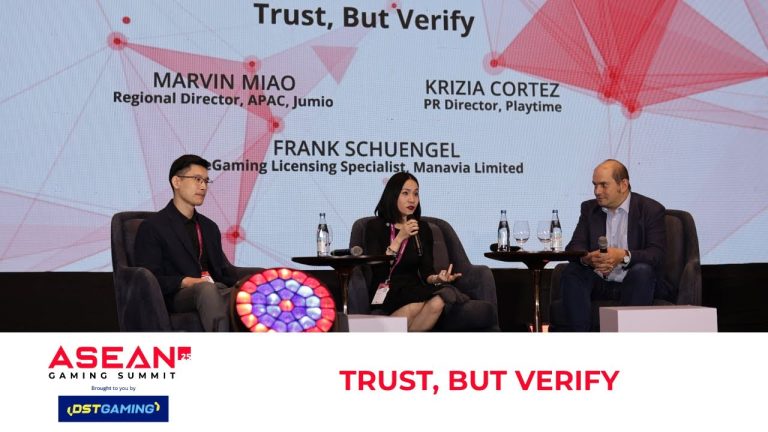
Industry experts at this expansive panel from the ASEAN Gaming Summit delve into the intricacies of Know Your Customer (KYC) processes, focusing on its critical role in ensuring compliance, trust, and security in increasingly digital marketplaces.
The panel was moderated by Manavia Limited’s Frank Schuengel and featured key insights from Playtime’s PR Director Krizia Cortez and Jumio’s APAC Regional Director Marvin Miao.
The speakers highlight how KYC has evolved from cumbersome paper-based systems to modern electronic frameworks that facilitate efficient identity verification.
The conversation covers the growing number of KYC service providers, the importance of trust in the verification process, and how user experience is paramount in both attracting and retaining customers in the online gaming market. They also discuss the unique cultural attitudes towards data-sharing in various regions, particularly in the Philippines, and the regulatory challenges that vary globally. The experts emphasize that the goal of KYC is not just to verify identities but to create a safer, more reliable online environment that encourages user participation.
Their insights further explore the challenges posed by emerging technologies, especially AI, and the sophisticated ways fraudsters attempt to infiltrate systems. The discussion concludes on a hopeful note, indicating that tech and regulatory advancements could pave the way for improved user experiences while maintaining necessary security protocols.
Highlights
The transformation of KYC from traditional methods to modern eKYC services.
Emphasis on the importance of trust between platforms and users.
Diverse regional attitudes toward KYC requirements in online gaming.
The exponential rise of KYC providers creating a competitive landscape.
The evolving role of regulatory bodies in ensuring compliance and user protection.
Adapting KYC procedures to counteract sophisticated AI-driven fraud.
Moving beyond KYC as a burden to leveraging it as a strategic tool for enhancing user experience.
Key Insights
The Role of Trust in KYC: The essence of KYC is fundamentally about fostering trust between businesses and their customers. As the industry shifts towards a more digital landscape, establishing reliable verification processes becomes paramount. Customers are more likely to engage with platforms that demonstrate diligence in protecting their personal information. This trust can lead to repeat business and a loyal customer base.
Evolving User Expectations: There is a growing expectation from users for streamlined onboarding processes that do not compromise their security. As online gaming and other digital services become mainstream, customer patience for lengthy KYC procedures diminishes. Firms must balance thorough verification with user experience to retain competitive advantage.
Regulatory Landscape: KYC regulations vary widely across regions, creating challenges for global operators. Countries like the Philippines are rapidly adapting regulations to align with best practices observed in other markets, allowing for more effective compliance and fostering trust among users.
Enhancing Security with Data Sharing: Organizations can enhance security measures by leveraging data networks to identify potentially fraudulent users. By evaluating shared information within a collaborative network, operators can swiftly reject suspicious applications, improving overall system reliability.
Cultural Attitudes Towards Data: Different regions exhibit varying degrees of comfort with sharing personal information. In the Philippines, there is increasing acceptance of KYC processes as regulations evolve and people recognize the importance of security in the gaming sector. Understanding local cultural nuances allows firms to tailor their approaches accordingly.
Expanded Services for Customer Verification: The rise of payment solutions with their own verification processes supports KYC efforts, as many users already provide personal data when engaging with these platforms. This dual verification offers efficiency and reassures both operators and users about security compliance.
Combating Advanced Fraud Techniques: The rapid evolution of AI poses a risk in KYC verification, necessitating innovations in techniques to identify and mitigate sophisticated fraudulent activities. Companies need to constantly adapt to technological advancements deployed by fraudsters while also employing advanced algorithms and human oversight.
In summary, the video solidifies KYC as a pivotal component in the success of online platforms. By innovating while considering local regulations, cultural aspects, and user experiences, businesses can harness KYC’s potential beyond compliance, transforming it into a competitive advantage that fosters trust and longevity in customer relationships.
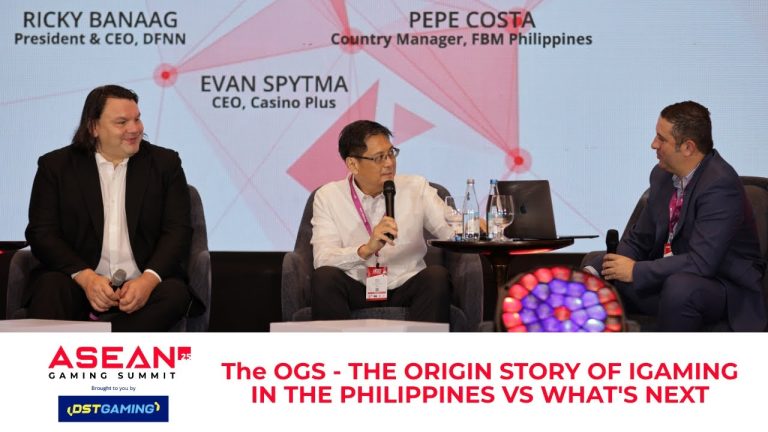
A top group of veteran iGaming experts joined together at the ASEAN Gaming Summit to discuss how the industry has evolved, particularly in the Philippines, and what can be expected in the post-pandemic era. The panel was moderated by FBM Philippines Country Manager Pepe Costa and featured DFNN’s President and CEO Ricky Banaag and Casino Plus CEO Evan Spytma.
The pandemic catalyzed regulatory reforms aimed at safeguarding players by creating a more structured gaming environment, leading to an influx of players into regulated channels rather than unlicensed options.
Key insights include the importance of a strong online presence, the increased use of e-wallets, and the necessity for cooperation among stakeholders such as regulators, telecom companies, and gaming providers. As the regulatory framework evolved, it became critical for businesses to provide real-time feedback to enhance compliance and streamline processes.
The panel highlights the current environment of friendly competition among established brands and newcomers, as well as the necessity for responsible gaming initiatives to maintain a sustainable and safe gaming ecosystem moving forward.
Highlights
Emerging Landscape: The regulatory landscape for iGaming in the Philippines has seen significant developments in response to the pandemic.
Digital Transformation: The pandemic necessitated a rapid shift from land-based to online gaming platforms, reflecting broader trends in digital transformation across industries.
E-Wallet Adoption: More than 80% of Filipinos use e-wallets, making them essential for iGaming transactions in a largely unbanked populace.
Regulatory Collaboration: Strong collaboration between industry players and regulators has enhanced the compliance framework, contributing to the growth of a safe gaming environment.
Specialized Games: The introduction of localized and specialty games reflects the uniqueness of the Filipino market, catering directly to local preferences.
Continuous Evolution: The regulatory framework continues to adapt, with new licenses and fees aimed at fostering competition and innovation in the iGaming space.
Responsible Gaming: The importance of responsible gaming practices is emphasized as the sector expands, ensuring the protection of players and the integrity of the industry.
Key Insights
Regulatory Modernization: The pandemic catalyzed a necessary modernization of regulations governing the gaming industry, with PAGCOR actively working to create a licensing framework that ensures player safety and encourages legal participation. By focusing on player experience and regulatory compliance, PAGCOR aimed to shift players from unregulated to regulated platforms.
Online Engagement: Filipinos spend an average of nine hours online daily, with a significant portion on mobile devices. This high level of engagement positions the Philippines as a prime market for online gaming, making it essential for companies to enhance their digital strategies to capture this audience effectively.
E-Wallet Integration: The pandemic-driven rise in e-wallet usage has been vital for the iGaming sector. As players gravitate toward digital transactions, payment providers play a crucial role in facilitating seamless experiences, making partnerships with popular e-wallets a priority for gaming companies to enhance their market penetration.
Collaboration with Regulators: The current regulatory landscape has been shaped by intensive cooperation between industry stakeholders and regulators. Real-time feedback mechanisms have been established to adapt to evolving consumer behavior and ensure compliance, which underscored the importance of a collaborative ecosystem for sustained growth.
Opportunities for New Entrants: The evolving market dynamics have opened doors for new operators, like CasinoPlus, to introduce innovative gaming experiences. Their early investments in adapting to technological advancements and regulatory frameworks have positioned them favorably amidst the competition.
Importance of Localized Content: By recognizing cultural preferences and local gaming styles, gaming companies have gained a competitive advantage. The introduction of specialty games demonstrates the need to cater to local tastes, enhancing player retention and satisfaction.
Promoting Responsible Gaming: As the industry grows, promoting responsible gaming initiatives becomes paramount. Stakeholders are encouraged to implement safeguards to ensure player protection and responsible gambling practices, fostering a healthy environment where gaming remains an enjoyable form of entertainment without adverse societal impacts.
The conversation sheds light on the transformative changes within the iGaming industry in the Philippines. Fueled by the pandemic’s challenges, the shift towards online gaming has opened new pathways for growth, innovation, and collaboration across the industry. The commitment from regulators and industry players to create a regulated, responsible, and player-friendly environment signals a promising future for the online gaming landscape in the Philippines. As the industry strives to improve, continuous adaptation to technological advancements and player preferences will be essential in maintaining a competitive edge while prioritizing player safety and responsible gaming practices.
The University of Macau has revised its 2025 Macau economic growth forecast from 7 percent to 6.8 percent, citing the potential indirect impact of the trade war on tourism spending.
The projection was made by scholars from the University’s Center for Macau Studies and Department of Economics during their quarterly economic development seminar.
The downward adjustment reflects increased global economic uncertainty, particularly how US tariff policies could shrink global trade volume. While Macau’s goods trade volume is relatively small, limiting direct impact, a slowdown in major economies like China could indirectly affect Macau’s economy through declining tourist spending power.
This tourism spending reduction may occur as the 125 percent US tariff on China takes effect, given that the majority of Macau’s visitors come from the Greater Bay Area.
In 2024, according to the data reviewed by AGB, Macau welcomed 34,928,650 visitors, with 24,491,424 (70.1 percent) from mainland China. Among Chinese visitors, about 49 percent (11,985,383) came from the nine Pearl River Delta cities in the Greater Bay Area, representing 34.3 percent of total visitors.
The Greater Bay Area, with its concentration of manufacturing and export industries, could be hit harder by tariff policies than other regions in China. This situation could worsen as Macau’s tourism spending has already been struggling due to China’s weakened economy.
Tourism spending already showing signs of decline
According to the latest survey from the Statistics and Census Service (DSEC), per-capita non-gaming spending of visitors in Macau dropped by 14.6 percent year-on-year in 2024, amounting to MOP2,157 ($269).
Both overnight and same-day visitors recorded spending declines. Overnight visitors spent an average of MOP3,884 ($484), an 8.2 percent decrease, while same-day visitors spent MOP691 ($86), down 12.7 percent year-on-year.
Earlier this month, Vitaly Umansky, senior analyst at Seaport, indicated that China’s economic improvement, especially among upper middle class consumers, is key to driving upward growth in Macau.
In his projection, Macau’s gaming industry will see 6.5 percent growth in gross gaming revenue for 2025. Stronger growth is expected in the second half of the year, with projections of 10.9 percent growth compared to just 2.2 percent in the first half, reflecting anticipated economic recovery timing.
The estimated growth is closely tied to China’s economic policies and stimulus measures. According to Seaport, recent developments in China’s policy approach offer reasons for optimism. The Chinese government’s March announcement of a focus on boosting consumption and improving consumer confidence is seen as an important leading indicator of a strengthening China consumer and a driver of mass revenue growth in Macau.
Despite these positive indicators, China has not yet released any large-scale economic stimulus following the trade war escalation after April 2nd, the so-called “Liberation Day”, when Donald Trump announced reciprocal tariffs on over 60 countries.
Meanwhile, in Macau, Secretary for Economy and Finance Tai Kin Ip, due to the weakness of the gaming revenue recorded in the first quarter of this year, has warned that Macau’s fiscal revenue in 2025 might “not be as optimistic as expected,” emphasizing prudent financial management.
Concerns about US-funded gaming companies
When asked about the risks to US-funded gaming companies in Macau, Kwan Fung, Assistant Professor at the University of Macau, stated that any global trade conflict could prompt companies to re-evaluate their investment strategies. However, he emphasized that Macau’s economic fundamentals remain resilient, with the main risks are still concentrated in fluctuations in external demand.
The research team from the University of Macau also released forecasts for other key economic indicators which indicated that the local employment market is expected to remain stable despite the geopolitical uncertainties.
The research team projects that an overall unemployment rate in Macau will remain at a low 1.7 percent, with a local resident unemployment rate of 2.3 percent.
Meanwhile, service exports are projected to grow by 6.8 percent, private consumption expenditure is expected to increase by 3.8 percent, and the inflation rate is anticipated to remain low at 0.7 percent.
Leaders of Thailand’s coalition parties, Pheu Thai and Bhumjaithai, reassured the public of their alliance’s stability after Bhumjaithai Secretary-General Chaichanok Chidchob opposed the casino legalization bill during a parliamentary debate.
His comments, made without party approval, raised concerns about discord within the coalition.
According to The Nation, Chaichanok, son of influential Bhumjaithai figure Newin Chidchob, declared his opposition to the bill “no matter who proposed it,” shocking party leaders. Bhumjaithai leader Anutin Charnvirakul clarified that Chaichanok’s remarks were personal opinions, not official party policy, and confirmed the party’s support for the bill.
Prime Minister Paetongtarn Shinawatra dismissed suggestions of conflict, emphasizing mutual concern for national issues. She noted that Chaichanok’s comments may have arisen during the heated debate and insisted that no significant damage had occurred.
Anutin reiterated that Bhumjaithai MPs must seek party approval before debating in Parliament, which Chaichanok failed to do. Despite this incident, Anutin reaffirmed the entertainment complex bill had already received Cabinet approval, including support from eight Bhumjaithai ministers.
The coalition partners agreed to support the bill during an April 8th meeting, though a few MPs cited religious objections. Anutin mentioned that one MP, Chada Thaiset, abstained from voting for this reason, highlighting individual dissent within the coalition.
Thailand has postponed a parliamentary debate on a bill that would legalize casinos amid mounting opposition and a concerning international trade environment.
On Wednesday protesters even gathered outside the Thai parliament demanding the bill be scrapped altogether rather than merely delayed, citing concerns about its potential social impact.
International duty-free retailer DFS is reportedly planning to withdraw from the M8 Mall on Senado Square in Macau before June this year, just six months after establishing a presence at the location, according to a local report by Allin Media.
The report, updated on Thursday, has added to concerns about Macau’s economic recovery. The ongoing downturn has not only led to a wave of closures among small- and medium-sized businesses but has also resulted in layoffs and store closures among large retail chains.
Sources cited in the report indicate that the decision is primarily due to significantly lower than expected foot traffic at M8 Mall.
It is also necessary to note that M8 Mall is located in a core touristic area in the city.
The sluggish consumer market has had a ripple effect on DFS. In June last year, the company required staff to take at least six days of unpaid leave in July and August. This was followed by layoffs in August, with DFS stating that it had to reduce its workforce by approximately 5 percent in response to the sharp downturn in Macau’s luxury retail market.
The report also suggests that the former DFS store may be taken over by China Duty Free Group (CDF), which is reportedly planning to convert the space into a retail outlet focused on perfumes, cosmetics, and high-end toys.
Official statistics reflect the broader challenges facing the industry. In February 2025, Macau’s retail sales totaled just MOP4.26 billion ($531 million) — a dramatic 28 percent drop compared to the same period last year, and a 25.2 percent decline month-on-month. All product categories recorded a downturn, with footwear, department stores, leather goods, and adult clothing experiencing declines of over 30 percent.
Additionally, the total value of electronic payment transactions in the retail sector for the first two months of 2025 fell by 18.9 percent year-on-year, reaching MOP9.28 billion ($1.16 billion). Department stores and leather goods were particularly affected, with transaction values dropping 28.1 percent and 26.8 percent respectively, suggesting a widespread tightening of consumer spending.
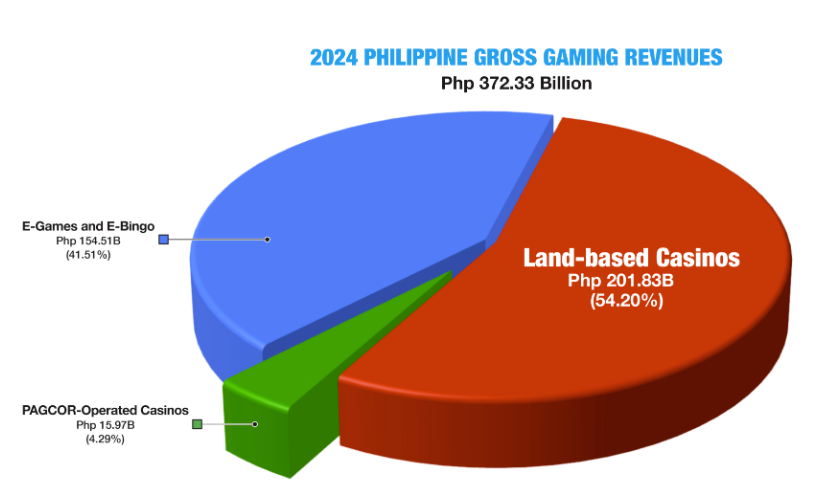
The Philippine gaming industry recorded notable growth in 2024, with land-based casinos remaining the largest contributor to gross gaming revenue (GGR).
According to the Philippine Amusement and Gaming Corporation (PAGCOR), these establishments generated PHP201.83 billion ($3.52 billion), accounting for 54.2 percent of the industry’s total GGR.
Overall, the industry’s GGR reached PHP372.33 billion ($6.5 billion) in 2024, reflecting a 30.52 percent increase compared to PHP285.27 billion ($4.98 billion) in 2023.
Source: PAGCOR
“This GGR feat underscores the crucial role of licensed casinos in sustaining the growth momentum of the Philippine gaming sector,” said PAGCOR Chairman and CEO Alejandro H. Tengco. “They remain our biggest revenue drivers and a major source of government funding for socio-civic programs.”
eGames sector reports strong growth
Source: PAGCOR
While land-based casinos retained the largest share, the eGames and eBingo segment posted significant growth. This digital sector generated PHP154.51 billion ($2.7 billion) in 2024, a 165.66 percent increase from PHP58.16 billion ($1.02 billion) in 2023. It now represents 41.51 percent of the total GGR.
“The significant leap in eGames and eBingo revenues shows that the industry is evolving rapidly. PAGCOR is committed to keeping pace with technological advancements while strongly advocating responsible gaming,” Chairman Tengco added.
Casinos directly managed by PAGCOR contributed PHP15.97 billion ($278 million), representing 4.29 percent of the total GGR.
Higher contributions to public funds
The industry’s overall growth significantly enhanced PAGCOR’s financial performance. The agency’s total revenue rose by 40.74 percent to PHP111.71 billion ($1.95 billion) in 2024, up from PHP79.37 billion ($1.39 billion) in 2023.
In a press release issued Thursday, PAGCOR noted that its contribution to government programs increased by 37.61 percent to PHP68.20 billion ($1.19 billion), while its net income more than doubled to PHP16.76 billion ($292 million), compared to PHP6.81 billion ($119 million) the previous year.
Including offshore gaming operations—banned in late 2024 but still contributing PHP38.14 billion ($666 million)—the industry’s total revenue reached PHP410.47 billion ($7.17 billion).
With the remittance of 50 percent of its net income (PHP8.45 billion or $147 million) to the national treasury, PAGCOR’s total contribution to the government reached PHP76.66 billion ($1.34 billion) in 2024.
“With a larger GGR base, we anticipate broader economic benefits, including increased employment, investment, and public funding,” Tengco said, referring to the wider impact of the industry’s growth.
Good Morning. Hurry up and wait. Thailand’s casino bill prospects have been start and stop for some time, with the most recent delay likely pushing its legislation to be considered by the House in September or October, says a top lawyer. But all hope is not lost, as the proposed bill still enjoys strong government support. Meanwhile, the ASEAN Gaming Summit is the gift that keeps on giving: top panelists examine what’s next for live tables and ETGs, as technology continues to surprise and delight. And in the world of data: real-time information is giving companies a new competitive edge, and helping give players exactly what they want.
What you need to know
Thai entertainment complex bill could only reach a final vote in the Lower House between September and October, following new delay.
A top panel of experts breaks down the future of live tables and ETGs, focusing on technological improvements and compliance.
Real-time data is pushing the gaming sector to new heights, improving marketing decision-making and maximizing operator profit. Ultra-personalization helps truly target customers efficiently, without wasting precious time or money.