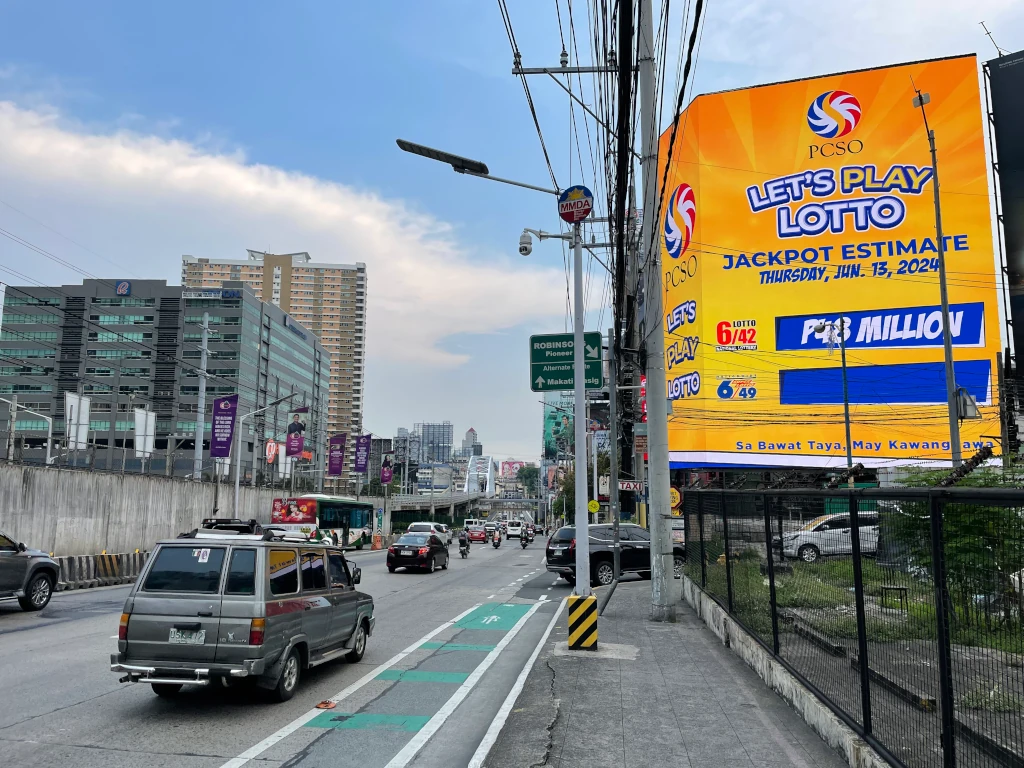
The Philippine Amusement and Gaming Corporation (PAGCOR) has ordered all licensed online gambling operators and related service providers to take down all out-of-home (OOH) advertising by August 15th, marking its first major move to address mounting public concerns over the aggressive marketing of electronic gambling.
The directive, issued through a memorandum signed by PAGCOR executives Jeremy Luglug and Ma. Vina Claudette Oca, requires “all licensees, suppliers and electronic gaming administrators and providers” to dismantle gambling-related outdoor ads.
The measure comes amid growing criticism from religious groups and lawmakers who have flagged online gambling’s role in worsening addiction and financial distress, particularly among vulnerable communities.
PAGCOR is also drafting a comprehensive set of guidelines for the advertising of electronic gambling, which will include restrictions on the location and timing of both physical and broadcast ads. The regulator is working with the Ad Standards Council (ASC), which oversees advertising content across media channels, to ensure consistent enforcement.
A memorandum of understanding between PAGCOR and the ASC is set to be signed on July 16th, formalizing the partnership and establishing the ASC’s role in screening and monitoring gaming-related advertisements. Under the forthcoming rules, gambling ads will be banned near sensitive locations such as churches, schools, and hospitals. In addition, gambling commercials will not be permitted to air during prime time television slots.
The announcement follows a separate move by the Fintech Alliance Philippines, a major industry group representing digital payment and e-wallet providers, which pledged to implement stronger internal controls to curb excessive online gambling access. Meanwhile, the Bangko Sentral ng Pilipinas (BSP) has signaled that it is also preparing new policy guidelines related to the issue.
Hong Kong-listed LET Group has indicated that is going to focus on its Westside City Project in the Philippines, as it restructures its assets, amongst a capital crunch.
According to its annual report published on Thursday, the group’s Chairman Lo Kai Bong noted that the company will ‘concentrate our resources in the Philippines gaming market, specifically on the development of the LETX Resort, also know as the Westside City Project. We firmly believe that this project is the cornerstone of our future success, as we strive to seize new growth opportunities in the Philippine integrated resort market’.
The focus comes as the group aims to divest its interest in the Tigre de Cristal hotel casino in Vladivostok – a project which has been plagued by the ongoing conflict in the Ukraine.
The group also has exited its interest in Hoiana Resort & Golf, which was in a ‘loss making position during FY2024’. The group deregistered its joint venture after voluntary dissolution in December of 2024.
While the group indicates that it is fully focused on the Philippines, it did warn that its current available borrowing facilities ‘may not be sufficient to complete the construction of the Main Hotel Casino and further funds are required’.
It furthered that its current assets and liabilities ‘indicate the existence of a material uncertainty which may cast significant doubt on the Group’s ability to continue as a going concern’.
But the group’s Chairman struck an upbeat tone, noting that ‘I am confident that the Philippine integrated resort market holds considerable promise for LET’s Group’s future. I recognize that investing in a company requires significant financial and time commitment to realize returns. Nonetheless, I ask that you place your faith in our vision and join us on this exciting journey’.
The gaming floors in Asia have seen a radical redesign over the past 20 years, shifting increasingly away from the physical space to options more accessible from a distance. Proxy bets, live dealers, online casinos and now – the non-gambling sibling – social gaming. Industry veteran Shaun McCamley notes that land-based operations have been slow to move into the social space, despite the many lucrative options it offers.
A tidal shift has been seen in recent years in the amount of focus that can be placed on VIP play, most accentuated in the junket space, as Macau – the world’s casino mecca – eviscerated the sector and imprisoned those it deemed to be flagrantly flaunting its benefits (whilst breaking the law).
These factors, with a particular focus on junkets, have left land-based operators seeking new territory (like PIGOs), one that comes in the digital realm.
Gaming industry veteran Shaun McCamley
But for McCamley, they don’t yet appear to be harnessing the potential.
When asked which Asian land-based operator was doing best in the sphere, the gaming veteran noted that “the owners and the CEOs don’t have online backgrounds. They’re fantastic executives. They do a wonderful job in building the properties and driving revenues […] But when it comes to online, they don’t understand”.
McCamley opines that this leads to the responsibility for online operations shifting to lower departments, oftentimes ending up on the plate of IT (information technology).
The executive notes that this strategy is vastly different from a company like DigiPlus, which has customized its offerings for the online environment, and is unlikely to see strong competition from land-based operators who now want a piece of the pie.
Social gaming
Real money gaming hasn’t been the only focus that operators moving into the online space have targeted. And companies like Aristocrat and Light & Wonder have seen rampant success from their social gaming forays.
“I was told by one of the executives at Light & Wonder that their social gaming business now outpaces their global slot business,” notes McCamley.
Light & Wonder has since reached out to note that, given market dynamics and recent performance, social gaming is no longer leading slots in regards to performance.
So what exactly makes social gaming attractive for the land-based operators?
“We all know that 80 percent of property’s visitors do not gamble […] But the majority join the property’s loyalty programs because they want to earn points.”
Having a social gaming vertical aligned with your property, with your brand, that’s linked directly into your loyalty program, that’s an amazing tool.
Shaun McCamley
Land-based operators have the advantage of pulling from a massive customer database, not necessarily gamblers.
“You don’t use the social media vertical as a means to try and convert them to a casino player […] The social platform that you work with stands alone in its own vertical, and it drives its own revenue”.
The beauty of it comes in how the framework is structured: multiple tiers, leaderboards, and ‘free’ money.
“What happens is, they get the platform to sell them more free money,” notes McCamley, referring to how free points are quickly used, prompting clients to purchase more to continue gameplay.
The free offering likely results in about 20-30 minutes of play, notes McCamley, while the options for a simple purchase to allow the punter to “feel like a VIP” – increasing amounts that can be used, for a price, guarantees ongoing engagement.
Plus, “the number one point to realize is that there’s no GGR […] there’s only gross revenues, which is even better. For every dollar you take, you hold on to 100 percent of it, and you’re operating costs are around 20-30 percent.”
Given that it’s not linked to gambling, “there’s no gaming tax to pay, there’s no profit tax. The only thing that you’re paying is your corporate taxes”.
And in-app purchases account for some 80 percent of the typical platform’s revenue stream, he notes.
Speaking from experience
McCamley has quite a bit of experience with VIPs, managing gaming operations for numerous operators and running his consultancy for over 24 years. From Perth to Hong Kong, to Macau, to Vietnam, Europe, the UAE, the executive has seen the ins-and-outs of multiple business models, and what leads to success.
In Perth in the 1980s, it was negotiating for higher table bet limits; in Macau in the 2000s it was studying their proxy betting environment – which were later pitched to authorities in Vietnam – successfully.
These strategies relied on the continued presence of VIP players, largely facilitated through junkets, something which is dying out throughout the region.
But what comes to fill the gap? How do you capture that mass and premium?
Entertainment is a huge draw, although fixed shows such as Melco’s House of Dancing Water in Macau – despite being a massive endeavor – are “always going to be a challenge, particularly because the level of investment that’s gone into that”.
“You have to be very careful. I that we all agree that entertainment is an important part of the product, but it’s the level of entertainment that you bring in for your ROI, given the fact that revenues are a little bit challenging in today’s market,” notes McCamley.
VIPs (or premium mass players) are attracted to these events, allowing synergy for the shift from a performance venue to the casino floor.
But “you’ve got to build all the other aspects, have a full strategic plan to support the entertainment that you bring in”. This could involve gaming tournaments scheduled around the event, promotions and special perks that will keep the VIP player in town.
But how do you maintain that VIP player at your property?
“The one thing a VIP wants is recognition. It doesn’t matter where they come from […] that’s the key thing. And that’s what you have to be prepared to provide – the extra level of service and attention to detail. That’s what they want […] Look at the small things and make sure you get those right, and then everything else will fall into place”.
And whether it’s the land-based or the online sphere “it’s all about volume” – creating a particular demand for your product, a feeling of being special, and of getting the gratification that meets those needs. Some of which are much quicker to reach in the online space.
When ESPN Bet crashed during 26% of March Madness game time, it proved what heavyweight operators already know: that level of downtime is unthinkable—and expensive. That’s why GR8 Tech created the Champion’s Playbook.
When handling millions of bets during a single event, every second of uptime and every millisecond of speed can significantly affect profitability. GR8 Tech has distilled insights from processing billions of bets annually into a tactical guide designed for operators who demand more than just ‘good enough.’
Inside the guide, operators will discover:
Three pillars of high performance: the non-negotiable standards for uptime, speed, and scalability that separate champions from contenders—plus the specific benchmarks that matter.
From heavyweight performance to champion experiences: how to transform solid infrastructure into engaging, personalized player experiences while protecting margins from churn and fraud.
A hard-hitting due diligence checklist: ready-made questions to evaluate your current provider or efficiently eliminate unsuitable candidates from your shortlist.
“After hundreds of conversations with operators, I know exactly what’s broken in the industry. The checklist cuts through the sales pitch to the questions that matter. Use it on any provider, including GR8 Tech. The answers will separate the real heavyweights from the pretenders,” says Yevhen Krazhan, CSO at GR8 Tech.
Why this matters now
The iGaming landscape demands excellence. Players expect 24/7 availability, lightning-fast responses, and experiences that feel built just for them. Meanwhile, 70% of businesses struggle with poor data quality, and mobile users abandon sites that take longer than 3 seconds to load. In this environment, technical mediocrity isn’t just disappointing—it’s expensive.
Ready to perform like a true iGaming heavyweight?
Download the Champion’s Playbook and start building your path to high-performance dominance.
Play’n GO has announced the release of Rise of Orpheus, a mythical slot that takes players deep into the underworld in pursuit of love, light, and powerful gameplay features.
With its richly atmospheric visuals and evolving feature set, Rise of Orpheus stands as a testament to Play’n GO’s commitment to blending narrative depth with standout gameplay.
At the heart of the game is the Reunion feature, triggered when both lovers appear on screen. Orpheus walks across the reels to reach Eurydice, leaving Wilds in his path and forming a powerful combined symbol. In tandem, Eurydice’s Multiplier grows with each of her appearances during Free Spins, heightening the emotional – and gameplay – stakes.
Meanwhile, the Wrath of Cerberus Respin and Wild Meter mechanics provide escalating excitement and layered rewards. These features don’t just elevate gameplay – they mirror the desperate determination of Orpheus’ journey.
Players drawn to the rich lore of Divine Showdown or the emotional arcs of Tales of Asgard: Freya’s Wedding will find familiar satisfaction in Rise of Orpheus. As part of Play’n GO’s mythology-inspired portfolio, this title offers a unique take on the legendary love story, marrying poetic tragedy with inventive mechanics.
Magnus Wallentin, Games Ambassador at Play’n GO, said: “With Rise of Orpheus, we wanted to craft a slot that resonates emotionally as well as mechanically. This is a love story wrapped in myth, with every feature reinforcing the journey of reunion and risk.”
The leading iGamingcontent supplier, Pragmatic Play, has released Dice City, a new live casino game show featuring unique mechanics and three interactive bonus games.
Dice City is played on a large 6×6 game board. Players wager on any of the six bet spots before two dice are rolled to determine the winning field, which will award either a cash prize or entry to one of three bonus games. Boosters add to the excitement, randomly multiplying one bet spot by up to 10x.
The bonus games are played on different game boards. In Dice Battle, players select one of two dice before they are rolled. Both dice award a prize, with the one landing on a higher number awarding up to 1,000x.
In Lucky Drop, players select a number between 1-6, climbing a five-level ladder each time either of the two dice land on that number for a chance to win up to 5,000x.
And in Boom or Bust, players pick the blue or red die as they hope to hit Level Up symbols en route to wins of up to 10,000x.
Offering simple, intuitive gameplay and unique-to-market mechanics, Dice City delivers a vibrant and exhilarating game show experience.
Irina Cornides, Chief Operating Officer at Pragmatic Play, said: “Adding to Pragmatic Play’s diverse and popular range of live casino game shows, Dice City is easy and fun to play, combines original mechanics with three interactive bonus games, and offers wins of up to 10,000x.”
On Wednesday, July 9, the Philippine Amusement and Gaming Corporation (PAGCOR) handed over an additional batch of emergency vehicles to five LGUs and institutions, supporting President Ferdinand Marcos Jr.’s initiative to equip all local government units with patient transport vehicles (PTVs).
The latest beneficiaries include the municipality of Benito Soliven in Isabela; San Pedro City in Laguna; the Polytechnic University of the Philippines (PUP); Ospital ng Parañaque; and the Joint Task Force Unit Ilocos (JTUI) Headquarters.
PAGCOR Chairman and CEO Alejandro H. Tengco said the donation aims to strengthen the medical and disaster-response capabilities of local government units, public institutions, and security forces as advocated by President Marcos. “Each PTV we turn over is a step closer to making vital medical services more accessible to every Filipino,” Mr. Tengco said.
Mayor Art Mercado of San Pablo City, one of the LGU recipients, said the vehicle will significantly enhance the city’s emergency response, particularly for low-income communities. “It’s a lifeline that will help us save more lives,” he added.
Former Congressman Gus Tambunting also welcomed the donation to the Ospital ng Parañaque, saying: “With this PTV, our hospital can immediately respond to urgent cases, particularly those in need of immediate referral to larger medical facilities.”
At the Polytechnic University of the Philippines, where thousands of students attend daily classes, the donated PTV was seen as an essential addition. “In emergency medical situations on campus, this vehicle could spell the difference between life and death,” said university official Dr. Anna Ruby Gapasin.
2nd Lt. Cassay Marie Chua of the Joint Task Force Unit Ilocos, meanwhile, emphasized the importance of medical mobility in their operations. “This transport vehicle will greatly support our troop welfare and humanitarian missions, especially during calamities,” he said.
Since the program’s launch last February, PAGCOR has already donated 35 PTVs to LGUs, hospitals, and frontline agencies to help ensure timely and safe medical transport across the country. Aside from PAGCOR, the Office of the President and the Philippine Charity Sweepstakes Office are also distributing PTVs to local government units nationwide.
The Indonesian Financial Services Authority (OJK) has ordered the blocking of 17,026 bank accounts suspected of involvement in online gambling as part of a coordinated effort to combat illegal gambling in the country.
According to The Indonesia Business Post, this initiative involves collaboration between OJK, financial institutions, and various government agencies.
Dian Ediana Rae, OJK’s Chief Executive of Banking Supervision, highlighted the importance of this action in addressing online gambling. The data used for this enforcement was provided by the Ministry of Communication and Digital Application.
While the specific timeframe for the blocked accounts was not disclosed, the action aligns with Law No. 4/2023, which mandates OJK to work against illegal financial activities alongside 16 other government institutions.
Banks are now required to verify customer identities using National Identity Numbers (NIK) and enhance due diligence to prevent misuse of the financial system.
OJK emphasized the need for banks to monitor all accounts to detect potential financial crimes and report suspicious activities to the Financial Transaction Reports and Analysis Center (PPATK).
The leading game aggregatorQTech Games continues its strong deal momentum following its latest integration with rising online slots supplier 77 Gaming.
Integrating content from one of the more innovative and creative online slots providers adds yet more muscle to QTech Games’ burgeoning platform, which is taking the widest range of online games to emerging territories with established names, such as Playtech and Aviator, sitting alongside the industry’s most exciting up-and-coming providers.
Recognised for its growing library of visually rich, mobile-first games, 77 Gaming is now layering daring narratives onto some cutting-edge mechanics, offering global operators varied content with which to captivate modern players. And by fusing unique maths modelling, which spans the volatility spectrum, with eye-catching storytelling, these games are fostering some truly engaging gameplay for a new cohort of QTech players.
77 Gaming’s portfolio of slots titles has been optimised for mobile, a cornerstone of QTech’s RNG model, which is founded on its fully-owned and customised technical platform, affording games providers and operators the fastest integration available. Through this leading platform, which has sealed its definitive status as a global gaming one-stop shop, clients enjoy the best performance and customer support available, localised to every region across both developing and more mature markets.
The deal organically broadens 77 Gaming’s international footprint, unlocking untapped jurisdictions for diversified growth from Asia to Africa and Eastern Europe to Latin America.
Philip Doftvik, QTech Games’ CEO, said: “77 Gaming creates world-class slots provision for worldwide customers, opening up an expansive range of slots for every type of player and market. They are always looking to redefine the existing ecosystem and reimagine more traditional gaming experiences with every play. Similarly, we’re committed to rolling out first-class content that drives revenue for our partners. So, teaming up with 77 Gaming reflects our dedication to curating standout content from every niche of the industry. This deal extends our impressive sequential pipeline for 2025 – and we’re thrilled to now have 77 Gaming aboard our dominant aggregation platform for emerging markets.”
Vicky Luo, Spokeswoman of 77 Gaming, added: “At 77 Gaming, we’re committed to raising the bar in the igaming sector and pushing the boundaries of how these games look and feel. With world-class mechanics, our games generate an unparalleled gaming experience, in our mind. Our unique design style and rapid production pace make them a strong fit for the leading aggregation models on the market, so this QTech integration is a real validation for us. Furthermore, this collaboration with QTech Games represents a fantastic opportunity to strengthen our product distribution across emerging territories and deliver our great games to a range of top-tier partners.”
Hong Kong Stock Exchange-listed Far East Consortium has announced the conditional grant of 20 million share options to its Executive Directors, Wing Kwan Winnie Chiu and Jennifer Wendy Chiu, daughters of founder, Executive Director and Chairman, David Chiu.
Each director of the company will receive options to subscribe for a total of 20 million ordinary shares, subject to acceptance and a nominal payment of HK$1 ($0.13).
The proposed grant is contingent upon approval from the independent shareholders at the company’s upcoming general meeting. Due to the familial connections the grant requires independent shareholder consent, with the Chiu family and their associates will abstain from voting on this resolution.
The independent non-executive directors of FEC have already approved the proposed grant, aligning with the company’s compliance with the Listing Rules. The share option scheme, adopted on August 30th, 2022, aims to incentivize eligible participants and help the company attract and retain top talent.
The remuneration committee determined the grant based on several factors, including the company’s performance and the past contributions of the Chiu sisters, who have been with the company since 2005.
‘The committee believes that granting these options not only rewards their previous efforts but also motivates future performance and aligns their interests with the company’s long-term growth. The options will vest in four tranches, further encouraging the directors to drive the company’s success’, the dispatch reads.
Far East Consortium, alongside HKEX-listed Chow Tai Fook, hold a 50 percent interest in the Queen’s Wharf Brisbane, the multi-billion-dollar project of Australian gaming operator The Star, which opened in late August of this year.
The Australian gaming operator has been given an extension on the deadline for attempting to negotiate with its Queen’s Wharf Brisbane joint venture partners after they decided to pull out of a previous buy-out plan.