



Macau’s government has effectively extended its long-standing target for non-gaming industries to account for around 60 percent of gross domestic product (GDP), with the goal now shifted to 2030 under the city’s proposed third five-year development plan.
The revised timeline appears in the consultation draft of the Macau Economic and Social Development Plan (2026–2030), released on Tuesday, where the government states that by 2030, the ‘value added of non-gaming industries as a share of GDP’ is expected to reach ‘around 60 percent.’
The figure itself is not new. What has changed is the timing.
Under Macau’s earlier Development Plan for Appropriate Economic Diversification (2024–2028), authorities had previously targeted reaching the same 60 percent threshold by 2028, making the latest five-year proposal an implicit two-year extension of the diversification timetable.
The adjustment offers one of the clearest indications yet that the government now expects Macau’s transition away from gaming dependence to proceed more gradually than initially envisioned.
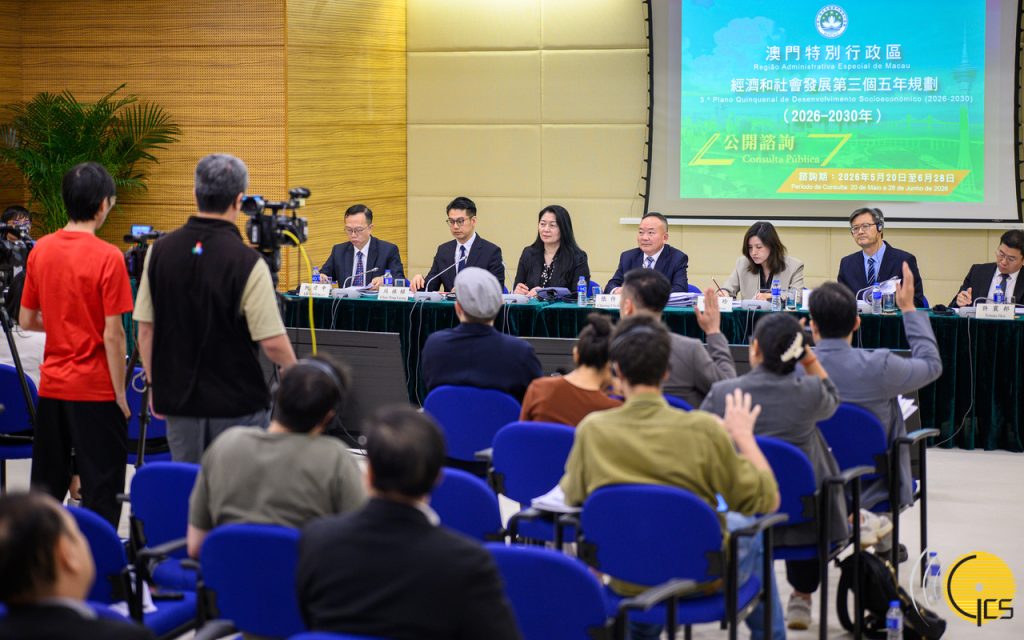
Policy Research and Regional Development Bureau Director Cheong Chok Man stressed that increasing the proportion of non-gaming industries does not mean “simply reducing the gaming sector.”
Speaking during a press briefing on Tuesday, Cheong said the gaming industry could continue to develop under a framework that is “lawful, orderly, regulated and healthy,” while the government would continue promoting appropriate economic diversification, fostering non-gaming industries and supporting the transformation of traditional sectors under Macau’s ‘1+4’ diversification strategy.
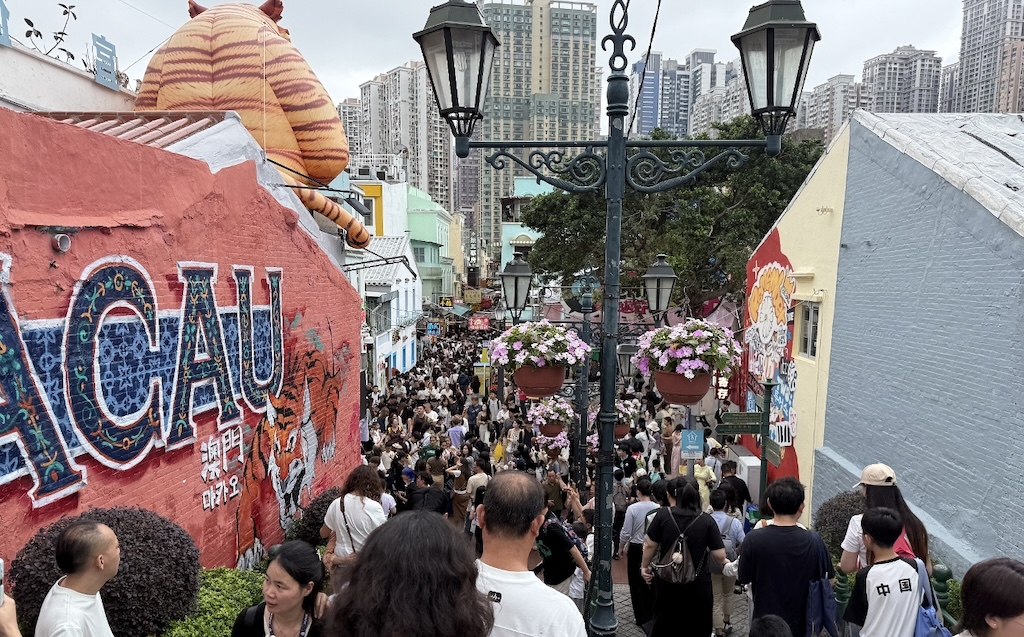
Diversification remains central policy priority
Despite the revised timeline, the consultation document makes clear that economic diversification remains at the core of the administration’s long-term strategy.
The plan states that Macau will continue to pursue ‘substantive new progress’ in moderate economic diversification, while further strengthening industries including traditional Chinese medicine and healthcare, finance, high technology, conventions and exhibitions, culture and sports.
Notably, the document avoids setting any direct target for reducing gaming’s share of GDP. Instead, authorities framed the policy objective around expanding the non-gaming economy.
Rather than positioning gaming as an industry to be reduced, the government continues to describe the sector as one that should develop ‘lawfully, orderly and healthily.’
At the same time, the plan places substantially greater emphasis on non-gaming industries, innovation and regional integration than on gaming expansion itself.
The blueprint repeatedly highlights Hengqin cooperation, healthcare, education, artificial intelligence, high technology and international tourism as future growth engines for the city.
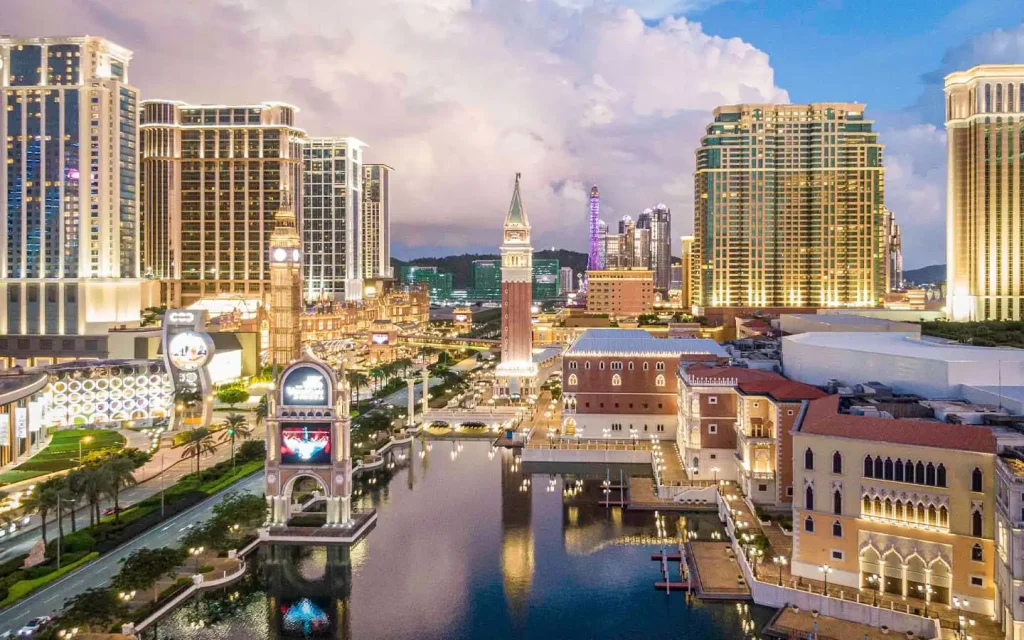
Gaming sector recovery complicates diversification math
The revised timetable also reflects the reality of Macau’s post-pandemic recovery.
Following the reopening of borders in 2023, gaming revenue rebounded more quickly than many policymakers had anticipated, restoring casinos as the dominant driver of economic activity and government finances.
That recovery has also made diversification more difficult mathematically. Even if non-gaming industries continue expanding, rapid growth in casino revenue increases the overall size of the gaming economy, making it harder for non-gaming sectors to raise their proportional share of GDP.
The consultation draft itself acknowledges that Macau still faces deep structural challenges, including ‘a single industrial structure’ and the continued dominance of the gaming sector.
The government further noted that issues including uneven regional economic development, structural unemployment and demographic pressures remain unresolved.
The revised target timeline therefore appears less a retreat from diversification than an acknowledgment that transforming Macau’s economic model will likely require a longer policy cycle.

International tourism and non-gaming investment
The five-year proposal also reinforces the role casino concessionaires are expected to play in the diversification process.
Under the section addressing the gaming industry, the government said it would continue monitoring concessionaires’ compliance with their contractual obligations, particularly regarding non-gaming investment commitments, international visitor development, local employment support and assistance for small and medium-sized enterprises.
Authorities added that concessionaires would be encouraged to invest in projects generating ‘economic and social benefits’ while helping enhance Macau’s international image.
The document also reinforces Macau’s push toward international tourism diversification, identifying Southeast Asia, Northeast Asia, Portuguese-speaking countries, Spanish-speaking markets, Europe, the United States and Muslim visitor markets as strategic targets for future expansion.
Between 2026 and 2030, the government expects international visitor arrivals to increase at an average annual rate of around 5 percent.
This internationalization push aligns closely with requirements introduced under Macau’s new 10-year gaming concessions, under which operators are obligated to help expand overseas tourism demand.
Crackdown on gaming-related crime remains a priority
The consultation draft also signals continued pressure on gaming-related crime as part of broader public security efforts.
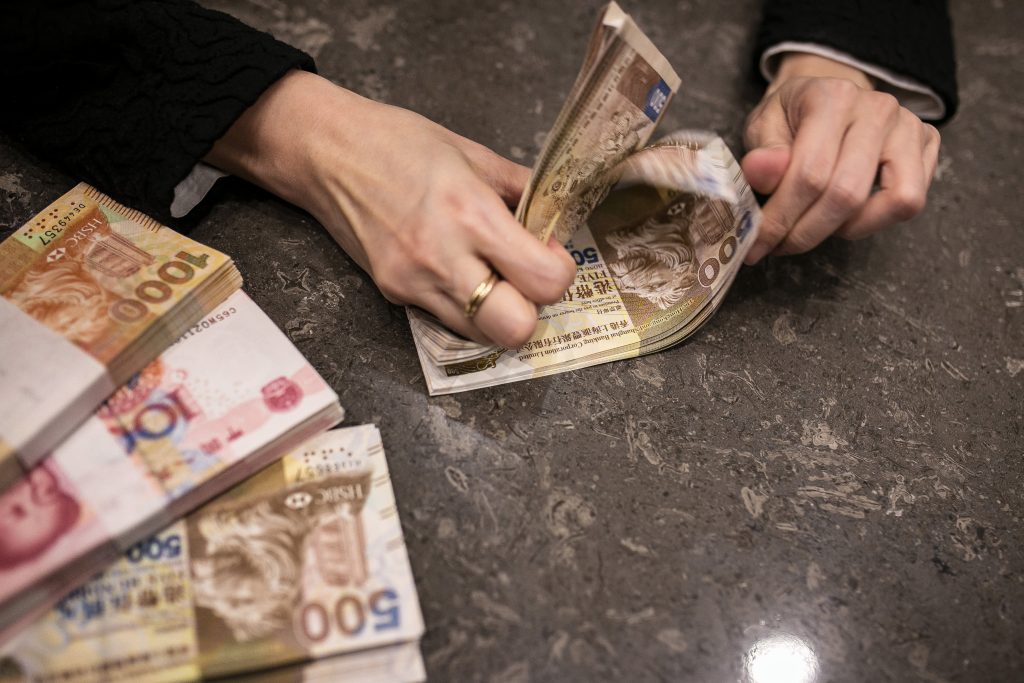
The document states that the government will continue to ‘fully combat gaming-related crimes,’ with a particular focus on illegal lending for gambling and unlawful currency exchange activities.
Authorities also pledged to deepen the use of technology in policing, including artificial intelligence applications within Macau’s citywide electronic surveillance system, while further strengthening cross-border law enforcement cooperation with mainland China and Hong Kong.
The emphasis reflects growing official concern over illegal money exchange operations and other gaming-linked underground activities that have drawn heightened enforcement attention in recent years.
Public consultation on the five-year plan will run from May 20th to June 28th.