



Chinese authorities have dismantled a sprawling criminal network in northern Myanmar run by the notorious Bai family, whose illicit empire spanned fake casinos, online fraud hubs, and drug trafficking, generating over RMB286 billion ($39.5 billion) in illegal profits while leaving a trail of death and exploitation.
According to CCTV, in a sweeping cross-border operation, Chinese and Myanmar law enforcement arrested 57,000 suspects linked to fraud and gambling crimes, dealing a major blow to Kokang’s “Four Major Crime Syndicates.”
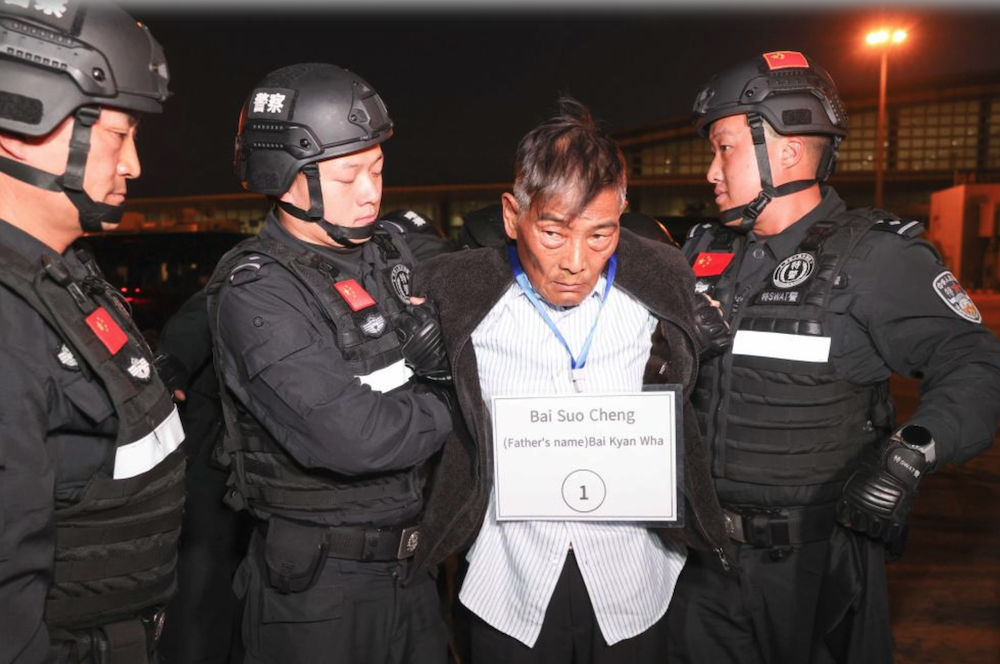
The Bai family, led by Bai Suocheng, operated 41 massive scam and gambling compounds, including the infamous Cangsheng Tech Park and Wangzhe Honglou (King’s Red Mansion), where victims were lured into investment scams, fake law enforcement schemes, and rigged online betting.
Brutal regime of fraud, gambling, and violence
For nearly a decade, the Bai family wielded political and military power in Kokang to build a crime-fueled enterprise, even forming the Kokang Entertainment Management Committee to legitimize their operations.
They charged “protection fees” from scam dens, while their private militia enforced brutal discipline—executing underperforming fraud workers and trafficking Chinese nationals into forced labor.
After a 2023 investigation led by China’s Ministry of Public Security, key figures—including Bai Suocheng, his son Bai Yingcang, and daughter Bai Yinglan—were captured and extradited. Chinese task forces uncovered victims’ remains and 11 tons of drugs in raids across Myanmar’s war-torn north.
Prosecutors revealed the syndicate’s operations caused considerable losses, with over 31,000 telecom fraud cases involving more than RMB106 billion ($14.6 billion) stolen from victims.
The report also claims that their illegal gambling operations moved an additional RMB180 billion ($24.8 billion) in illicit funds. The human cost was equally staggering, with six Chinese citizens killed and countless others subjected to torture and abuse in the scam compounds.
“The Bai family turned northern Myanmar into a lawless playground for transnational crime. This operation demonstrates our unwavering commitment to protecting Chinese citizens from overseas fraud networks.”
With 36 top suspects now in custody, including the family’s leadership, the case marks a decisive victory in China’s battle against cross-border cybercrime—while exposing the brutal reality of Southeast Asia’s underground scam industry.
A recently released report by the United Nations Office on Drugs and Crime (UNODC) had pointed out that transnational organized crime networks in Southeast Asia have aggressively diversified their operations, expanding beyond unregulated — and often illegal — online gambling into various financial and cybercrimes.