Wynn Resorts is poised to further balance its cash flow profile with the development of Wynn Al Marjan Island, according to Deutsche Bank.
In the latest investment report released after Wynn Resorts’ Investor Day, the brokerage notes that over the past few years, the company has witnessed a significant shift in its business mix, largely due to expansions and contractions across its key properties. These include notable growth at Wynn Las Vegas and the ramp-up at Encore Boston Harbor, alongside a modest contraction at Wynn Macau.
In 2019, Wynn’s business was heavily reliant on Macau, with 76 percent of its earnings before interest, taxes, depreciation, amortization, and restructuring or rent costs (EBITDAR) coming from the region. However, the evolving dynamics of the company, alongside consolidated EBITDAM projections for Wynn Al Marjan Island and 2026 consensus estimates, signal a more balanced future cash flow profile.
Deutsche Bank’s report highlighted a scenario where Wynn Al Marjan Island could contribute meaningfully to Wynn’s earnings. By factoring in “stabilized management and license fees, as well as the 40 percent share of adjusted property EBITDA” from Wynn Al Marjan Island, alongside 2026 EBITDAR forecasts, the analysis suggests that Wynn’s shares are trading with a free cash flow yield range of 14.4 percent to 16.1 percent.
Although this is an attractive range, the bank noted that the analysis included full consolidation of Wynn Macau, which may overstate the figures somewhat. Historically, Wynn’s shares have traded within a yield range of 6 to 10 percent.
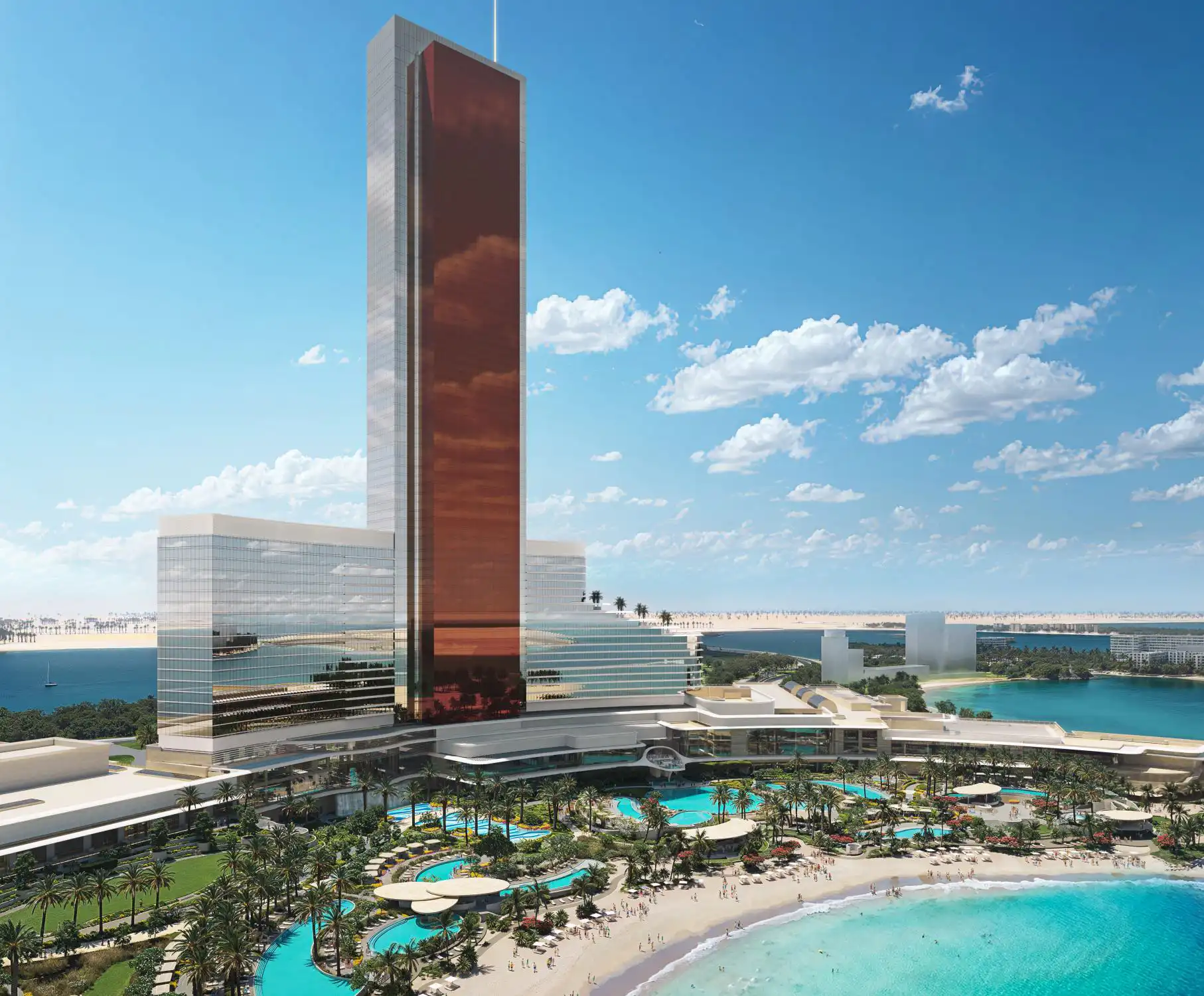
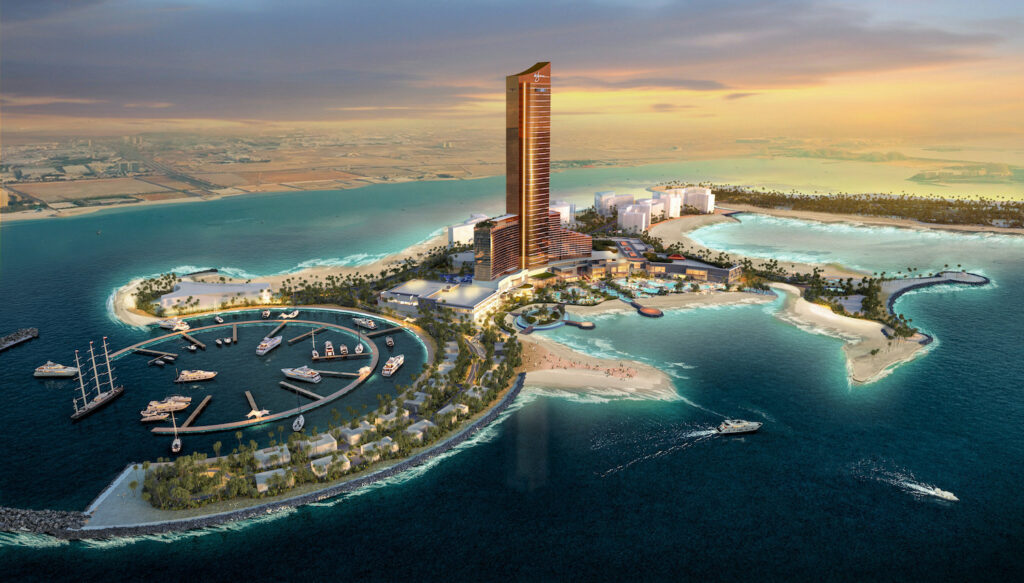
Wynn Al Marjan Island, Arrival at Hotel, project render. Source: Wynn Resorts
Projected growth in UAE
Wynn Resorts also projects significant growth in the UAE gaming market. The company anticipates the total gross gaming revenue (GGR) market size to be between $3 billion and $5 billion, assuming two additional operators eventually enter the market.
Wynn Al Marjan Island, slated to open in the first quarter of 2027, is expected to generate between $1.0 billion and $1.66 billion in GGR.
These estimates assume GGR will range from 0.6 percent to 1.0 percent of the UAE’s GDP, which, while discounted compared to Singapore (1.2 percent) and Australia (1.1 percent), would still represent a premium to the U.S. (0.4 percent).
Additionally, net revenue for Wynn Al Marjan Island is projected to be in the range of $1.375 billion to $1.875 billion, with expected margins of 36 percent to 43 percent, supported by favorable market conditions and lower tax rates compared to Macau.
Analysts Carlo Santarelli and Steven Pizzella indicate that one aspect Wynn has consistently excelled in is accurately forecasting the operating expense structure for greenfield developments. In the case of the UAE, the company expects operating expenses, excluding gaming taxes, to be between $2 million and $2.4 million per day.
This is comparable to Macau’s $2.5 million daily operating cost, but with the added benefit of the UAE’s significantly lower gaming tax rate. This lower tax burden could drive higher margins for Wynn Al Marjan Island, further enhancing profitability relative to Macau.
Wynn Al Marjan Island construction works as of 30/09/2024. Source: Wynn Resorts
Projections for Wynn Al Marjan Island
Despite the challenges that come with projecting revenue for new developments in untapped gaming markets, Deutsche Bank believes that the UAE market dynamics, including operational expenditure assumptions and tax rates, lend credibility to the property’s potential. The report notes that Wynn has set an EBITDA target between $500 million and $800 million for Wynn Al Marjan Island.
Wynn Resorts’ proven ability to outperform peers in terms of EBITDA per hotel room also supports this target. For example, Wynn Las Vegas has consistently exceeded expectations in terms of profitability. Based on current assumptions, Wynn anticipates that its Al Marjan Island property could generate between $324,000 and $519,000 in EBITDA per hotel room annually.
For comparison, Wynn Macau’s assets have generated approximately $407,000 per room over the last twelve months, despite facing more competition and a higher gaming tax rate. Meanwhile, Marina Bay Sands, operating in Singapore’s comparable market, has produced $1.05 million per hotel room over the same period.
Asia Pioneer Entertainment Holdings Limited (APE) has announced that Ms. Maria Garcia was appointed as APE’s first female Director since the company’s listing on the Hong Kong Stock Exchange in 2017, with effect from 30 September 2024.
Maria oversees the company’s growth and development in both the Macau and Southeast Asian markets. Before joining APE, Ms. Garcia spent over 17 years in public relations and event management, coordinating significant events in Macau, Hong Kong, and China for private, diplomatic, and governmental entities.
Maria Garcia joined APE in 2006 as Sales Director of the Corporate Sales and Marketing Department, serving for six years before leaving to pursue various roles within the gaming sector and founding her own business. In 2020, she returned to APE as a Business Consultant and resumed her role as Sales Director for Macau and Southeast Asia in December 2022, where she continues to serve to this day.
With more than 36 years of work experience, nearly 20 of which have been in the gaming industry, Ms. Garcia’s achievements and professionalism are both significant and commendable.
Mr. Herman Ng, Chief Executive Officer and Executive Director of APE said, “We are delighted to welcome Maria to the board. I have had the pleasure of working with her for over a decade. She is an industry expert with extensive knowledge, experience, and a wide network of connections. I am confident she will excel in this role.”
Maria Garcia, Board of Directors, Asia Pioneer Entertainment
Speaking about her new position, Maria Garcia expressed her excitement, stating, “It is a true honor to join APE’s board as its first female director. The past few years have been challenging for the company, particularly due to the impact of the global pandemic. I am proud of our resilience and the progress we’ve made together during these times. In my new role, I am committed to fully utilizing my strengths to tackle future opportunities and challenges alongside APE as we work towards a bright and successful future.”
With her extensive experience and leadership, Ms. Garcia’s appointment underscores APE’s commitment to diversity and excellence in the gaming industry, paving the way for future growth and innovation.
Despite a softening economy, the online travel agency giant Trip.com Group reported that the daily order volume for both inbound and outbound travel during the October Golden Week exceeded that of 2019, reaching an all-time high.
This information was disclosed in the recently released “2024 National Day Travel Consumption Report,” authored by Trip.com Group.
The company notes that this year’s October Golden Week, combined with the recovery of the tourism market and the restoration of flight and hotel availability, significantly boosted travelers’ willingness to travel, driving sustained growth in tourism consumption.
According to Trip.com data, the National Day holiday offers better value for tourism compared to other holidays, such as Labor Day and the Dragon Boat Festival. In terms of outbound travel, the top destinations included Japan, Thailand, South Korea, Malaysia, Singapore, Vietnam, Indonesia, the United Kingdom, the United States, and Australia.
Additionally, the travel platform notes that Brazil, the Philippines, Mexico, the UK, and the UAE emerged as the fastest-growing outbound destinations. These locations attracted a significant number of Chinese tourists, becoming a new driving force for the global tourism industry.
The report also highlighted that international flight volumes from China to destinations like Singapore and Malaysia have fully recovered and surpassed levels seen in the same period of 2019. With the increase in supply, prices for short-haul outbound routes have returned to rational levels.
Data indicate that during the Golden Week period, flight prices for short-haul routes to Thailand, Singapore, and Malaysia are now comparable to those in 2019, making it easier for families to travel.
The proportion of family travel during this holiday increased from 34 percent to 37 percent, with the average spending on family trips exceeding twice that of overall spending, further driving tourism consumption in these destinations.
In terms of booking trends, Trip.com data revealed that the average advance booking time for travelers during the National Day holiday decreased from 6.8 days in 2023 to 6 days in 2024. Nearly 30 percent of travelers chose to depart on the same day or just one day in advance, an increase of 6 percentage points compared to the previous year.
This trend suggests that staggered travel is gradually becoming the new norm, with many travelers opting to spread their long holiday travel needs throughout the year to achieve a better cost-performance ratio and a more comfortable travel experience.
According to China’s National Immigration Administration, border inspection agencies handled a total of 13.1 million inbound and outbound travelers, averaging 1.87 million per day, a 25.8 percent increase compared to last year. The peak day for entry and exit occurred on October 5, with 2.035 million crossings.
Among these, 7.589 million were mainland residents (up 33.2 percent from last year), 4.494 million were residents from Hong Kong, Macau, and Taiwan (up 13.2 percent), and 1.014 million were foreigners (up 37.2 percent). A total of 574,000 transport vehicles were checked, representing a 32.6 percent increase from last year.
SOFTSWISS, a leading tech company with over 15 years of expertise in iGaming, joins the global Pink October initiative to attract attention to preventing breast cancer.
This year’s Pink October campaign at SOFTSWISS is themed “A Minute Today, a Future Ahead” and emphasizes the importance of early detection and preventative care. Breast cancer is the most common cancer affecting women, and early diagnosis is key in the fight against the disease. When it is noticed early, the 5-year relative survival rate is 99%.
Early detection involves doing monthly breast self-exams and planning regular clinical breast exams and mammograms. Half of the 2,000 SOFTSWISS employees are women, and the company will refund each of them for ultrasounds and mammograms in October and November.
Pink October at SOFTSWISS offers a wide range of activities throughout the month. In addition to reimbursing for medical examinations, an online webinar on mental health will provide valuable insights for those who face the disease. To support the international charity movement “Butterfly Support Mission”, women from SOFTSWISS will take part in a themed race.
The company’s employees also personally support the initiative. To further raise awareness, prominent female influencers from the SOFTSWISS community share information about the campaign across social media, amplifying the message of self-care and vigilance.
“Health is a crucial value beyond everything. At SOFTSWISS, we aim to help and support our employees’ well-being and health every day. By promoting the Pink October initiative, we want to stress the importance of well-timed self-care and make this issue visible both within the iGaming industry and beyond,” shares Chief Marketing Officer at SOFTSWISS, Valentina Bagniya.
Notably, the iGaming industry recognised SOFTSWISS’ strong dedication to ensuring the best working conditions for its employees. A few weeks ago, SOFTSWISS received the esteemed accolade “Employer of the Year” at the SBC Awards.
Supporting the Pink October initiative for the second year in a row, SOFTSWISS continues to lead by example, emphasising the importance of preventive health measures and community support. Through this initiative, the company hopes to inspire its employees and society to take action today for a healthier tomorrow.
Private sector hotel developers have committed to 158 new accommodation projects across the Philippines, adding a total of 40,084 rooms, according to the latest market report by Leechiu Property Consultants (LPC)
LPC projects that the Philippines will exceed its foreign arrival numbers for 2023, but it is still expected to fall short of the ambitious target of 7.7 million arrivals. LPC forecasts a complete recovery in foreign arrivals by 2026.
This expansion is anticipated to generate approximately PHP250 billion ($4.3 billion) in investments and create around 57,000 jobs in the hotel industry. The report also highlights the government’s intensified focus on enhancing airport infrastructure, with major hotels and tourism destination airports currently being bid out.
In terms of regional developments, Luzon accounts for 50 percent of the national pipeline, with notable projects in Clark, which will add 2,098 keys, and over 8,000 keys in the National Capital Region (NCR).
The Visayas region represents 42 percent of new projects, largely driven by leisure tourism in destinations such as Boracay, Mactan Island, and Panglao Island. Mindanao holds 8 percent of the pipeline, with significant contributions from Davao City, Cagayan de Oro City, and Siargao.
In Metro Manila, Parañaque City is set to lead with an influx of new hotel keys. Upcoming openings include Banyan Tree Manila Bay, Hotel Okura Manila Bay, and the city’s fourth integrated casino complex, Westside City Resorts.
Westside City prject
In Makati, Ayala Land Hotels and Resorts Corp is leading the majority of new developments, while Ascott will manage the remaining inventory. Quezon City is expected to see 70 percent of its pipeline keys supplied by local brands, including Fili Hotel – Bridgetown and Hotel 101 Libis.
The top 10 hotel developers will account for 54 percent of the national pipeline keys, with 55 percent of these projects utilizing alternative ownership models, such as condotels, to enhance cash flow during development.
Developers are strategically targeting prime locations, particularly resort and casino destinations, to capitalize on robust tourism demand. The pipeline is focusing on upper midscale and upper upscale hotels, catering to both premium leisure and business travelers.
Good morning. The situation is evolving out there. The United Nations Office on Drugs and Crime warns that Southeast Asia is increasingly threatened by cybercrime and illegal online gambling, with losses estimated to reach up to $37 billion in 2023. Organized crime groups are leveraging these platforms for illicit activities. Meanwhile, in the UAE, Wynn Resorts increased the UAE casino project budget to $5.1 billion, aiming for high-net-worth clientele with a new gaming license secured.
What you need to know
The UN reports alarming illegal online gambling and cyber fraud growth in Southeast Asia, causing $37 billion in financial losses.
Wynn Resorts boosts its UAE project budget to $5.1 billion, targeting affluent clients following the acquisition of a gaming license.
Southeast Asia is grappling with an alarming surge in illegal online gambling and cyber fraud, according to a recent report from the United Nations Office on Drugs and Crime (UNODC). The report estimates that financial losses linked to scams in the region could reach between $18 billion and $37 billion in 2023. Organized crime groups are increasingly exploiting unregulated online casinos and high-risk virtual asset service providers, creating a complex web of money laundering and cyber-enabled fraud that challenges law enforcement efforts across the region.
Altenar, a leading sportsbook provider is bringing its global expertise to Asia, looking to expand its operations. Since 2011, Altenar has powered hundreds of online sports betting sites worldwide and is a major B2B provider in Europe and Latin America licensed markets.
For global betting company 1xBet, Asia is a key market for several reasons. This is why 1xBet pays special attention to the Asian market and actively promotes its sports betting platform and the most popular gambling games on the continent.
Thailand’s Tourism Minister Sorawong Thienthong is seeking the backing of business leaders to help move forward the country’s plans for a multi-faceted entertainment complex.
He insists it is not just a casino but a comprehensive development aimed at boosting tourism and attracting international investments.
Speaking at the “ASEAN Economic Outlook 2025” event in honor of the 37th anniversary of Krungthep Turakij newspaper, Sorawong, who also serves as secretary general of the Pheu Thai Party, emphasized that this initiative could play a major role in elevating Thailand’s economic standing. With a vision of Thailand re-emerging as “the fifth tiger of Asia,” Sorawong sees the entertainment complex as a key driver of this transformation.
He made a point to dispel the notion that the complex would focus solely on gambling, saying, “To think of this project as just a casino is missing the bigger picture.” Instead, the complex is envisioned as a sprawling hub featuring amusement parks, restaurants, bars, game centers, and department stores—all aimed at diversifying the nation’s tourism appeal.
Sorawong acknowledged that political discussions around the project have been fraught with opposition, and called on the private sector to step in, voicing support where political discourse has faltered. “I ask the business community to speak up. Their involvement is crucial to bringing this vision to life,” he urged.
The project has already undergone public hearings led by the Fiscal Policy Office, with the next steps involving a formal proposal to the Cabinet for review. Sorawong sees this as a turning point for Thailand’s tourism industry, suggesting the entertainment complex could become the kind of landmark destination the country currently lacks.
He also hinted at broader plans to bolster Thailand’s global profile, noting that 2025 will be a “grand year” for tourism and sports, as the nation gears up to host high-profile events like the 33rd Southeast Asian Games and the Thailand Grand Prix in Buriram.
While the minister is optimistic about the project’s potential, he reiterated that success will require strong backing from Thailand’s private sector, saying, “These developments will not materialize without the business community’s full support.”
With its ambitious plans, Thailand is looking to reposition itself among Asia’s economic powerhouses, hoping to recapture the energy that once earned it a place alongside the “Four Asian Tigers” of Singapore, Hong Kong, South Korea, and Taiwan.
The Presidential Anti-Organized Crime Commission (PAOCC) in the Philippines has raised alarms about potential political influence from Philippine Offshore Gaming Operators (POGOs) in the 2025 midterm elections.
PAOCC spokesperson Winston Casio expressed concerns that despite an official ban, POGOs remain active and may financially back candidates linked to Chinese criminal syndicates. The warning comes as dismissed Bamban Mayor Alice Guo, allegedly tied to POGO-related activities, was keen to seek her candidacy, further fueling fears of political manipulation by such operators.
However, yesterday, Alice Guo announced that she would not seek reelection as mayor of Bamban in 2025 in an effort to clear her name amid the ongoing cases filed against her.
As election season heats up, the PAOCC is urging vigilance, noting the ongoing risk of “POGO politics.” The influence of these gaming operations, particularly from Chinese criminal organizations, remains a serious concern despite government crackdowns. Casio pointed out that POGOs continue to operate, with recent raids revealing new hires, indicating their persistence despite official bans.
This issue highlights broader concerns regarding transparency and the integrity of the upcoming elections. Guo, linked to POGOs, has over P1 billion in assets frozen by the Court of Appeals and is under investigation by the Anti-Money Laundering Council (AMLC). According to Representative Jil Bongalon, Guo’s financial dealings have drawn scrutiny due to large withdrawals and property disposals ahead of the freeze order, suggesting potential preemptive actions to secure funds.
The PAOCC’s warning underscores how deeply POGOs are intertwined with both criminal syndicates and the local political landscape. As the 2025 elections approach, it remains to be seen how effective the government’s efforts will be in mitigating POGO influence, or if these operators will continue to evade accountability by embedding themselves in Philippine politics. This situation sheds light on the pervasive corruption that allows these organizations to flourish despite government interventions.
Las Vegas-based gaming operator Wynn Resorts has increased the budget for its casino project in the UAE – Wynn Al Marjan Island to $5.1 billion.
The new budget is $1.2 billion higher than the previous estimate, as outlined in a presentation to investors and analysts on Tuesday.
The budget includes land, fees, and capitalized interest – around $4.55 billion would come from direct construction costs – and would be largely funded by $2.4 billion of debt, with Wynn adding that debt raising is already oversubscribed amid “strong demand from local and international investors.”
Wynn Al Marjan Island, scheduled to open in 2027, represents a significant financial and operational undertaking for the company. Located in Ras Al Khaimah, the fourth largest of the UAE’s seven emirates, the project will span most of Marjan Island’s third section.
Wynn Al Marjan Island construction works*Wynn Al Marjan Island construction works**as of 30 September 2024. Source: Wynn Resorts
Last Friday, Wynn Resorts made a key announcement confirming that it had secured the UAE’s first commercial gaming license, clearing the way for legal gaming activities at the resort.
The update was shared during the company’s Analyst & Investor Update Meeting, where a 99-slide presentation outlined the latest development plans.
Wynn Al Marjan Island is located about 50 minutes from Dubai International Airport, offering convenient access and placing the resort within an eight-hour flight for a large portion of the global population.
Hotel arrival at Wynn Al Marjan IslandView from the pool at Wynn Al Marjan IslandWynn Al Marjan Island TowerSource: Wynn Resorts
The resort will feature 1,542 rooms, with the gaming area occupying nearly 4 percent of the total space.
Wynn Resorts is targeting high-net-worth customers for this project. According to the company’s presentation, 9.7 million high-net-worth individuals live in the UAE, accounting for nearly 20 percent of the world’s total millionaires. This group is seen as a key customer base for the resort.
Wynn expects a significant portion of its gross gaming revenues to come from international VIP customers, projecting that 37 percent of its revenue will come from “international VVIPs,” a category defined as ultra-high-net-worth individuals.
Another 29 percent of revenues are expected from other international travelers, while 34 percent will come from the domestic market. The nine million non-Emiratis living in the UAE represent an important segment that Wynn believes could benefit from the new gaming offering.
Although federal gaming laws have yet to be finalized in the UAE, current regulations prohibit the use of national symbols and traditional Emirati dress in gaming advertisements, suggesting that marketing efforts will likely focus on expatriates and foreign visitors.
Rendering of Wynn Al Marjan Island – aerial viewRendering of Wynn Al Marjan Island – Interior viewRendering of Wynn Al Marjan – view from the beach
Core markets
Wynn Resorts sees its core markets as Europe, India, the Gulf Cooperation Council (GCC) countries, and the UAE itself. Wynn Resorts CEO Craig Billings previously has noted that India, in particular, represents a critical market due to its large population and considerable wealth. Indian travelers, along with those from Europe and the GCC, are expected to be key sources of business for Wynn Al Marjan Island.
The company also expects to maintain a monopoly on gaming in Ras Al Khaimah for the foreseeable future. According to Wynn’s projections, only one casino license will be granted per emirate, which would give them exclusive control of the gaming market in RAK for several years.
Over time, the landscape may evolve into a duopoly or oligopoly, with a limited number of competitors entering the UAE market, potentially in Dubai or Abu Dhabi.
Wynn Resorts assumes the UAE gaming market will be worth approximately $3 to $5 billion. Meanwhile, the operator predicts it will hold a 33 percent market share in gross gaming revenue across the country, even as other integrated resorts open.
Southeast Asia is facing an alarming rise in cyber-enabled fraud and organized crime, with casinos and online gambling platforms playing a central role, a recent United Nations report says.
A United Nations Office on Drugs and Crime (UNODC) report on Transnational Organized Crime reveals how underground casinos, junkets, and high-risk virtual asset service providers (VASPs) are driving the convergence of cybercrime and money laundering.
Financial losses attributed to scams targeting victims in East and Southeast Asia are staggering, with UNODC estimating losses between $18 billion and $37 billion in 2023 alone. A significant portion of these losses is linked to organized crime activities in the region.
Criminal organizations were said to be increasingly using these venues for money laundering and other illicit activities, exacerbating the challenges for law enforcement across the region.
At the same time, illegal online casinos remain key channels for transnational crime groups to integrate illicit funds into the formal economy.
These platforms have been linked to money laundering, human trafficking, and cyber fraud, generating vast profits for organized crime syndicates in the region. Sophisticated underground banking networks and cryptocurrencies have further complicated enforcement efforts.
As cyber-enabled fraud continues to evolve, the proliferation of deepfake technology and AI-driven scams is on the rise, enhancing the sophistication of criminal operations. The report warns of the growing threats posed by these developments, which are shifting criminal activity into more hidden, tech-driven spaces.
According to UNODC, this has become particularly prevalent in border regions and Special Economic Zones (SEZs) like the Golden Triangle and parts of Myanmar, Cambodia, and Lao PDR.
The Philippines and Cambodia, previously major hubs for regulated offshore gambling operations, have seen a rapid spillover into illegal operations. Despite an official ban on online gambling, Cambodia continues to struggle with unregulated platforms, while illegal online gambling thrives in regions controlled by criminal networks.
Originally driven by junket operators in Macau, the industry’s expansion into unregulated online platforms has created lucrative opportunities for transnational criminal organizations. These groups have exploited loopholes in jurisdictions like Cambodia and the Philippines, where gambling operations flourished until government crackdowns in the late 2010s.
Despite efforts by Southeast Asian governments to control the illicit industry, organized crime syndicates have managed to adapt. These groups have utilized the infrastructure of physical casinos, particularly in Cambodia’s Sihanoukville, to house online gambling operations that continue to thrive underground.
Scam losses mounting
According to to the UNODC report, the rise of cyber-enabled fraud and related criminal enterprises has generated billions in losses for victims across East and Southeast Asia.
“Organized crime groups are converging and exploiting vulnerabilities, and the evolving situation is rapidly outpacing governments’ capacity to contain it,” stated Masood Karimipour, UNODC Regional Representative for Southeast Asia and the Pacific.
Masood Karimipour, UNODC Regional Representative for Southeast Asia and the Pacific
Karimipour emphasized the scale of the challenge, noting that “leveraging technological advances, criminal groups are producing larger-scale and harder-to-detect fraud, money laundering, underground banking, and online scams.”
According to the UN representative, this has resulted in the emergence of “a criminal service economy” in the region, which is now a critical testing ground for transnational criminal networks looking to expand their influence.
The report details recent cases illustrating how underregulated online gambling platforms and high-risk virtual asset service providers (VASPs) are being exploited by major organized crime groups.
These platforms allow criminals to move, launder, and integrate billions of dollars in illicit proceeds into the financial system with minimal accountability. The findings indicate that illegal online casino operators are diversifying their activities to include cyber-enabled fraud and crypto-based money laundering services.
Extensive evidence has uncovered organized crime networks operating within casino compounds, special economic zones, and border areas to conceal their illicit activities. “It is more critical than ever for governments to recognize the severity, scale, and reach of this truly global threat,” Karimipour added.
The report also highlights the alarming issue of human trafficking, where organized crime groups forcibly recruit thousands of workers to carry out scams. These victims are often lured into illegal scam compounds through fake job advertisements, only to find themselves trapped in exploitative situations.
Additionally, the report notes a disturbing rise in AI-driven crimes involving deepfakes, with mentions of deepfake-related content targeting criminal groups in Southeast Asia increasing by over 600 percent in the first half of 2024 across monitored online platforms.
Authorities have struggled to contain the spread of illegal online casinos. In Indonesia, over 3 million citizens are believed to be engaged in illegal gambling, prompting the government to form a task force aimed at eradicating the practice.
Similarly, the Philippines, once a hub for legalized offshore gambling under its Philippine Offshore Gaming Operator (POGO) system, saw the industry collapse under widespread criminality.
The POGO industry, which was designed to regulate online gambling targeting foreign markets, has been rife with corruption, leading to a nationwide ban. Nevertheless, illegal POGOs continue to flourish.
‘This ultimately led to President Marcos of the Philippines declaring a nationwide ban on POGOs. Despite the ban, authorities have expressed concerns over how entrenched illegal offshore gaming operators have become, with hundreds of POGOs continuing to operate despite previously having their licenses canceled’, the report adds.
Proximity to China turned the Mekong River region into an online gambling and money laundering hub
UN recommendations
To combat the evolving threats of organized crime, a set of recommendations has been proposed by the UNODC to enhance the awareness, understanding, and capacity of governments, oversight authorities, and law enforcement in Southeast Asia, particularly in the Mekong region.
These recommendations stem from ongoing dialogues with regional governments and align with the ASEAN + China Roadmap to Address Transnational Organized Crime and Trafficking in Persons.
Myanmar hands suspected heads of cyber scam criminal group to Chinese authorities
First, UNODC considered it essential to conduct thorough analyses of organized crime activities related to online gambling, cyber-enabled fraud, and the integration of AI technologies, including their infiltration into legitimate business sectors.
Establishing a platform for intelligence sharing and threat monitoring focused on these crimes is crucial. Collaborative research should be undertaken to better understand illicit financial flows within the region, with a focus on facilitators and offshore jurisdictions.
Additionally, regular monitoring of organized crime activities in casinos and high-risk areas, such as Special Economic Zones (SEZs), is necessary. Public awareness campaigns should also be promoted to highlight the connections between underregulated industries and organized crime.
On the policy and legislative front, national action plans and a regional strategy should be developed to address organized crime, money laundering, and related issues.
It is important to revise and strengthen legislation concerning money laundering, virtual assets, and casino management. Mechanisms should be established to review investor profiles in casinos and online platforms to identify beneficial ownership. Furthermore, adapting mutual legal assistance frameworks will facilitate the freezing and seizure of assets, the report adds.
In terms of enforcement and regulatory responses, creating a regional forum for sharing information about the use of casinos and virtual assets in money laundering is essential. Authorities must identify and prevent the operation of unlicensed casinos and high-risk virtual asset service providers.
Efforts should be made to increase the identification of trafficking victims and strengthen cross-border investigations, while enhancing capabilities for recovering and analyzing digital forensic evidence is also necessary, along with providing specialized training for authorities on online gambling operations and advanced money laundering methods.