

Philippine President Ferdinand Marcos Jr.’s decision not to take a stance on online gambling during his State of the Nation Address (SONA) represents a deliberate effort to avoid rushed policymaking on a complex and sensitive issue, according to gaming law expert Tonet Quiogue.

Amid mounting calls from legislators and various sectors for a total ban on online gambling, the President’s silence signaled a refusal to be rushed into a decision on a complex issue that requires more data, deeper study, and holistic understanding, said Quiogue, CEO and founder of Arden Consult.
‘This was not a missed opportunity—it was a conscious choice to avoid a knee-jerk policy that could create more problems than it solves,’ Quiogue wrote in her analysis following the President’s July 28th SONA. ‘By declining to take a populist or overly simplistic stance, the President has left the door open for a more thoughtful, evidence-based approach to take shape.’
The gaming expert’s remarks come as the Philippines faces growing pressure to address online gambling-related concerns, including rising addiction rates, financial distress in households, and scams linked to criminal networks. Marcos was expected to clarify his position on the issue on Monday during the SONA. However, Quiogue contends that the President’s measured approach reflects sound economic reasoning and policy prudence.
Economic considerations drive cautious approach
The President’s stance reflects a ‘sober assessment’ of the country’s economic realities, according to Quiogue’s analysis, which she shared on her LinkedIn page. Licensed online gaming contributed more than PHP112 billion ($1.96 billion) to government coffers in 2024, including PHP16.6 billion ($290 million) allocated to universal healthcare through PhilHealth (one of the major focuses of his this year’s SONA), and PHP46 billion ($805 million) directed to the national treasury.
In the first quarter of 2025 alone, e-gaming and e-bingo revenues surged—outpacing even physical casinos—comprising nearly half of all gaming revenues. With the country under fiscal strain, a blanket ban could trigger major budgetary shortfalls and result in the loss of an estimated 50,000 jobs. Moreover, millions of Filipino players would likely migrate to illegal platforms.
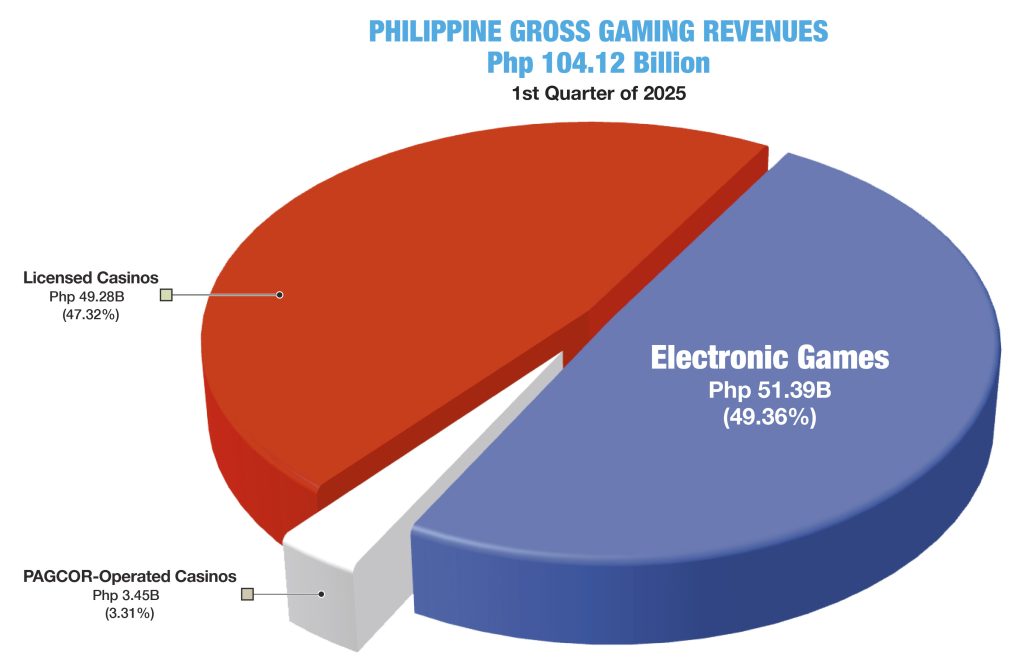
‘Regulating instead of banning is thus both a financial necessity and a harm-reduction strategy,’ Quiogue noted, emphasizing that prohibition often drives activity underground, making it harder to monitor and control.

Recent regulatory developments show momentum
Despite the lack of a presidential directive, Quiogue highlighted several recent developments that underscore the government’s commitment to strengthening oversight.
On July 16th, the Philippine Amusement and Gaming Corporation (PAGCOR) signed a memorandum of understanding with the Ad Standards Council (ASC) to pre-screen all gambling advertisements. Under this agreement, gambling ads now require ASC approval before release, similar to ads for alcohol or medicine.
The Cybercrime Investigation and Coordinating Center has also stepped up enforcement against unlicensed operators, warning local influencers and content creators to stop promoting illegal gambling platforms. The agency has announced plans to issue legal demand letters and pursue criminal charges against violators.
Meanwhile, the Bangko Sentral ng Pilipinas (BSP), the nation’s central bank, has circulated draft regulations that would require e-wallets and payment service providers to implement stricter KYC procedures and enhanced transaction controls for online betting activities.

Industry self-regulation emerges
In what could be a turning point, several PAGCOR-licensed online gaming operators have begun forming a new association aimed at self-regulation and closer collaboration with government authorities. The group has expressed willingness to enforce stricter age verification, set betting limits for at-risk players, and adopt tougher anti-money laundering protocols.
‘This proactive stance—essentially “we will police ourselves more rigorously”—is exactly what a skeptical public needs to see,’ Quiogue observed.

A balanced path forward
Quiogue described the President’s decision not to take an impulsive position on online gambling as ‘a breakthrough for Philippine policy—a triumph of level-headed analysis over populist impulse.’ However, she warned that long-term success depends on consistent effort and coordination among all stakeholders.
“Regulate, not ban, is not a one-time decision, but a continuous commitment. It requires diligence from authorities, integrity from industry, and awareness from the public.”
Quiogue also noted that Marcos Jr.’s refusal to impose a total ban demonstrates ‘an understanding that governing is about channeling, not simply suppressing, human behaviors.’
In the future, she stressed that the real challenge lies in delivering effective regulation that mitigates risks while retaining benefits. ‘If we do it right, the Philippines can become a model of how a developing nation tames the perils of online gambling through smart laws and vigilant enforcement,’ she concluded.
“This is both a win and a warning […] The stakes, quite literally, are the futures of Filipino families and the integrity of our rule of law. In this game, we cannot afford to lose—so we must play to win, with eyes wide open and all hands on deck.”