



Angel Group‘s next-generation smart gaming tables are set to transform the baccarat experience by combining artificial intelligence with pose recognition technology, which the company’s Chief Technology Officer says will become the key differentiator among smart table providers as the industry moves toward broader adoption.
Angel presented its new-generation smart table at G2E Asia, held in Macau from May 12th to 15th. Speaking with AGB on the sidelines of the event, Aaron Raj, Chief Technology Officer of Angel Australasia Pty Ltd, said that while smart tables are expected to eventually become standard across the gaming floor, the quality of data generated will define which solutions stand out.

“It’s a combination of AI and pose recognition that is going to make a big differential, [a] duplicating factor between all the smart table operators,” Raj said. “Everyone will have smart tables at some point in time. But how they’re going to differentiate between one smart table and another is based on the quality of the data, and the quality of data is defined by the kind of solution that you deploy.”
Angel Group is a Japanese manufacturer specializing in playing cards, casino equipment, and smart table technology. It is currently one of only two smart table providers whose products have been adopted by Macau concessionaires, alongside Walker Digital Table Systems. The Japanese manufacturer has already deployed thousands of smart tables across Macau. Its pose recognition technology recently obtained regulatory approval in Singapore, while the approval process in Macau is currently underway.
A new approach: tracking players, not chips
According to Raj, the fundamental difference between Angel’s next-generation solution and conventional smart tables lies in the methodology. Existing systems primarily rely on Radio-Frequency Identification (RFID) chips to track betting activity, but Raj noted that chip-based data can become unreliable.
“Chip has an ID, and it has an owner, and it gets overwritten multiple times, millions of times within a gaming day. And you don’t even know whether it’s right or not,” he explained. “If the chip is owned by someone else, the data is again overwritten with the ownership information, so the data is spoiled.”
To address this, Angel’s solution combines AI with pose recognition, which identifies players directly through their body and movement patterns rather than relying solely on chip data. The system can uniquely identify each player’s bets across the felt, even when multiple players place wagers on the same stack. Raj clarified that pose recognition encompasses broader body movement tracking, with facial features forming only one component of the technology. In Macau, facial recognition remains restricted under current regulations.
The CTO also highlighted the flexibility of the AI-based architecture, citing Angel‘s response to the introduction of the “Monkey no Monkey” side bet in Macau. The company was able to roll out a solution supporting the new side bet within a couple of weeks, a capability he attributed directly to the AI foundation of the baccarat platform. The same flexibility extends to other game types, with Angel’s blackjack solution now described as “shoe-agnostic,” meaning it can work with any card shoe and accommodate multiple blackjack variants without hardware changes.
Real-time data dashboard and industry growth potential
A key feature of the next-generation system is the deployment of large dashboards in casino back offices, allowing operators to monitor real-time data across the entire gaming floor with greater clarity. The dashboards consolidate information on turnover, dealer performance, player ratings, float inventory, and compliance-related metrics, giving operators a comprehensive view of floor activity at any given moment.
The push toward smarter gaming tables comes amid growing recognition of their potential impact on industry economics. In a research note released in early April 2024, Citigroup analysts argued that smart gaming tables could deliver meaningful organic growth in Macau’s gross gaming revenue (GGR) without requiring higher visitation.
According to their estimates at the time, every five seconds saved per baccarat hand could translate into approximately 5.9 percent of organic GGR growth, as faster game speed allows more rounds to be dealt per hour. Since then, smart table adoption has accelerated rapidly, with almost all baccarat tables on Macau’s gaming floors now equipped with the technology across the city’s six concessionaires.
No disruption to dealer operations
The introduction of smart tables in Macau has not been without controversy. Some Macau dealers have raised concerns through local lawmakers, arguing that smart tables have increased their workload rather than simplified their tasks.
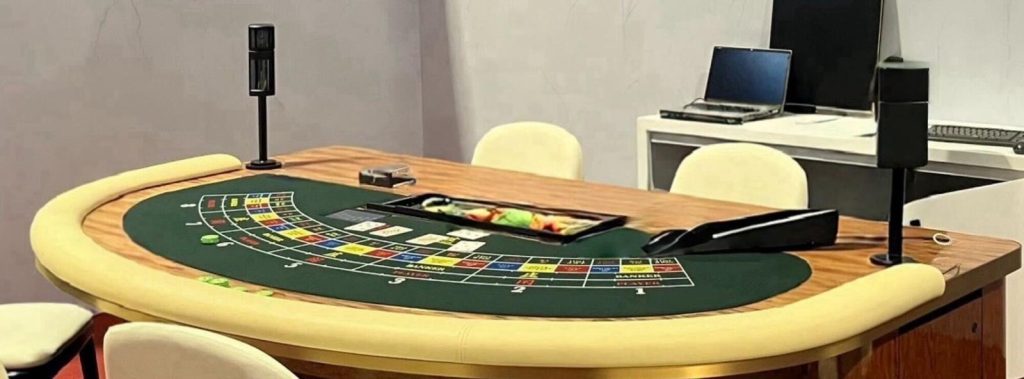
A central feature of Angel’s approach, according to Raj, is that the technology integrates into existing tables without altering established dealer procedures. Dealers continue to operate as they would on a traditional table, with the AI working in the background to monitor compliance with game rules, payouts, and bet collection.
“The traditional table, we are fitting in our equipment, and it becomes smart. So no dealer or supervisor can complain because that’s what they have been dealing [with] for the last 20, 30, 40 years,” Raj said. The system only alerts dealers or supervisors when a deviation occurs, such as an incorrect payout.
Raj added that the focus is not solely on speed but on the player experience and the quality of backend data, which supports anti-money laundering (AML) monitoring, compliance, and dealer performance evaluation. “With AI, we want to cover the entire floor, and we are already doing it, and we want to see it in all the game types,” he said.