
A prominent gaming lawyer has strongly criticized proposals for additional taxes on the Philippines’ online gambling sector, arguing that licensed operators already face one of the world’s heaviest tax burdens and that further increases could drive the industry underground.

Tonet Quiogue, CEO and Founder of Arden Consult and a top gaming law expert in the country, released a comprehensive analysis on July 13th challenging recent statements from high-ranking government officials who have compared online gambling to sin products like cigarettes and suggested the industry is undertaxed.
“The reality is that licensed online gaming companies already pay some of the highest taxes in the world,” Quiogue stated in her brief titled “No New ‘Online Gaming Tax’ Needed: Philippine Online Gaming Already Pays Substantial Taxes and Fees.”
The intervention comes as the Philippines grapples with a complex situation surrounding online gambling, with a strong push from various politicians and public figures for stricter controls, and in some cases, outright bans. The debate has intensified following recent statements from key economic officials supporting new taxation measures.
Current tax burden already substantial
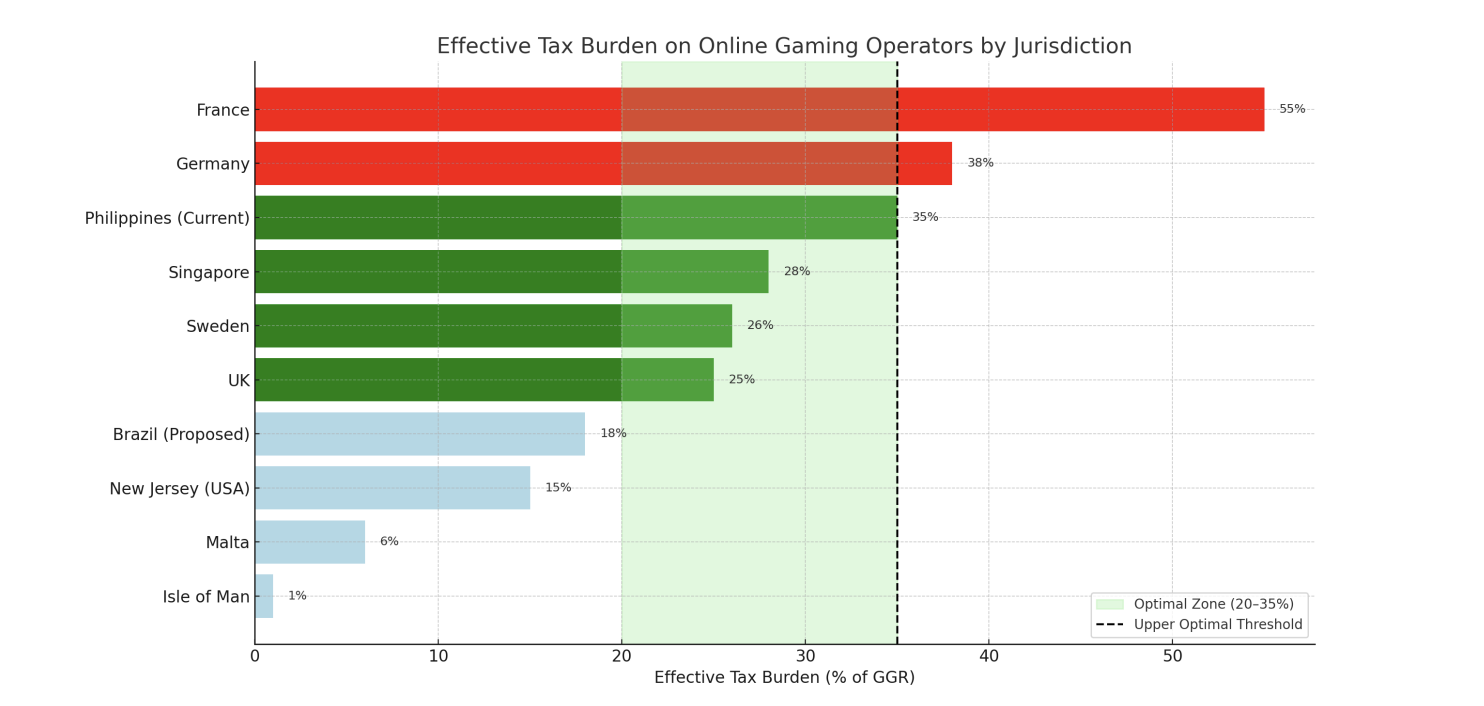
According to Quiogue’s analysis, PAGCOR-licensed online gaming operators currently pay a license fee averaging 30 percent of gross gaming revenue by 2025, reduced from historical peaks of up to 47.5 percent. Additionally, operators pay a 10 percent audit fee on the PAGCOR share, approximately another 3 percent of GGR, plus a 5 percent franchise tax on GGR to the national government.
“Altogether, roughly 35 percent to 38 percent of each operator’s GGR is collected by the government even before any operating costs or profit are accounted for.”
She emphasized that unlike traditional businesses taxed on net income, licensed operators are taxed on gross gaming revenue before deducting operating expenses. “Even if a Licensed Operator incurs losses or earns minimal profit in a given period, it must still remit the PAGCOR license fee and franchise tax on GGR, as well as the applicable audit fee,” she noted.
Government officials support new taxes
The gaming lawyer’s stance directly contradicts recent statements from senior government officials. Department of Economy, Planning, and Development Secretary Arsenio M. Balisacan told reporters last Wednesday that the government could tax online gambling, comparing it to cigarettes. “You can treat it like your cigarettes — impose taxes, but at the same time, make sure that it will not become a social menace, just like the POGOs,” Balisacan said.
Finance Secretary Ralph G. Recto last week announced the government is proposing an online gaming tax, alongside policy options to limit access to gambling platforms. These measures may include restricting play time, limiting cash-ins, imposing age restrictions and requiring warnings on gambling dangers.

President Ferdinand R. Marcos, Jr. has also expressed support for further taxing and regulating the industry to mitigate addiction-related harm. The Akbayan party-list group earlier filed a bill at the House of Representatives seeking to impose a 10 percent levy on online gambling, with proceeds allocated to addiction treatment, recovery and public education.
International comparisons reveal high Philippine rates
Quiogue’s analysis shows that the Philippines already imposes one of the heaviest effective tax burdens on legal online gaming globally. At 35 percent of GGR, the rate sits at the upper end of world standards. By comparison, New Jersey levies about 15 percent to 17 percent on online casino GGR, while Brazil’s proposed sports betting regulation suggests an 18 percent GGR tax.
“Several US states have GGR tax rates in the low teens, and emerging markets in South America like Colombia have likewise set modest rates of around 15 percent of GGR to attract and legitimize operators,” Quiogue noted.
The gaming lawyer cited global best practices suggesting an optimal tax zone of 20 percent to 30 percent of GGR that maximizes government revenue while keeping the legal market attractive to both players and operators.

Risk of driving industry underground
Quiogue warned that excessive taxation could backfire, citing examples from France and Germany where overly aggressive tax policies drove players to illegal markets.
“When the government takes too large a cut of GGR, legal providers struggle to compete with untaxed black-market operators and may either exit the market or never enter in the first place.”
She highlighted Kenya’s experience, where a 2017 tax increase to 35 percent of GGR from 7.5 percent prompted major legal players to exit the market. “Betting activity didn’t stop, but much of it shifted to the illegal market, a lose-lose for both regulated businesses and the tax authority,” Quiogue observed. Kenya eventually reversed course, recognizing the policy was counterproductive.
The lawyer argued that licensed operators are competing against illegal online gaming companies that “pay zero taxes to the Philippine government.” Philippine Amusement and Gaming Corp. (PAGCOR) Chairman Alejandro H. Tengco has acknowledged this challenge, telling media that PAGCOR monitored almost 11,000 illegal websites in the past 2 years, taking down about 76 percent or roughly 8,000 of them.

Economic ecosystem at stake
Beyond individual operators, Quiogue emphasized that a broader ecosystem supports the online gaming industry. Under PAGCOR‘s regulatory framework, gaming affiliates and support service providers including content suppliers, marketing agencies, KYC/AML firms, payment gateways, and customer support centers must be accredited and domiciled in the Philippines.
“This means they must establish a legal presence, hire locally, and comply with Philippine tax, labor, and corporate laws,” she explained. “PAGCOR has anchored a whole supply chain within the national economy — generating new jobs, corporate income tax contributions, BIR registrations, and increased local business activity.”
However, she cautioned that this ecosystem remains fragile.
“Regulated online gaming in the Philippines has been active for barely three years. It is not yet perfect, but it is improving — and with time and proper stewardship, there is great room for refinement and responsible growth. What it cannot survive is the weight of excessive taxation or policy overreach.”