South Korea’s integrated resort industry is at a crucial crossroads as policymakers and experts call for bold reforms to restore the country’s competitiveness against regional rivals like Japan and Singapore.
At a recent Korea Times Global Business Club event, held in partnership with the Tourism Sciences Society of Korea, industry leaders dissected the reasons behind Korea’s stagnation and highlighted Japan’s Osaka project as a model for sustainable transformation.
The forum, titled “Strategies for securing sustainable competitive advantage in Korea’s Integrated Resort (IR) industry,” gathered tourism officials, academics, and executives to discuss what might have went wrong in Korea’s IR strategy, and how to put it back on track.
While Korea was among the first in Asia to embrace the integrated resort concept, its execution has lagged behind the more cohesive and forward-looking frameworks seen elsewhere in the region.
Japan’s Osaka IR, spearheaded by MGM Resorts International, is often cited as a textbook example of long-term vision and public-private alignment. The $8.1 billion project on Yumeshima Island is set to become Japan’s first major casino resort when it opens in 2030. With 2,500 hotel rooms, large-scale convention facilities, and extensive entertainment amenities, the complex is projected to draw around 20 million visitors per year, generate $3.4 billion in annual gaming revenue, and create more than 20,000 jobs.

According to Kang Sung-sook, a professor at Tezukayama University, Osaka’s IR is not just a tourism development – it’s a national economic strategy.
“Japan built the foundation for integrated resort development in the early 2000s,” she explained. “It was never about casinos alone. The government saw tourism as a tool for countering demographic decline and revitalizing regional economies,” she highlighted.
That deliberate, long-term approach contrasts sharply with Korea’s policies. While Japan crafted an integrated roadmap involving central and local governments as well as international investors, Korea’s system has remained constrained by oftentimes inconsistent legislation, departmental turf wars, and a lack of unified oversight.
Dong-eui University Professor Yoon Tae-hwan, argued that the problem isn’t ambition but alignment. “Korea adopted the IR concept at the legislative level but failed to synchronize government ministries, local authorities, and private stakeholders under a single vision,” he said. “Oversight is spread across multiple agencies – from the Ministry of Culture, Sports and Tourism to the National Gambling Control Commission – creating overlapping regulations and regulatory blind spots.”

This bureaucratic complexity has made it difficult for operators to compete globally. Unlike Singapore or Japan, South Korea lacks a single “control tower” to streamline governance and ensure consistent policy direction.
Yoon urged the creation of an independent regulatory body modeled after Singapore’s Casino Regulatory Authority, staffed by professionals with specialized expertise. “By doing so, Korea can offer clear, predictable standards to investors and rebuild international trust,” he said.
Expectation meets reality
The experts also expressed a feeling of lack of innovation in Korea’s resort design and marketing. Early enthusiasm from foreign investors faded as projects failed to evolve beyond limited gaming operations. “Korea’s integrated resorts were initially well positioned to attract international visitors,” Yoon noted. “But without diversified entertainment, luxury retail, or MICE infrastructure, growth quickly plateaued.”
In contrast, Japan’s MGM Osaka IR can potentially integrate cultural, entertainment, and business tourism into a single ecosystem. The project’s design focuses as much on exhibitions, performances, and gastronomy as on gaming floor, an approach meant to broaden appeal and encourage longer stays.
Tezukayama University Professor Kang outlined that Osaka’s success lies in its ability to align public policy, corporate investment, and community engagement under one vision. “It’s a coordinated national project, not a collection of individual casinos,” she said.
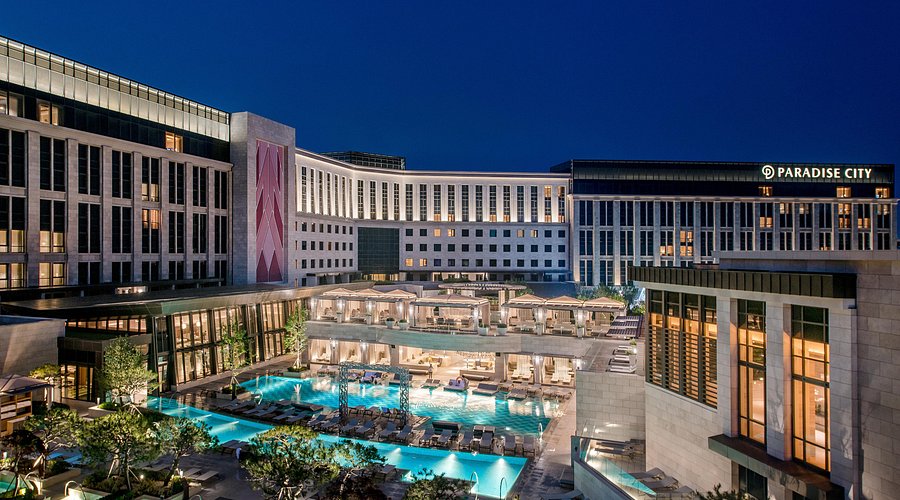
Interestingly, Kang also suggested that Japan’s rise could open new doors for South Korea rather than close them. With domestic entry restrictions still in place, Japanese consumers’ exposure to casino gaming remains limited. Once those restrictions are eased, she believes some Japanese visitors will look abroad – especially to Korea – for new experiences. “This could turn competition into mutual benefit,” she said, envisioning a future where the two markets complement rather than cannibalize each other.
Still, the consensus among attendees was clear: Korea must act swiftly to reverse its decline. The country’s integrated resorts have under-performed not because of geography or potential, but because of inconsistent policy support, slow infrastructure upgrades, and a lack of clear investment incentives. Experts also cited weak coordination between tourism and gaming sectors as a major stumbling block, leaving operators unable to leverage Korea’s broader cultural and entertainment assets.
Many suggested that Korea’s IR strategy should shift from casino-centric development to destination management – integrating gaming with entertainment, retail, convention facilities, and local tourism.
“Japan’s operators invested in comprehensive destination management…Korea, on the other hand, often overlooked tourism integration.”
Yoon Tae-hwan
Both speakers agreed that Korea’s path forward requires deeper dialogue among ministries, industry leaders, and international investors. By focusing on regulatory modernization, sustainable hospitality, and cross-border partnerships, Korea could recapture the momentum it once had and establish itself as a serious competitor in the Asian IR market.