


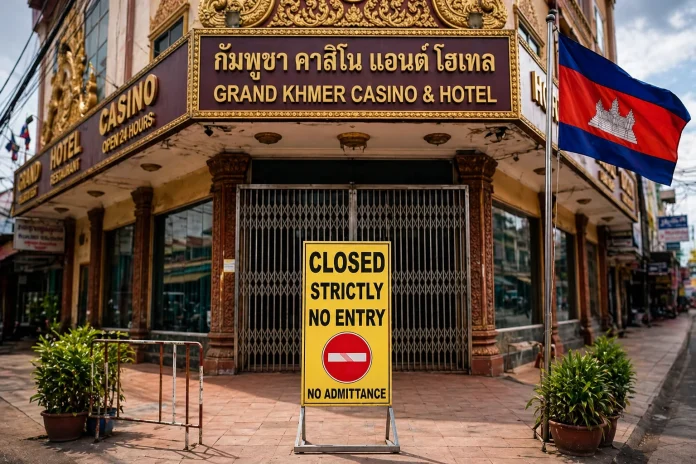
Cambodia has shut down 91 casinos linked to online scam operations as authorities intensify a sweeping nationwide crackdown on cybercrime networks, in a move that underscores growing regulatory and geopolitical pressure on the country’s gambling and digital enforcement landscape.
The Cambodian government said it has raided more than 250 suspected scam centers over the past nine months, targeting operations believed to be involved in online fraud, illegal gambling and associated criminal activity. The closures form part of a broader campaign aimed at dismantling scam compounds and foreign-run networks that have increasingly drawn international scrutiny.
Authorities also confirmed that 13,039 foreign nationals from 33 countries have been deported for their alleged involvement in online scam operations. In addition, 241,888 individuals reportedly left Cambodia voluntarily between mid-January and April 19th as enforcement activity intensified, highlighting the scale and impact of the crackdown on the country’s foreign workforce and grey-market ecosystem.
The announcement followed a high-level visit by Chinese Foreign Minister Wang Yi to Phnom Penh, where he met Prime Minister Hun Manet on April 22nd. During the visit, Beijing urged Cambodia to strengthen its efforts against cross-border gambling and online fraud, describing such activities as a serious threat to public safety and regional stability.
The issue has become a key element in Cambodia’s bilateral relations with China, which has been increasingly vocal in calling for coordinated regional action against transnational cybercrime networks. Chinese authorities have repeatedly expressed concern over scam operations targeting mainland citizens from bases in Southeast Asia.
According to official statements reported by Xinhua News Agency, the 91 casinos were identified as either directly operating scam activities or facilitating online fraud networks. The closures signal a more aggressive stance by Phnom Penh toward land-based venues suspected of acting as fronts or infrastructure hubs for illicit digital operations.
The crackdown also coincides with a tightening of Cambodia’s legal framework. A new law on combating online scams came into force on April 6th, introducing significantly harsher penalties for those involved in such activities. Under the legislation, operators whose scams result in fatalities face prison terms ranging from 15 to 30 years or life imprisonment. Ringleaders can receive between five and 10 years in prison, rising to 10 to 20 years in cases involving violence, human trafficking, illegal detention or forced labor. Lower-level participants face sentences of two to five years.

The law was promulgated by royal decree signed by Hun Sen, acting as head of state, following final approval by the Senate on April 3rd, and took immediate effect.
Cambodian authorities have framed the campaign as a long-term effort requiring coordination between domestic agencies, foreign governments and international partners. The government has also indicated that the crackdown is intended to restore the country’s international reputation, which has been affected by persistent reports linking Cambodia to scam compounds, human trafficking and forced labor operations.
Regional and international pressure has intensified in recent months. Reports have highlighted the rapid expansion of cyber scam networks across Southeast Asia, particularly in Cambodia and Myanmar, where criminal groups are alleged to operate large-scale fraud schemes targeting victims globally. Governments, including the United States, have responded with enforcement measures such as sanctions and criminal charges against individuals and entities tied to these networks.
Following his Cambodia visit, Wang continued his regional tour to Thailand, where discussions also focused on strengthening cross-border cooperation against cybercrime and illegal online gambling.
The closure of 91 casinos represents one of the most visible enforcement actions to date and signals a shift toward more direct intervention in the intersection between land-based gambling infrastructure and online criminal activity. It also suggests that Cambodia is seeking to demonstrate tangible progress as scrutiny increases from China, the US and other regional stakeholders.