Contract of service (COS) and job order (JO) workers employed by the Philippine Amusement and Gaming Corporation (PAGCOR) are not considered government employees under the Civil Service Commission’s (CSC) jurisdiction, the country’s Supreme Court (SC) has ruled.
In an 18-page decision promulgated in June, the SC First Division dismissed a petition filed by a group of PAGCOR workers whose contracts were not renewed. The case stemmed from a complaint of illegal dismissal, which the workers brought to the CSC Regional Office VI (CSCRO-VI) after their contracts were terminated.
The SC cited CSC-COA-DBM Joint Circular No. 1, which clearly states that COS and JO workers are not covered by Civil Service laws and regulations. Section 7.4 of the circular specifies that these workers do not receive the same benefits as regular government employees, such as leave credits, Personal Economic Relief Allowance (PERA), Representation and Transportation Allowance (RATA), or 13th-month pay.
“We reiterated that there is no employer-employee relationship between the government and job order workers, and that their services are not considered government service,” the SC noted. “For these reasons, job order employees are not covered by Civil Service law, rules, and regulations.”
The ruling clarified that the PAGCOR workers in question, employed as cooks, waiters, pantry aides, stewards, dishwashers, kitchen supervisors, and busboys, among other roles, had signed fixed-term contracts with the agency. Some had worked under these contracts for periods ranging from one to 17 years, with occasional renewals.
The workers argued that their repeated contract renewals and length of service effectively made them regular employees entitled to security of tenure, and they brought the matter to the CSCRO-VI. However, the CSCRO-VI dismissed their complaint, citing lack of jurisdiction, a decision that was upheld by both the CSC and the Court of Appeals.
The SC emphasized that, while PAGCOR holds the authority to hire its own workers, including those under contract of service or job order arrangements, this power should not be misused. The court reminded PAGCOR and similar agencies that COS and JO workers should not be mistreated or mismanaged, despite not enjoying the full benefits of regular government employees.
“We sternly remind PAGCOR and all similar agencies that while their authority to contract services is recognized under applicable civil service rules, such hiring authority should not be used to mistreat or otherwise mismanage contract of service or job order workers,” the court said.
Crown Melbourne has been hit with a AU$2 million ($1.34 million) fine by the Victorian Gambling and Casino Control Commission (VGCCC) for allowing 242 self-excluded individuals to gamble at its casino between October 2023 and May 2024.
The VGCCC found that Crown Melbourne breached its obligations under the Casino Control Act 1991 (Vic), which makes it illegal for a self-excluded individual to enter, stay, or gamble in the casino. VGCCC Chair Fran Thorn stressed the importance of casinos upholding self-exclusion protocols to protect those vulnerable to gambling-related harm.
Fran Thorn, Chair of VGCCC
“It is an offense under the Casino Control Act for a casino to allow an excluded person, including those who have self-excluded, to enter or gamble,” said Thorn. “Self-exclusion is a key harm-prevention initiative, and gambling providers must take all necessary steps to enforce this. By failing to do so, Crown has exposed these individuals to the risk of further gambling harm.”
Thorn added that, in some cases, self-excluded patrons went to great lengths to bypass security measures and violate their exclusion terms.
The VGCCC uncovered these breaches as part of its continuous monitoring of Crown’s operations. The investigation revealed that the incidents were the result of systemic and control failures rather than a deliberate attempt by Crown to ignore its regulatory responsibilities.
To address these issues, the VGCCC has directed Crown to hire an independent expert to evaluate the effectiveness of its self-exclusion program. This expert will provide recommendations for improvements, which Crown will be required to implement.
Earlier this year, the VGCCC ordered Crown Melbourne to implement a transformation plan aimed at reforming its practices following the damning findings of the Finkelstein Royal Commission. The Commission acknowledged that Crown has made some efforts to strengthen its exclusion protocols, including enhancing its monitoring activities, physical security, technology use, and staff training.
However, despite these efforts, the VGCCC remains committed to ensuring Crown completes its reform agenda.
“Crown has taken steps to strengthen its controls and improve monitoring, but these breaches show that more work is needed,” Thorn added. “We will continue to oversee Crown’s progress in transforming its operations and ensuring it complies with all regulatory obligations.”
The Philippines’ efforts to eliminate Philippine Offshore Gaming Operators (POGOs) are proving successful, with only 100 POGO hubs being monitored.
According to a Presidential Anti-Organized Crime Commission (PAOCC) spokesperson, a report by the Philippine Amusement and Gaming Corporation (PAGCOR) indicates that “many have already closed shop and many are already wrapping up their operations”.
PAOCC executive director Undersecretary Gilbert Cruz indicated confidence in shuttering all vestiges of illegal POGOs, saying smaller operators are converging, making it easier to find them as they operate primarily at night.
The official also indicated that local chief executives involved in illegal POGO operations will soon be facing legal cases.
“We have already connected the dots as to who are involved in POGOs. A lot of names have already surfaced,” indicated Cruz in an interview cited by the Philippine News Agency.
Legal POGO operations have all been mandated to close by the end of the year, following an announcement by the nation’s President, Ferdinand Marcos Jr. in July.
The shuttering of the operations and the pursuit of illegal operators has continued to top headlines in recent months, with the prominent case of ‘POGO mayor’ Alice Guo and the crackdown on POGO compounds in the country. On October 10th, Philippine authorities also arrested Lyo Dong, a key figure allegedly behind illegal POGO and other operations for over a decade.
EvenBet Gaming, a leading developer of online gaming software and solutions, has announced a major update to its platform, with Clubs set to revolutionize the online poker experience for both operators and players.
Clubs is a first-of-its-kind B2B product, offering omni-channel functionality that operates across desktop and mobile devices. Private club and classic cash poker games will become available to players via a single web client.
EvenBet’s latest Poker Clubs software update aligns with the recent In-Store release, providing yet another additional revenue source for operators, and creating a solid foundation for a perfect synergy of private clubs, classic cash games and tournaments.
Clubs will also allow players to participate in all games and tournaments provided by the platform simultaneously. This potential for cross-game promotions will act as a supplementary player acquisition tool, resulting in better engagement for EvenBet’s partners, enhancing game opportunities for players.
The upgraded technology will be integrated directly into the Poker Clubs application, giving operators access to data on Club activity and In-Store purchases which can be utilized for player segmentation and personalization to deliver tailored offers to specific members.
Dmitry Starostenkov, CEO at EvenBet Gaming, said: “We strive to remain ahead of the curve when it comes to optimizing and diversifying our offering.”
Relax Gaming, the renowned iGaming aggregator and supplier, has bolstered its leadership team with the appointment of Enrico Bradamante as Chief Growth Officer (CGO).
With over 12 years of industry experience, Bradamante’s appointment reflects Relax Gaming’s ambition to further enhance its growth strategy across global markets.
Bradamante’s impressive career has seen him serve as Managing Director at NetEnt and Chief Commercial Officer at Aristocrat Interactive (formerly Pariplay). He is also the Chairman and Founder of iGEN (iGaming Executives Network), further demonstrating his leadership within the industry.
In his new role at Relax, Enrico will work closely with both the commercial team and other departments to identify growth opportunities and drive innovation across the organization.
Based in Relax Gaming’s Malta office, Bradamante will be responsible for expanding the company’s footprint in key markets while ensuring it remains at the forefront of industry trends.
Commenting on the new appointment, Martin Stålros, CEO at Relax Gaming, said: “We are thrilled to welcome Enrico to the Relax Gaming executive team. His wealth of experience and deep understanding of the iGaming industry will be instrumental in further driving our growth strategy. Enrico’s expertise will help us continue to differentiate ourselves in an increasingly competitive market, and I look forward to working closely with him as we enter this exciting phase of expansion.”
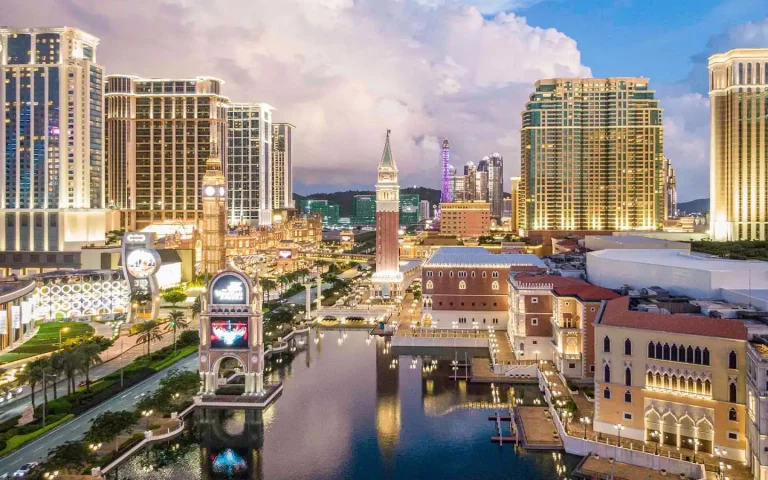
Macau’s gaming industry is closely monitoring how the new leadership will influence policies affecting the sector, as Bank of America notes that “a key unknown for the sector remains the regulatory climate under a new Chief Executive.”
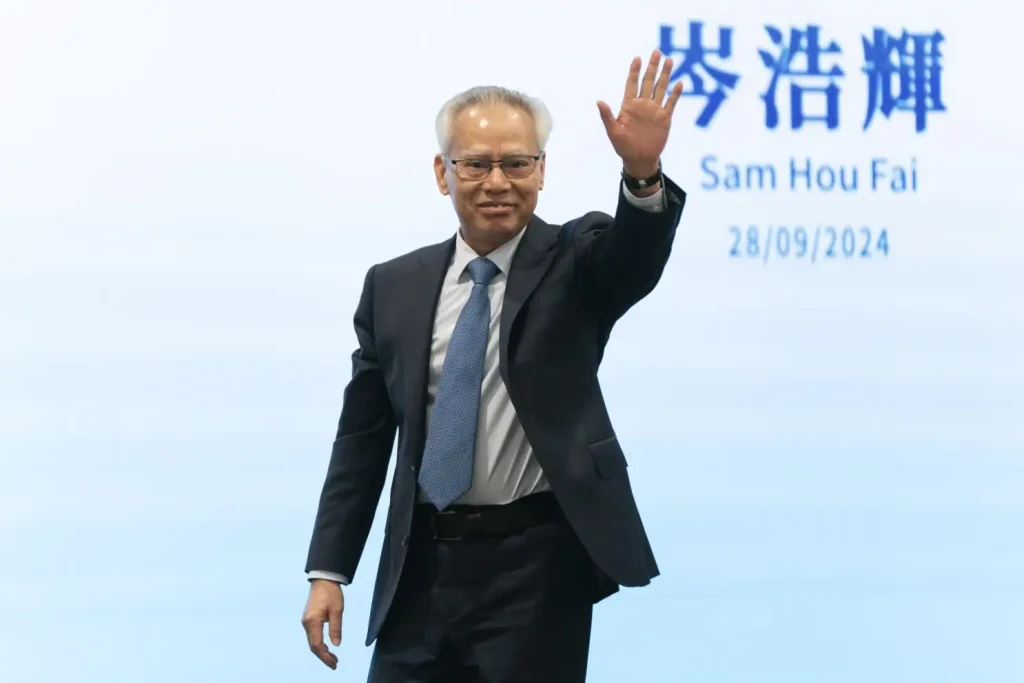
Macau’s new Chief Executive, Sam Hou Fai, was elected on Sunday, October 13th, and his term will begin in December, coinciding with the Macau SAR’s 25th anniversary celebrations.
Sam Hou Fai, Macau’s new Chief Executive
During the campaign period, Sam Hou Fai urged gaming operators to ensure the industry’s growth is maintained through “healthy, orderly, and sustainable” development. At the same time, Sam further explained that this form of development doesn’t mean shutting down or downsizing the industry.
In a recent investment memo, the brokerage highlights that Macau’s gaming sector has shown resilience, particularly with stronger-than-expected gross gaming revenue (GGR) from the October Golden Week. This positive performance underscores Macau’s potential to navigate challenges, despite weak consumer spending in mainland China. Additionally, the Chinese central government’s more coordinated economic policies have helped reduce broader macroeconomic risks.
Bank of America also pointed out that, while China’s consumption growth may take time to recover, investors expect Macau’s GGR to align with China’s GDP growth by 2025.
For gaming operators, this suggests that income returns may serve as a key differentiator. As a result, the firm projects that Sands China will resume dividend payouts in the second half of 2025, while the four dividend-paying operators are expected to see an average yield of around 3 percent. This yield could increase further as companies complete their deleveraging efforts.
GGR projections
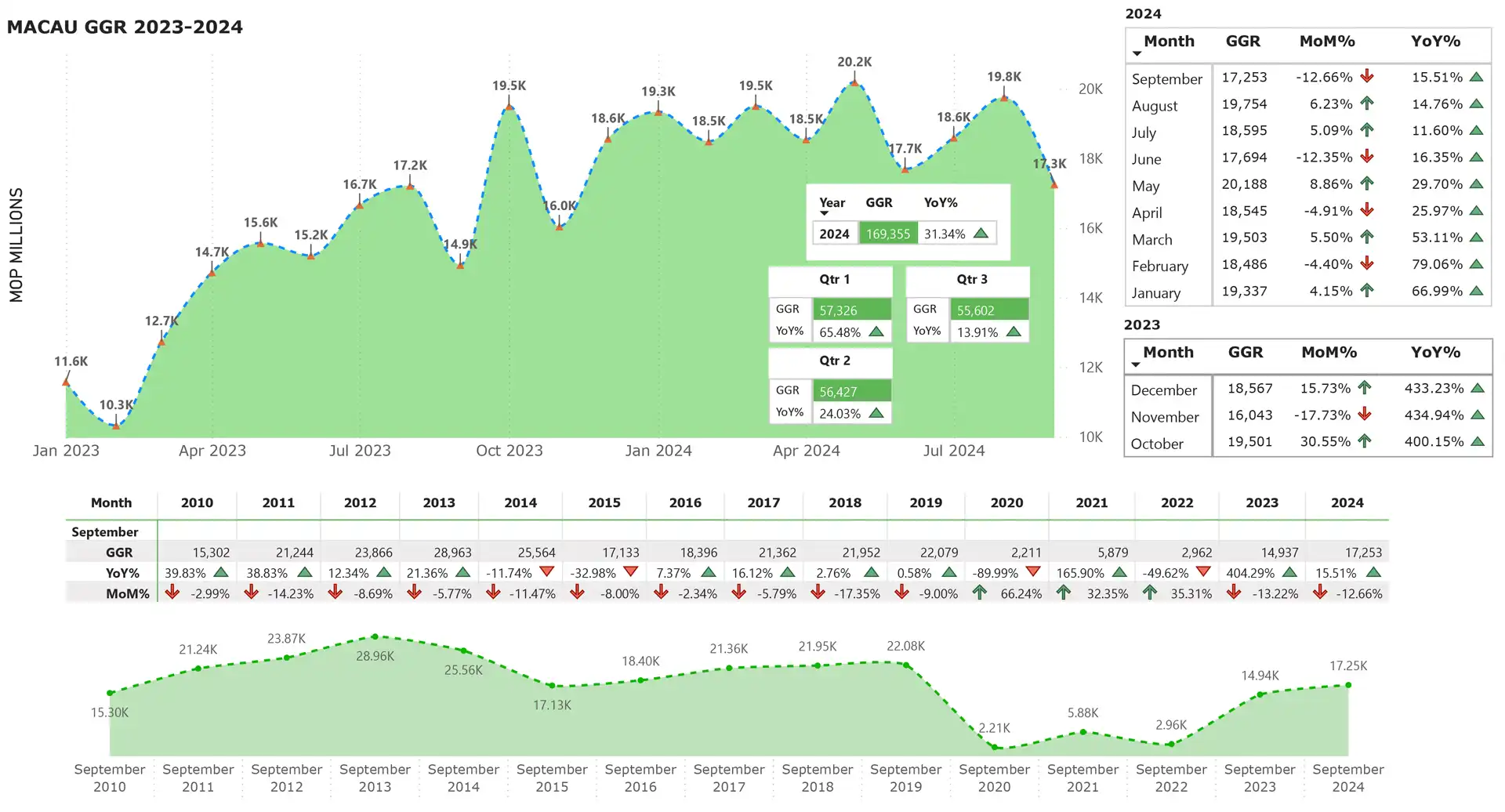
Bank of America has revised its forecasts for 2024 and 2025 GGR based on recent trends. The firm raised its 2024 GGR estimate by 2 percent to MOP227 billion ($28.32 billion), reflecting a 24 percent increase compared to the previous year and amounting to 78 percent of pre-pandemic levels.
For 2025, the estimate was increased by 7 percent to MOP230 billion ($28.7 billion), indicating a 2 percent year-on-year growth. The brokerage notes that the projection reflects an underlying growth of 4-5 percent. However, this growth may be tempered by the ongoing effects of the crackdown on illegal currency exchange activities in early 2025.
In terms of EBITDA, the brokerage adjusted its estimates upwards by 2 percent for 2024 and by 10 percent for 2025.
Commenting on 3Q24 results, Bank of America noted that while GGR saw a 13 percent year-on-year increase, there was a slight 1 percent decline compared to the previous quarter, largely due to typical seasonal trends. For 3Q24 EBITDA, a 6 percent decline quarter-on-quarter is expected, attributed to increased promotional efforts across the industry.
Operator performance outlook
Among the gaming operators, Bank of America expects SJM Holdings to show the strongest performance rise, with a 20 percent growth in EBITDA in 3Q24 compared to the previous quarter, driven by the continued ramp-up of its Grand Lisboa Palace. In contrast, other operators are likely to see a decline in EBITDA.
Analysts are expecting drops of 19 percent for MGM China due to increased event costs, with Galaxy Entertainment to be down 10 percent due to seasonally lower construction EBITDA and potential market share loss in September, Melco falling by 6 percent amid its ongoing investment, and Sands by 3 percent as a result of renovation work.
The firm also cautioned that additional non-gaming event costs in the second half of the year could pose a risk to profitability.
3Q24 mass GGR remains flattish QoQ
In another investment memo, UBS anticipates a relatively stable performance for mass GGR in 3Q24, remaining flattish on a quarter-on-quarter basis. In contrast, VIP GGR is projected to decline by approximately 14 percent compared to the previous quarter. This decline in VIP revenue underscores ongoing challenges in that segment, which have persisted throughout the year.
For 3Q24, the Gaming Inspection and Coordination Bureau (DICJ) reported total gross gaming revenue of MOP55.6 billion ($6.94 billion), averaging around MOP604 million ($75.4 million) per day. This figure represents a 14 percent year-on-year increase; however, it reflects a slight decline of about 1 percent compared to the previous quarter.
This performance is weaker than the usual seasonal trends, largely attributed to one-off events, including the European football tournament that took place in June and July, as well as a delayed start to the school holidays in July.
On a positive note, the non-gaming sector is expected to experience a seasonal uptick, driven by an increase in visitor arrivals at teen rates compared to the previous quarter. This increase in foot traffic translates to a forecasted rise in sector non-gaming revenue of around 5 percent compared to the previous quarter.
The uplift in non-gaming activities suggests that while gaming revenue faces challenges, other areas are benefiting from enhanced visitor engagement and spending.
Despite the anticipated growth in non-gaming revenue, analysts from UBS expect that the sector’s luck-adjusted EBITDA will decline by approximately 3 percent compared to the previous quarter’s performance. This projection highlights the overall impact of the weaker gaming performance on the financial outlook for the sector.
The number of Suspicious Transaction Reports (STRs) filed by gaming operators in Macau in the third quarter of the year fell to 860, the lowest quarter of the year so far.
According to official data from Macau’s Financial Intelligence Office (GIF), in the first quarter, the figure was 1,125, while in the second quarter it totaled 1,056.
However, looking at the period from January through September, STRs filed by Games of Fortune Operators increased by 30 percent annually, to 3,041.
This comprised 73.8 percent of the total STRs filed in the nine-month period.
During the nine-month period in 2024, Financial Institutions and Insurance Companies filed 843 STRs, up from 617 in the same period of 2023. Those from Other Institutions made up just 5.7 percent of the total, at 234, up slightly from 226 in the Jan-Sept period of last year.
A stakeholder in Genting-operated Resorts World Bimini, in the Bahamas, is seeking damages in excess of $600 million from the company, according to a filing by the parent company Genting Malaysia Berhad (GENM).
In a filing to Bursa Malaysia by GENM, the 22 percent stakeholder in RW Bimini, RAV Bahamas Ltd, filed a complaint on October 7th naming GENM wholly-owned subsidiary Genting Americas (GAI) ‘which involves the operations of Resorts World Bimini (RW Bimini)’.
The filing did not clarify specifics of the litigation but the US District Court for the Southern District of Florida lists it as ‘Other Fraud’.
According to a report by The Bahamas Tribune, RAV Bahamas is claiming that Genting used its majority ownership to conceal liabilities incurred at other properties and placed on the books of RW Bimini.
RW Bimini is owned and operated by BB Entertainment Ltd (BBE), which GENM indirectly holds a 78 percent interest in via GAI.
Financials cited by The Tribune indicate it had $885 million in liabilities versus just $191.5 million in assets at year-end 2022, of which $165.2 million represented the value of RW Bimini’s real estate.
RAV Bahamas reportedly claims that GAI conducted ‘a massive and co-ordinated fraud’ and that it has been ‘depriving’ RAV Bahamas of profits and limiting access to the property’s financial records.
In the filing, Genting notes that ‘GAI is of the view that the Complaint is baseless and totally without merit and will vigorously defend against the Complaint’.
It furthers that it will make further announcements ‘as and when there are material developments’.
The Blackstone Group reportedly injected nearly AU$500 million ($337 million) into Crown Resorts in 2023 following its significant penalties for breaking anti-money laundering and counter-terrorism financing (AML/CTF) legislation.
According to sources cited by the Australian Financial Review, the funding was given after the AU$450 million ($300 million) fine imposed by Australia’s financial watchdog AUSTRAC on Crown.
Blackstone acquired a majority stake in Crown Resorts in 2022 for AU$8.9 billion ($6 billion).
This goes in line with statements given by Crown Resorts CEO Ciarán Carruthers to AGB in May of this year, indicating that “I knew the funding was going to be made available from Blackstone and we spent over AU$200 million since that acquisition in making sure that the work was there and the resources were there”.
Carruthers left his role as Chief Operating Officer in Wynn Macau in September of 2022 to helm Crown Resorts through its transition process, one of numerous top executives hired on after Blackstone’s acquisition. Carruthers is departing the role of CEO but no permanent replacement has yet been named by Crown.
Ciarán Carruthers, ex-CEO for Crown Resorts
According to AFR sources, the funds injected were to maintain operations and continue remediation efforts, even as costs continued to rise and VIP customers were fewer and more frugal.
Crown, Australia’s largest casino operator, also recently announced that it was contemplating the sale of its prestigious Capital Golf Club as part of efforts to stabilize its finances and in July sold its 20 percent stake in Japanese restaurant and hotel chain Nobu in a $180 million deal.
Further disposal of non-essential assets could be in the works, as the impact of carded play, gambling limits and increased oversight of customer due diligence in Australia all come into play.
Macau’s gaming tax revenue reached just under MOP66.40 billion ($8.31 billion) in the first nine months of this year, surpassing the full-year total of MOP65.26 billion ($8.16 billion) collected in 2023, according to official data released by the Macau Financial Bureau (FSB).
From January to September, tax revenue from gaming increased by 45.1 percent compared to the same period last year.
In September alone, the government collected MOP7.62 billion ($953 million) in gaming taxes, a 6.4 percent rise from August, as reported by the Financial Services Bureau on Thursday.
Gaming taxes accounted for 83.1 percent of Macau’s total revenue for the first nine months of 2024, with overall tax revenue standing at MOP79.92 billion ($9.97 billion).
The government’s 2024 budget plan anticipates gaming tax revenue to reach nearly MOP83.61 billion ($10.43 billion), with the current take representing 79.4 percent of that target.
Under Macau’s 10-year gaming concession system, which came into effect on January 1st of last year, the effective tax rate on casino gross gaming revenue (GGR) stands at 40 percent.