

Economist Andrew Russel challenges the oversimplified economic view of casinos as “polluting factories”, highlighting their utilitarian and transactional functions to redefine the economic framework they should live in.
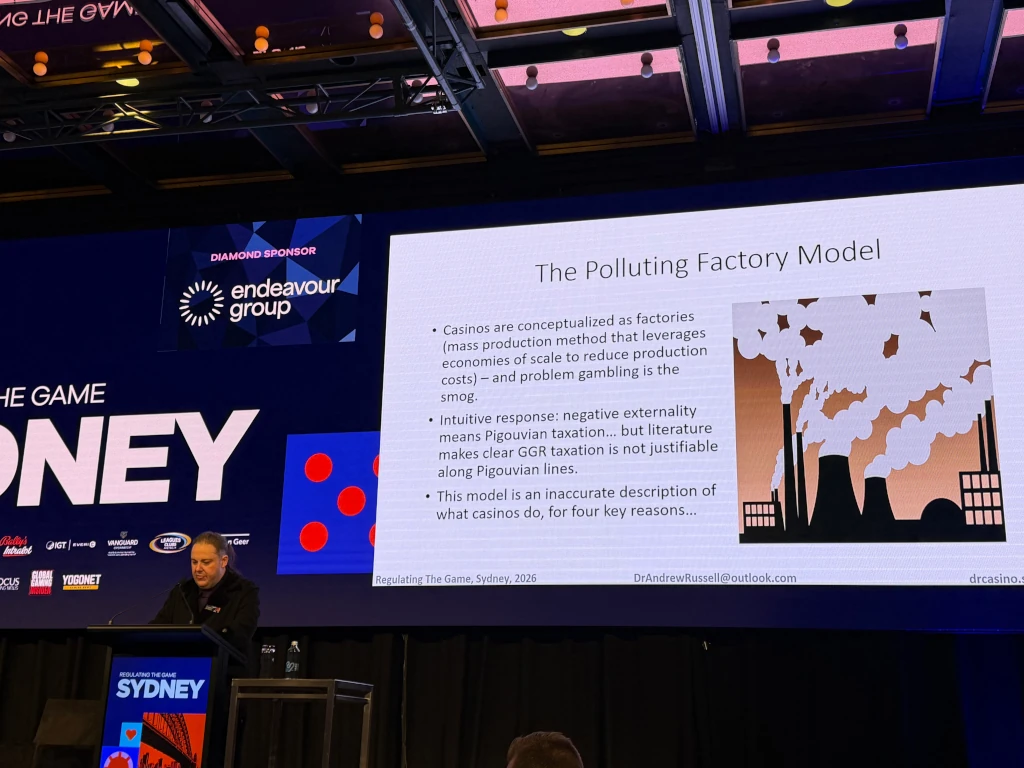
Speaking at the Regulating the Game 2026 conference in Sydney, Russell argued that replacing the “casinos as polluting factories” analogy with a framework rooted in New Institutional Economics (NIE) is the only way to modernize a regulatory landscape that currently serves government interests far more than the public or the industry.
The traditional factory model rests on the idea of mass production and economies of scale. Factories exist to lower production costs. If casinos were truly “gambling factories”, Russell points out, several daily operational realities would make no sense.
“Factories are utilitarian”, Russell noted, pointing to the opulence of properties like Crown Sydney or the Bellagio. “They [factories] don’t have architectural thrills. They don’t hire superstar architects to design assembly lines.” On top of that, if the goal were simply low-cost production, the use of casino chips – which add significant labor and procurement costs – would be discarded in favor of physical cash.
The persistent coexistence of casinos alongside social gambling (the “poker night with the boys”) also defies factory logic. If casinos were the ultimate low-cost production technology for gambling, the significantly cheaper social model should have been driven out of the market long ago. So, if it’s not a factory, what is it? Russell proposes a shift in perspective: the casino is not a producer of a product, but a governance structure for a complex set of contracts.
What are casinos?
“The substance of casino gambling is contracting,” Russell explained. “When you play a hand of baccarat, you are executing a sequence of financial transactions with extremely high policing and enforcement costs.” Because it is relatively easy to cheat at table games and incredibly difficult to prove that cheating in a court of law, the casino exists as an institutional environment specifically designed to lower these “transaction costs.”

From this NIE perspective, everything from the vertical integration of security staff to the use of chips becomes an efficient economic choice. Chips, for instance, are relationship-specific assets. They are a financial technology that creates a closed, secure environment where the risk of theft or fraud – for both the player and the house – is minimized. Even the famous “casino spectacle” – the fountains, the marble, and the light shows – serves a hard economic purpose in Russell’s model: it acts as a costly signal of cash reserves.
In an environment where a player is turning their non-specific cash into relationship-specific casino chips, they face the risk of “unjust expropriation” – the house refusing to pay out. Opulence serves the same function today that grand marble pillars once served for banks: it is a visual demonstration of deep liquidity.
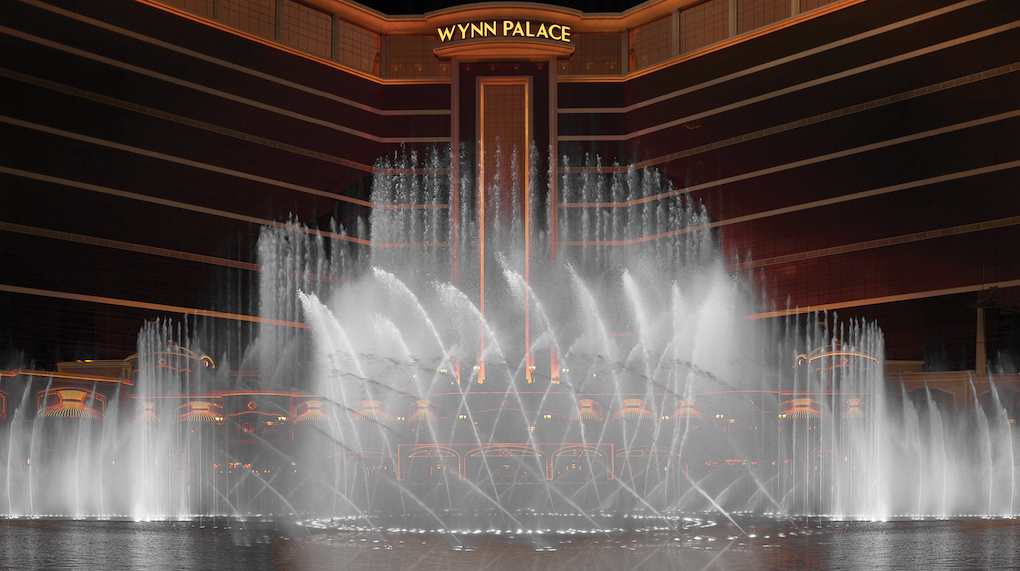
“Spectacle isn’t just advertising. It’s a form of consumer protection. It communicates to the high-roller that the risk of the house being unable or unwilling to honor their chips is extremely low.”
The danger of the “polluting factory” model is that it leads directly to punitive “Pigouvian” taxes: taxes intended to internalize the cost of the “pollution” (harmful gambling). However, as Russell pointed out, pathological gamblers are largely price-insensitive; high taxes on gambling revenue do little to curb harm while significantly deterring recreational, “healthy” players.
By reframing the casino as an institutional solution to legitimate economic problems (transaction and enforcement costs), Russell argues we can move away from “headline-driven” policy and toward regulation that actually works.
“Casino regulatory policy is systematically wrong because the popular understanding of the casino’s economic function is wrong.”
Andrew Russel
“Efficiency-oriented reform depends on replacing the polluting factory model. We need to acknowledge that the casino enables mutually beneficial exchanges that simply wouldn’t be possible in any other environment.”