S&P Global Ratings has revised the outlook on Genting Group companies to negative, warning that heavy capital spending and an aggressive growth strategy could weaken the Malaysian conglomerate’s credit quality over the next two to three years, even as it affirmed existing ratings.
In a statement, S&P said spending across multiple subsidiaries could outpace earnings growth, pushing the group’s leverage higher and its funds from operations (FFO)-to-debt ratio below 20 percent in 2026 and 2027.
‘The group’s elevated spending and risk appetite over the next two to three years will test its credit quality,’ S&P said, citing large investments in the United States, Singapore and Indonesia, alongside corporate actions at the parent level.
The ratings agency revised the outlooks on Genting Bhd., Genting Malaysia Bhd., Genting New York LLC and Resorts World Las Vegas LLC to negative, while affirming the issuer and issue credit ratings on all four entities.
S&P said the negative outlook reflects the risk that ‘spending could outpace incremental earnings growth,’ adding that the group’s leverage could deteriorate without ‘concrete and timely deleveraging measures’.
Capex surge across group
According to S&P, Genting’s total capital expenditure is expected to double in 2026 compared with 2025 levels, and to remain above MYR8 billion ($1.9 billion) annually through 2030.
Major investment commitments include Genting New York’s spending following the award of a full gaming license in New York, the expansion of Resorts World Sentosa in Singapore, and Genting Energy’s investment in a floating liquefied natural gas (FLNG) facility in Indonesia. These come on top of Genting Bhd’s MYR3.1 billion ($758.2 million) takeover bid for Genting Malaysia.
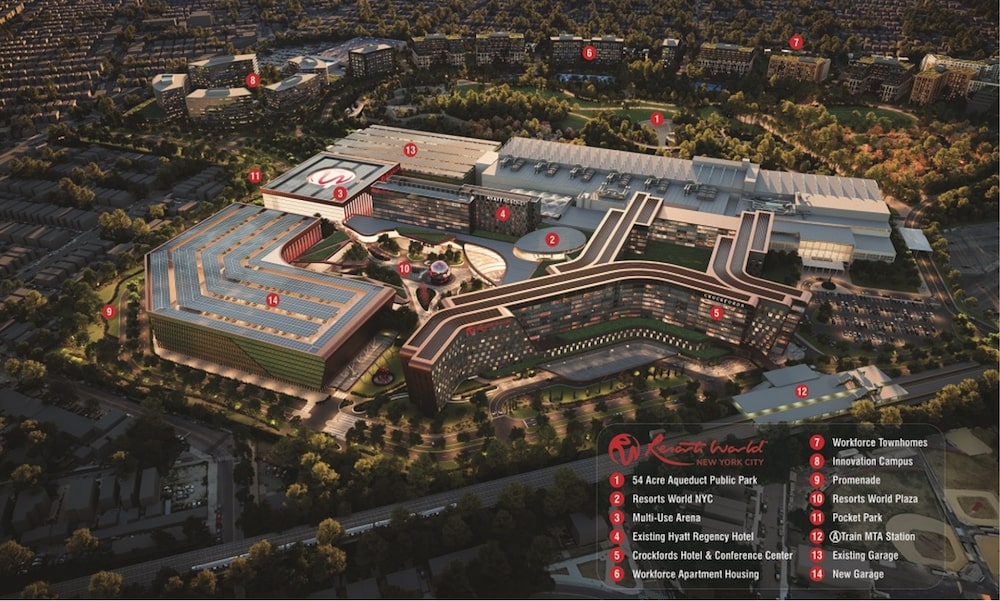
S&P estimates that spending related to the New York license will account for close to 30 percent of the group’s annual capex over the next two to three years, covering license fees, renovations and new construction.
While the New York project is expected to generate more than $400 million in annual EBITDA on a run-rate basis, S&P said other investments would take longer to contribute cash flows. The FLNG facility, for example, is ‘unlikely to generate cash flows until mid-2027 at the earliest’.
‘Incremental earnings are unlikely to keep pace with spending,’ the agency said, adding that large investments in Singapore would also draw down cash buffers despite an ongoing recovery in operations.
Rising debt, weaker leverage
As a result, S&P expects Genting Bhd.’s discretionary cash flow to remain negative over the next three years, with reported debt rising sharply by 2028 compared with pre-pandemic levels.
The agency warned that Genting’s growth-driven approach represents ‘a deviation from our expectations for an investment-grade credit profile’, reducing predictability around leverage and increasing exposure to event risks.
S&P also pointed to the absence of a clearly articulated financial policy, highlighting the debt-funded takeover bid for Genting Malaysia as evidence of a higher risk appetite at a time when ratings headroom is narrowing.
‘Any attempt by Genting Bhd to privatize Genting Malaysia via additional debt could further delay a recovery in leverage’, S&P said, adding that the group would need to demonstrate a stronger commitment to transparency and deleveraging.