



Las Vegas Sands views smart tables as the gateway to “a new frontier” in patron data, with the technology feeding the business intelligence the operator sees as artificial intelligence’s biggest prize, according to chairman and chief executive Patrick Dumont.

Dumont, who also chairs Hong Kong-listed Sands China Ltd, was speaking on Thursday during a fireside chat at the Bernstein 42nd Annual Strategic Decisions Conference in New York, hosted by Bernstein analyst Richard Clarke.
He pointed to three areas where AI could affect the business: the development of proprietary tools, staff efficiency, and business intelligence. “But I think the biggest opportunity for us is business intelligence,” Dumont said, describing the use of customer data to understand patron behavior as a frontier that connects directly to the group’s smart gaming tables.
Dumont said Sands has been investing in smart tables for more than eight years, calling the program “very successful” while noting it remained in its “early days” in terms of efficiency gains.
“The key for us is really a combination of RFID and optical,” he said. “That allows us to really be precise about the way that we understand what’s happening at the table.”
That approach sets Sands China apart from its rivals. AGB understands the operator uses a smart table system supplied by Japan’s Angel Group across its Macau properties, while the other five concessionaires have adopted technology from US firm Walker Digital Table Systems. Industry sources indicate that smart tables now cover virtually all baccarat tables across the Macau market.
The two systems take different technical approaches. Walker Digital is understood to rely on a pure RFID solution, while Angel combines RFID with optical capture, using cameras for motion tracking and pose recognition. Angel has deployed its system across thousands of tables at Sands China’s Macau properties, including The Venetian Macao, The Parisian Macao and The Londoner Macao.
Dumont said the goal was to bring table analytics close to the standard already available on the slot side, improving both security and the patron experience.
Sands has no plans to extend its reach into online gaming, even through brand licensing. “We are very focused on doing the things that we’re market leaders in,” Dumont said, adding that the company would not “pursue things that are not in our core”.
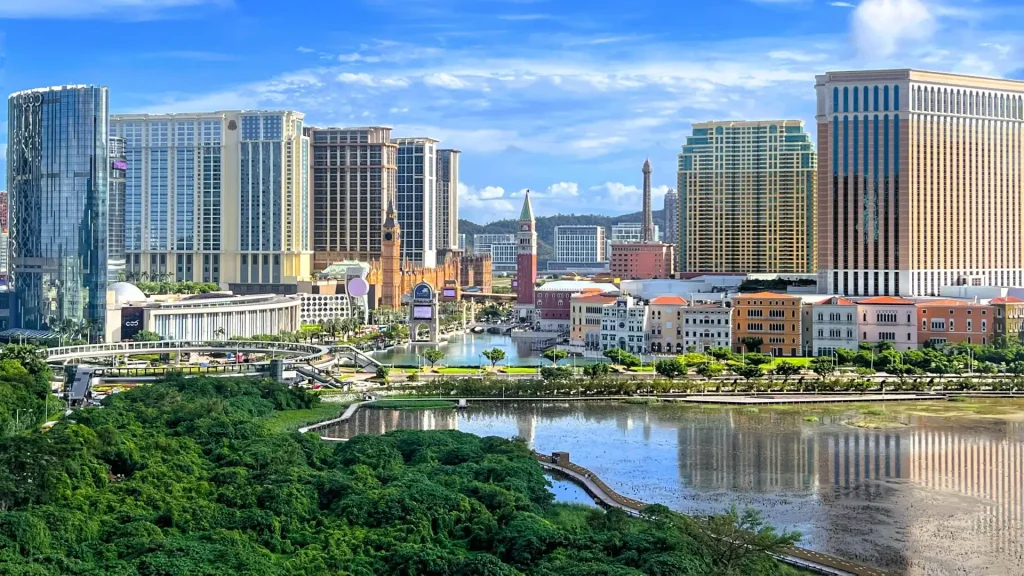
Confident on the long term
The technology drive sits alongside a wider capital program in Macau, which Dumont said rested on a positive long-term view of the market.
“I have a very positive outlook for Macau for the next 3, 5, and 10 years,” he said. “And that’s the reason why we’re so confident to continue to invest there.”
Sands is focusing its spending on three areas: product, people and service. Dumont said the company was working to introduce products “more able to address the demand of higher-value patrons, because we’re missing capacity in the premium segment, particularly in the most premium areas”. It is also seeking to optimize its premium mass and base mass operations.
He pointed to a wealthier returning customer base, noting that many patrons had built significant wealth over the past five years on the back of growth in China and Southeast Asia.
Dumont said Sands was targeting property EBITDA of between $2.7 billion and $2.8 billion in Macau, driven mainly by revenue growth as the operator adds capacity in its most premium areas.
The Venetian Macao is under renovation, with newly refurbished rooms due back online over the next 18 months and completion expected by the end of 2027. Sands announced in April that it was refreshing hotel rooms at the property and adding luxury suites.
Dumont described Macau as “a product-driven market”, adding: “I always joke with people, saying that before the Venetian was built, gross gaming revenue on Cotai was zero.”
The investment case rests on the group’s Macau performance. Sands China reported net income of $294 million for the first quarter of 2026, up from $202 million a year earlier, while adjusted property EBITDA rose to $633 million from $535 million.