Macau’s gaming operators are expected to face continued pressure on adjusted EBITDA margins through 2026, with profitability likely to remain at levels similar to the fourth quarter of 2025 due to intense competition, according to analysts at Jefferies.
The brokerage added that geopolitical tensions are also weighing on market sentiment, further clouding the outlook.
In a research note on Wednesday, analysts Anne Ling and Jingjue Pei said that while gross gaming revenue (GGR) growth remains resilient, the recovery continues to be driven by VIP play, which typically involves higher promotional activity and tighter margins. ‘Promotions and competition remain,’ the analysts noted.
For the first quarter of 2026, Macau’s GGR rose 14 percent year-on-year to MOP66 billion ($8.2 billion), supported by a strong January performance linked partly to the timing of the Chinese New Year holiday. Growth moderated in February and March, but Jefferies maintained its full-year forecast of 6.8 percent GGR growth, slightly ahead of market expectations of 6 percent.
Satellite closures to lift SJM profitability
SJM Holdings stands out as a potential exception. The brokerage expects the operator to benefit from the closure of satellite casinos, which is anticipated to improve cost efficiency and support margin expansion.
Jefferies forecasts SJM’s adjusted EBITDA to grow by 13 percent, 14 percent and 8 percent in 2026, 2027 and 2028, respectively, with margins rising from 14 percent to 16 percent over the same period. The firm also expects SJM’s flagship property Grand Lisboa Palace to capture around 3 percent market share by 2026, providing an additional earnings driver.
Galaxy pushes for table expansion
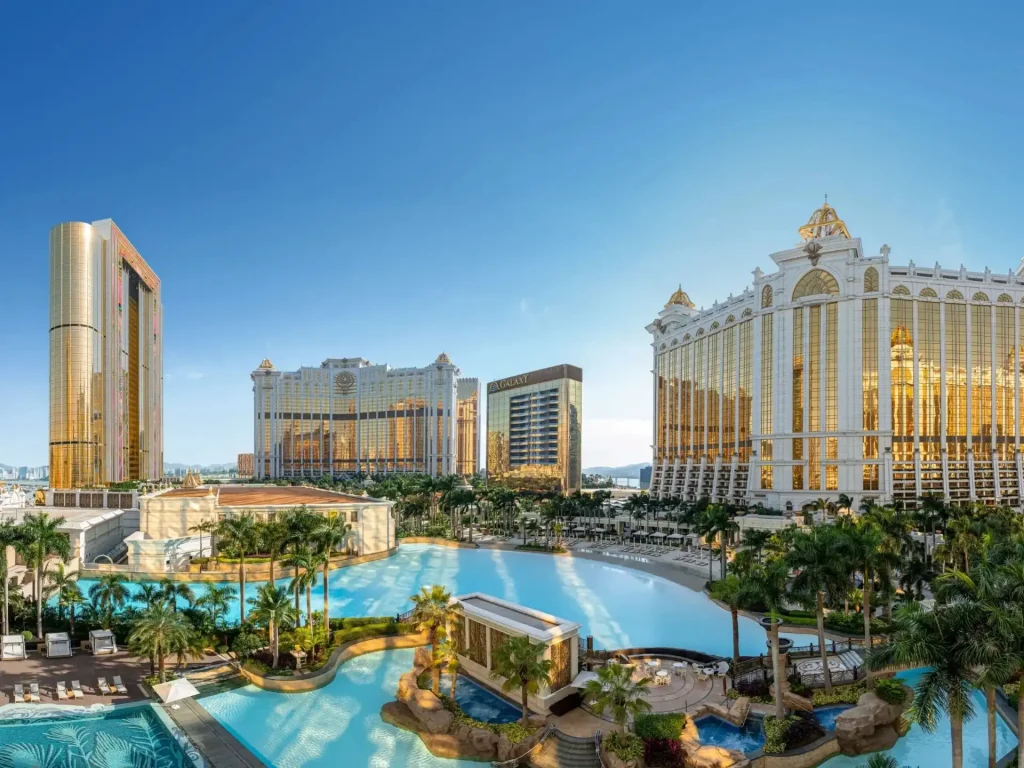
Among operators, Galaxy Entertainment remains a top pick for Jefferies, supported by its capacity expansion and positioning in the premium segment. The company is seeking to differentiate through higher-end offerings, including increasing room sizes in its Phase 4 development, reducing total keys to about 1,350 from 1,500, with completion targeted in 2027.
A key focus is capacity expansion. Jefferies indicates that Galaxy is lobbying the Macau government for additional gaming tables to support its upcoming Phase 4 of Galaxy Macau, highlighting constraints on table allocation as it scales up operations. The company is targeting a 20 to 22 percent market share ahead of the project’s completion.
Sands, Wynn and MGM emphasize EBITDA and premium segments
Sands China and Wynn Macau, meanwhile, are pursuing strategies centered on earnings growth and premium positioning. Sands China continues to prioritize absolute EBITDA generation over margin expansion, maintaining a target run rate of $2.7 billion despite potential quarterly volatility.
Wynn Macau is similarly focused on premium mass customers, with investments aimed at enhancing high-end offerings, including upgrades to gaming areas and hotel inventory. The operator maintains an emphasis on EBITDA and margin rather than market share growth.
MGM China is also maintaining a focus on premium mass, targeting stable mid-teen market share and EBITDA margins in the mid- to high-20 percent range. Management has described competition as ‘rational’ in recent quarters, with reinvestment levels remaining broadly stable, while the group continues to expand its premium offerings, including additional suites at MGM Cotai.
Across the sector, market share trends remain fluid. Jefferies expects Sands China and Wynn Macau to post sequential gains in the first quarter, while Galaxy, MGM China and SJM may see modest declines.