

India has moved to ban real money games and, while still lacking the president’s approval for implementation, it has the sector reeling. Here are some key takeaways from what it’s targeting and why it’s being enacted.

What’s in the bill?
‘The Bill imposes a complete ban on online money games […] Advertising and promotion of such games is strictly prohibited. Financial transactions related to these platforms cannot be processed by banks or payment systems’.
Any ‘unlawful platforms’ can be blocked.
The bill also notes that an online gaming authority, at a national level, will be established, ‘or an existing one may be designated for oversight’.
The function of the body? ‘Categorizing and registering online games, deciding whether a game qualifies as a money game, and addressing public grievances’.
Penalties
- Offering or facilitating online money games can lead to imprisonment of up to three years and a fine of up to RS10 million ($114K)
- Financial transactions ‘linked to these games are also punishable with similar penalties (above)
- Advertising such games can attract a jail term of up to two years and a fine of up to RS5 million ($57.2K)
Note: repeat offenders can face penalties including up to five years in jail and fines of up to RS20 million ($228.7K). ‘Police can arrest without a warrant and bail is not a right’.
While companies and their officers will be held accountable for offenses, independent directors and non-executive directors (not involved in day-to-day decisions), won’t be punished if they ‘can show that they acted with due diligence’.
Investigations
The right to potentially enter premises and make arrests without a warrant is also encompassed ‘in certain cases’. When authorized, officers may ‘investigate, search and seize both digital and physical property linked to offenses’.
Reason for implementation

The Government of India’s Press Information Bureau released a detailed explanation of the Promotion and Regulation of Online Gaming Bill 2025.
One key highlight of this is that, while its goal is to shut down real money games, it aims to promote e-sports and online social games.
According to its extensive release on the bill, the government highlights five key reasons for its implementation:
- ‘Addiction and financial ruin’: ‘compulsive play’ causes players to ‘lose their entire savings chasing the illusion of quick profits’
- ‘Mental health and suicides: ‘the bill seeks to prevent such tragedies by banning these exploitative platforms’
- ‘Fraud and money laundering’: platforms have been ‘misused for illegal activities’
- ‘Threat to national security’: ‘some gaming platforms were being used for terror financing and illegal messaging’
- ‘Closing legal loopholes’: ‘the bill ensures that the same standards apply in both physical and digital spaces’
- ‘Encouraging healthy alternatives’: ‘e-sports will be promoted as a legitimate sort […] while social and educational games that build skills and cultural values will receive government support’
Online money games are defined as ‘games where financial stakes are involved, whether based on chance, skill, or a combination of both’.
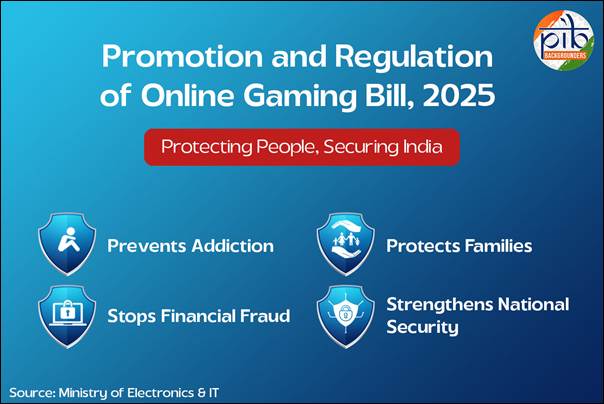
Information by the bill claims some 450 million people in India are ‘negatively affected by online money games’ and ‘faced a loss of more than’ RS200 billion.
‘There is a lack of coherent and enabling legal framework that can promote structure growth of the sector and allow responsible gaming practices to evolve’.
The bill also notes that ‘many gaming platforms operate from offshore jurisdictions’, which ‘presents challenges in terms of extra-territorial jurisdiction and inter-state inconsistencies’.
The government’s viewpoint
According to its published statement, the government notes that ‘The Promotion and Regulation of Online Gaming Bill, 2025, marks a decisive step in India’s digital journey. It recognizes the dangers of unregulated money gaming and responds with firm safeguards to protect citizens. At the same time, it carves out space for e-sports and educational games that nurture skills and creativity. By balancing innovation with responsibility, the Bill sets the tone for a safer and healthier digital future. It also strengthens India’s standing as a nation that can lead in shaping global digital policy. Most importantly, it ensures that technology serves society rather than harms it.’