

Home Blog Page 506

Daily Asia Gaming eBrief: Chinese fugitive linked to $2.3B online betting scheme arrested in Montenegro

0
Good morning. The long arm of the law. Wang Shuiming, a 42-year-old Chinese fugitive wanted for a multi-billion-dollar online gambling fraud, was arrested in Montenegro after arriving from the Maldives. His operations, which reportedly laundered billions, came under scrutiny in Singapore, where authorities seized $2.3 billion in assets associated with him last year. Meanwhile, Las Vegas Sands faced softer earnings in Macau and Singapore despite ongoing investments in both markets, as ongoing renovation projects impacted its performance. In the Philippines, PAGCOR announced that its 2024 revenue soared to a record high of $1.92 billion, a near 41 percent increase from the previous year.

What you need to know

  • Chinese national Wang Shuiming, a fugitive wanted across Asia for his role in a multi-billion-dollar online gambling fraud, has been arrested.
  • Renovation projects impacted LVS’s Macau results in 4Q24, but the impact should disappear as projects are concluded.
  • PAGCOR achieved a record $1.92B revenue in 2024, fueled by eGames, while POGOs contributed just 3% before the shutdown.

ASEAN 2025-REGISTER NOW

On the radar


AGB Intelligence

CHINA

Fugitive linked to $2.3B online betting scheme arrested in Montenegro

Wang Shuiming, a 42-year-old Chinese fugitive wanted for a multi-billion-dollar online gambling fraud, was arrested at Tivat Airport in Montenegro after arriving from the Maldives. His capture followed an Interpol Red Notice issued by China, as authorities allege he orchestrated an illegal betting operation that defrauded users of at least $2.3 billion. Montenegro’s border police identified him during routine checks, part of a broader initiative to combat financial crime


Industry Updates


Corporate Spotlight

1xBet’s 2024 Milestones: key achievements & heights of success

1xBet 2024 Milestones Key achievements and new heights of success

In 2024, 1xBet achieved significant breakthroughs and successes, solidifying its position in the iGaming industry. The brand secured major partnership deals, received prestigious awards, and showcased its innovations at the world’s leading forums.


MEMBERSHIP | INTELLIGENCE | ASEAN | CAREERS

Las Vegas Sands reports lower 4Q24 profits as Macau and Singapore show mixed results

Las Vegas Sands (LVS) reported a decline in profits for the fourth quarter of 2024, as the casino giant faced softer earnings in Macau and Singapore despite ongoing investments in both markets.

The company posted net revenue of $2.90 billion for the quarter, down slightly from $2.92 billion in the same period in 2023. Net income fell to $392 million from $469 million, a decline of $77 million. Adjusted property EBITDA stood at $1.11 billion, a 7.5 percent drop year-on-year.

Macau: A Slower Recovery Amid Investments

Macau operations – via the group’s local gaming concessionaire Sands China – generated adjusted property EBITDA of $571 million, down 12.7 percent from $654 million in Q4 2023.

Net revenue for the region also declined 4.9 percent year-on-year to $1.77 billion. The adjusted EBITDA margin dropped to 32.2 percent, down from 35.1 percent in the prior-year quarter.

Despite the downturn, the overall Macau market showed signs of resilience, with total gaming revenue reaching $7.1 billion, up 6 percent from Q4 2023, with mass gaming revenue, which is a key segment for Sands China, increasing by 5 percent year-on-year to $6.2 billion.

However, visitation from mainland China outside Guangdong province remained below pre-pandemic levels, reaching only 92 percent of 2019 figures.

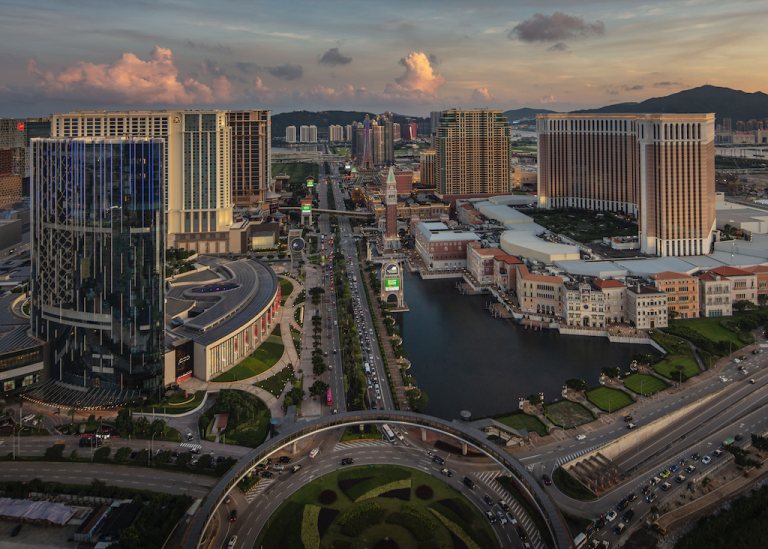
The company attributed part of the weakness to ongoing renovation projects. Around 20 percent of Cotai room inventory was out of service during the quarter as Sands China continued its phased rollout of Londoner Grand suites, which will be fully available by mid-2025.

Some 2,090 additional Londoner Grand suites and rooms will come online in phases through 2Q25, while Londoner Phase II renovation work said to be ‘progressing according to plan’

The Londoner Grand Casino opened in September, with 315 suites and rooms completed and in service throughout 4Q24, while the refurbished Venetian Arena re-opened during the quarter with events commencing in November.

Sand China hotel inventory represents around 42 percent of hotel rooms on Cotai, and represents a $17 billion investment by the group.

Singapore: Record Mass Gaming Revenue but Weaker Margins

At Marina Bay Sands in Singapore, adjusted property EBITDA fell slightly to $537 million, down 1.3 percent from Q4 2023’s $544 million.

Despite this, the property recorded its highest-ever mass gaming revenue at $746 million, marking a 27.7 percent increase from the previous year. Rolling volume also grew by 11.4 percent year-on-year to $8.1 billion.

The resort remains a key investment focus, with a $1.75 billion capital enhancement programme set for completion in Q2 2025. Upgrades include new suites, refurbished rooms, and expanded leisure offerings, aimed at attracting high-value international visitors.

LVS repurchased $450 million worth of stock in Q4 2024 and paid out $145 million in dividends. The company continues to focus on long-term expansion, with further investment in Macau and the upcoming IR2 development in Singapore, which will add an ultra-luxury hotel, an arena, and expanded MICE facilities.

With market conditions still fluctuating, CEO Robert Goldstein reiterated confidence in the company’s recovery strategy, stating that the group “remains committed to delivering premium experiences in both Macau and Singapore”

“Our investments are setting the stage for long-term growth, even as we navigate near-term challenges”, the CEO noted.

Asia’s most wanted gambling kingpin caught in Montenegro

0

Chinese national Wang Shuiming, a fugitive wanted across Asia for his role in a multi-billion-dollar online gambling fraud, has been arrested at Tivat Airport in Montenegro.

Wang, 42, was detained upon arrival from the Maldives following an Interpol Red Notice issued by China. Authorities allege he orchestrated an illegal betting operation that defrauded users of at least $2.3 billion.

Montenegro’s border police confirmed that Wang was flagged through Interpol databases during routine checks on passengers arriving by private jet. The operation was part of the country’s intensified border security measures aimed at cracking down on financial crime and illicit activities. Chinese authorities have been tracking Wang for years over allegations of large-scale money laundering linked to his online gambling network.

According to reports, Wang entered Montenegro using a passport from the Republic of Vanuatu, one of four nationalities he has acquired. In addition to his Chinese citizenship, Wang is believed to hold Turkish, Cambodian, and Vanuatuan passports, raising concerns about his ability to move freely despite ongoing investigations.

wang shuiming

His arrest is the latest development in a transnational crackdown on illicit gambling operations. Singaporean authorities previously flagged Wang’s suspicious financial dealings after he relocated there with his family in 2019. Legal proceedings in Singapore revealed inconsistencies in his statements about his Cambodian passport, with authorities suspecting he had obtained multiple nationalities through donations and questionable means.

Wang and his associates are accused of operating a sophisticated online betting platform that targeted Chinese nationals via mobile apps and digital gambling services. These platforms reportedly lured players into high-stakes wagers while facilitating large-scale money laundering operations across several jurisdictions. Law enforcement agencies believe his network laundered billions in gambling profits through an intricate web of financial and technology firms.

The scale of Wang’s alleged criminal enterprise became apparent last year when Singaporean authorities seized assets worth $2.3 billion from a group linked to him. A total of 10 individuals were arrested in August 2023, and an international search was launched for eight more suspects believed to be involved in the same operation. Wang was among those who managed to evade capture – until his arrest in Montenegro.

montenegro

Authorities in Singapore have long linked Wang to Su Weiji, another high-profile Chinese national accused of defrauding investors through digital currencies and other financial schemes. Investigative reports from the Organized Crime and Corruption Reporting Project (OCCRP) suggest that Wang and his close associate Wang Bingang played key roles in Su Weiji’s network, facilitating money laundering through financial entities registered in various offshore jurisdictions.

Court documents indicate that Wang falsified corporate financial records to present a facade of legitimate business activities to banks. By manipulating financial statements, he was able to maintain the illusion of wealth while engaging in large-scale fraud. Reports from Lianhe Zaobao, a leading Singaporean Chinese-language newspaper, suggest that his operations spanned multiple countries, with direct links to organized crime groups involved in digital fraud and online gambling.

Despite being on law enforcement radars for years, Wang remained elusive, frequently changing locations and identities. His arrest in Montenegro marks a significant step in the international effort to dismantle illegal gambling syndicates operating across Asia and beyond. He is expected to be extradited to China, where he faces prosecution for financial crimes and fraud-related offenses.

Macau sees record post-pandemic tourist arrivals during Chinese New Year

0

On January 31st, 2025, the third day of the Chinese New Year, Macau reached a post-pandemic tourism milestone, with 219,000 inbound tourists, surpassing the previous record of 217,000 set on the same day in 2024. 

This marks the highest single-day entry since the pandemic.

The Border Gate, Hong Kong-Zhuhai-Macau Bridge Macau Port, and Hengqin Port ranked as the top three entry points, handling over 80 percent of inbound visitors.

According to official data, mainland Chinese visitors made up the largest group, at 76.2 percent, followed by visitors from Hong Kong at 18.1 percent, Taiwan at 1.3 percent, and international tourists at 4.4 percent.

To manage the crowds near the Ruins of St. Paul, the Macau Public Security Police implemented crowd control measures between 2:15pm and 5pm on that day, ensuring smooth movement with strong cooperation from both residents and visitors.

A fireworks display on January 31st likely contributed to the increased visitor numbers.

On February 1st, the fourth day of the Chinese New Year, inbound and outbound traffic remained high, with around 736,000 crossings recorded. The Hong Kong-Zhuhai-Macau Bridge Macau Port alone saw 142,000 crossings, setting a new record. 

The day also saw 218,000 inbound tourists, marking the third-highest single-day entry.

In an official statement, the Macau Public Security Police noted that new visa policies for Macau’s neighboring cities and a range of festive activities contributed to the surge in passenger traffic at Macau’s ports.

The new visa policies, introduced this year, include the “one trip per week” and “multiple entry” schemes for residents of Zhuhai and Hengqin. These policies are seen as a key driver for the near-term growth in visitor arrivals. 

Previously, these residents were restricted to visiting Macau only once every two months under the Individual Visit Scheme (IVS). The new policies now allow them to visit more frequently, enhancing cross-border mobility.

Donaco International’s net revenue up 5.9% year-over-year in 4Q24

0

Cambodian and Vietnamese casino operator Donaco International has announced stabilized growth and operational improvements for the quarter ending 31st December 2024.

The company recorded a slight 0.5 percent quarter-over-quarter increase in net revenue, reaching AU$10.30 million ($6.4 million) in 4Q24, up from AU$10.25 million ($6.4 million) in 3Q24. This represents a 5.9 percent year-over-year increase compared to 4Q23.

Donaco reported EBITDA of AU$5.77 million ($3.6 million) in 4Q24, a 4 percent increase from AU$5.55 million ($3.5 million) in 3Q24, and a 14 percent increase compared to 4Q23.

In 4Q24, DNA Star Vegas, located on the Cambodia-Thailand border, reported higher net revenue of AU$6.57 million and property-level EBITDA of AU$4.22 million ($2.6 million), with average daily visitation reaching 957 players.

Aristo International Hotel, located in Vietnam, delivered steady performance during the quarter, generating net revenue of AU$3.73 million ($2.3 million), compared to AU$3.95 million ($2.5 million) in the previous quarter.

The slight decrease in revenue is also reflected in daily visitation. The press release mentions that the property’s average daily visitation remained consistent at 300 players, slightly down from 306 players in the previous quarter. The group also reported a modest decline in property-level EBITDA to AU$2.31 million ($1.4 million), down from AU$2.52 million ($1.6 million) in 3Q24.

Australia-listed Donaco ended the quarter with a stronger cash position of AU$36.26 million ($22.6 million), up from AU$33.02 million ($20.6 million), showcasing its financial resilience.

Non-Executive Chairman Porntat Amatavivadhana commented that the December quarter allowed Donaco to strengthen its cash position, reflecting a 10 percent increase over the previous quarter.

“This increase is attributable to steady performance across our operations, combined with the ongoing execution of stringent cost-control measures,” he said.

Star Vegas remains a key asset for the company. Donaco has committed to actively monitoring developments in Southeast Asia’s evolving gaming industry landscape, including the Thai government’s proposed Draft Entertainment Complex Business Act. The company will continue to assess the potential impact of these developments on its Star Vegas operations.

PAGCOR 2024 revenue hit new record of $1.92B, driven by domestic eGames 

0

The Philippine Amusement and Gaming Corporation (PAGCOR) announced that its 2024 revenue soared to a record high of PHP112 billion ($1.92 billion), marking a nearly 41 percent increase from the PHP79 billion ($1.35 billion) recorded in 2023.

Alejandro H. Tengco, Chairman of PAGCOR
PAGCOR Chairman and CEO Alejandro H. Tengco

This remarkable achievement was primarily driven by the sustained robust performance of the Electronic Games (E-Games) sector, which has become a key contributor to the agency’s financial success.

According to a press release dated January 30th, net operating income reached PHP84.97 billion ($1.45 billion), a 51 percent increase compared to the previous year’s PHP56.38 billion ($965 million). After contributing PHP68.21 billion ($1.17 billion) to nation-building initiatives, PAGCOR’s net income stood at PHP16.77 billion ($287 million).

“We are proud to announce that our 2024 financial performance is the best in PAGCOR’s history, and we thank our employees and stakeholders for making this achievement possible,” said PAGCOR Chairman and CEO Alejandro H. Tengco.

Before 2024, PAGCOR’s highest recorded gross operating revenue was PHP81.98 billion ($1.40 billion) in 2019, before the pandemic. Gaming operations and license fees remained the primary revenue sources, contributing PHP97.52 billion ($1.67 billion), while other revenue streams, including business income and service fees, added PHP14.18 billion ($243 million).

Net income more than doubled, rising from PHP6.81 billion ($117 million) in 2023 to PHP16.77 billion ($287 million) in 2024. Tengco attributed this exceptional performance to the E-Games and E-Bingo sectors, which contributed PHP48.79 billion ($835 million), or 50.03 percent of the 2024 gaming revenues.

montenegro

“The continuous growth of the E-Games sector is the key driver of PAGCOR’s record-breaking performance,” Tengco emphasized. “It reflects the increasing popularity of digital gaming platforms and the transformative impact of technology on the industry.”

The licensed casino sector contributed 33.91 percent, or PHP33.07 billion ($566 million), to PAGCOR’s 2024 revenue, while the agency’s Casino Filipino venues contributed 12.99 percent, or PHP12.67 billion ($217 million).

Manila pogo philippines

POGO revenue represents only 3%

The Philippine Offshore Gaming Operations (POGOs) ceased operations in December 2024 following the President’s orders, with minimal impact on the country’s gaming sector.

According to the official statement, POGOs contributed PHP2.99 billion ($51 million) in 2024, representing just 3.07 percent of the total gaming revenue.

With higher revenues, PAGCOR noted a significant 37.61 percent increase in its contributions to nation-building (CNB), reaching PHP68.20 billion ($1,17 billion) compared to PHP49.56 billion ($848 million) in 2023. 

“Our 2024 revenues allowed us to support more government programs and other nation-building initiatives,” Tengco said.

Remittances to the National Treasury reached PHP46.32 billion, a 33.39 percent increase from the 2023 remittance of PHP34.72 billion. PAGCOR also remitted PHP4.87 billion in franchise taxes and PHP1.09 billion in corporate income taxes to the Bureau of Internal Revenue.

montenegro

Additionally, the Philippine Sports Commission received PHP2.31 billion, while PHP91.88 million was allocated as cash incentives for athletes and coaches who won in international competitions, including the 2024 Paris Olympic and Paralympic Games.

PAGCOR also released PHP12.37 billion to fund socio-civic programs under the Office of the President.

Other mandated beneficiaries of PAGCOR’s 2024 revenues included cities hosting Casino Filipino branches, which received PHP698.60 million; the Board of Claims under the Department of Justice, which was allocated PHP178.80 million; and the Renewable Energy Trust Fund, which received PHP248.01 million.

PAGCOR had previously surpassed the PHP100 billion ($1.71 billion) revenue mark only once, in 2018, when it recorded PHP104.12 billion ($1.78 billion), including a one-time sale of property worth PHP32.71 billion ($560 million).

SkyCity resolves long-standing Adelaide casino duty dispute

0

New Zealand and Australia gaming operator SkyCity Entertainment Group Limited has announced the resolution of a protracted contractual dispute with the South Australian Treasurer concerning the calculation of casino duty related to loyalty points converted into gaming machine play at its Adelaide casino.

This resolution brings an end to the associated legal proceedings that have persisted for several years.

SkyCity Adelaide Pty Limited accepted an offer from the Treasurer that requires the company to pay a total of AU$38.1 million ($23.6 million).

This payment includes AU$13.1 million ($8.1 million) in additional casino duty, AU$24.8 million ($15.4 million) in interest, and AU$200,000 ($124,000) to cover the Treasurer’s legal costs.

The financial settlement encompasses casino duty return periods from January 2014 to January 2024.

Jason Walbridge, Chief Executive Officer of SkyCity, expressed satisfaction with the resolution, stating, that “this has been a long-running matter involving highly technical tax issues regarding the calculation of casino duty and the interpretation of the Agreement”.

“SkyCity is pleased the matter has been resolved and will continue to work with RevenueSA to ensure a cooperative and constructive relationship”, he added.

The parties are expected to finalize a settlement agreement that reflects the terms of the accepted offer in the near future.

An independent review into SkyCity Adelaide was initiated in June of 2024 after Australian courts approved the AU$67 million ($44.6 million) penalty laid out by Australia’s financial watchdog, and is expected to be completed by the end of May 2025.

LVS Macau poor results possibly one-off event as ongoing renovation projects are finished – Analysts

While Las Vegas Sands (LVS) 2024 Q4 results highlighted a mixed performance across regions—with Macau struggling under renovation impacts and market share losses—its Singapore operations continued to thrive, brokerage analysts indicated, showcasing the potential for recovery and growth in the coming months.

LVS reported adjusted EBITDA of $571 million for its Macau operations, representing a 12.7 percent decline year-over-year and a 2.4 percent decline quarter-over-quarter.

In contrast, net revenue for the region reached $1.77 billion, down 5 percent year-over-year but flat compared to the previous quarter. The overall gross gaming revenue (GGR) for Macau also experienced a dip, decreasing 4 percent year-over-year to $1.6 billion.

Jefferies analysts highlighted that the company’s EBITDA was impacted by a $22 million loss due to luck factors, which detracted from overall performance.

The reported EBITDA margin for Macau was 32 percent, with the margin for properties excluding the Londoner at 35.1 percent, showing a decline of 2.3 percentage points year-over-year.

The ongoing renovation of the Londoner, which is expected to be completed by May 2025, has significantly affected Sands China’s market share in Macau. The project has led to a 20 percent reduction in available rooms, contributing to a loss of approximately 180 basis points of GGR share, primarily in the VIP segment.

As the renovations progress, management anticipates the introduction of 2,090 additional suites and rooms in phases throughout the first half of 2025, which is expected to help regain market share later in the year.

Comments from CBRE suggest that the quarterly decline in Macau performance may be a one-off situation.

The agency noted that LVS reported adjusted property EBITDA of $571 million in Macau, which was below the consensus estimate of $620 million. On a hold-normalized basis, Macau EBITDA declined about 9.3 percent to $593 million, impacted significantly by the ongoing renovations at the Londoner.

Management pointed out that only 315 Londoner Grand rooms and suites were operational during Q4, compared to 2,405 once the renovations are fully completed in Q2 2025.

According to CBRE, Excluding the Londoner, margins across the Macau portfolio fell by 230 basis points year-over-year on a hold-normalized basis.

The margin at the Venetian Macao also declined by 370 basis points year-over-year, partially due to reduced visitation linked to a visit from President Xi Jinping in December of last year.

Seaport Research analyst Vitaly Umansky noted that while Sands China faced difficulties in Macau, particularly due to reduced room availability and a weak VIP market, the overall results were better than anticipated.

He emphasized that the current valuations for LVS appear attractive, positioning the company for potential growth as renovations conclude and market conditions stabilize.

As Sands China prepares to announce its full set of results in February 2025, the market will be keenly watching how the completion of renovations at the Londoner and ongoing developments in Singapore influence overall performance.

In contrast to the challenges faced in Macau, LVS’s operations in Singapore exceeded expectations.

The Marina Bay Sands property has been a standout, reporting a 43.3 percent increase in average daily rate (ADR) to $927 in Q4 2024, following a 32.6 percent increase in the previous quarter.

The capital program at Marina Bay Sands, valued at $1.75 billion, is set to be completed by May 2025, further enhancing its capacity and attractiveness to high-value guests.

‘Marina Bay Sands continues to be a growth engine and cash cow for LVS’, CBRE analysts pointed out

PAGCOR shuts down false claims of POGO reopening

0

The Philippine Amusement and Gaming Corporation (PAGCOR) has issued a strong warning against fraudulent messages claiming that Philippine Offshore Gaming Operations (POGOs) are set to reopen.

PAGCOR Chairman and CEO Alejandro H. Tengco clarified that there is no truth to these claims and urged the public to be cautious of scammers attempting to deceive potential investors.

According to Tengco, some individuals are spreading false information, promising investors a limited number of POGO licenses and falsely claiming that these operations will be managed directly under PAGCOR. He stressed that POGOs remain banned, with no plans to reinstate them now or in the foreseeable future.

Tengco advised anyone receiving such messages or letters to report them immediately to PAGCOR, the police, or other law enforcement agencies. He emphasized that these fraudulent schemes are targeting investors with demands of up to Php50 million in supposed attorney’s fees, consultation, and assessment costs for securing a POGO slot.

He reiterated that under the administration of President Ferdinand Marcos Jr., POGOs will not be reopening, and PAGCOR is not processing, nor will it entertain, any applications related to offshore gaming operations. The public is urged to remain vigilant and avoid falling victim to these deceptive tactics.

PAGCOR Photo Contest 2025 showcases PH infrastructure progress

0

The Philippine Amusement and Gaming Corporation (PAGCOR) has announced the early return of its highly anticipated PAGCOR Photography Contest 2025, now in its third year since its revival in 2023.

The competition officially kicks off on February 1, 2025 – Fifteen days earlier than last year’s schedule – and is open to all amateur and professional Filipino photographers aged 16 and above.

This year’s theme, “Infrastructure for Economic Development,” wants participants to capture through photographs the pivotal role of infrastructure in driving the nation’s progress.

“Our photo contest this year highlights the transformative impact of infrastructure projects – including highways, bridges, seaports, airports, water and flood control systems, power plants, green energy facilities, and digital connectivity – on our country’s economic growth,” said PAGCOR Chairman and CEO Alejandro H. Tengco

“These developments are crucial in fostering connectivity, facilitating trade and commerce, creating jobs, and promoting balanced, inclusive growth across the nation,” he added. 

Participants may submit their entries under three categories: Conventional, Mobile, and Drone. 

The Conventional Category will showcase photos taken with digital cameras such as Single Lens Reflex (SLR), compact, point-and-shoot, bridge, mirrorless and rugged cameras. 

The Mobile Category features images captured with smartphones, tablets, action cameras, and 360 cameras while the Drone Category will highlight aerial photos taken using drone-mounted cameras.

PAGCOR will select eight grand winners from each category. 

Winners in the Conventional Category will receive Php100,000 in cash and a trophy, while winners in the Mobile and Drone Categories will take home Php50,000 each and a trophy. 

The 24 non-winning finalists will also receive prizes. 

Non-winning finalists in the Conventional Category will be awarded Php35,000 each, while those in the Mobile and Drone Categories will receive Php20,000 each.

The PAGCOR Photo Contest 2025 will accept entries from February 1 to July 31, 2025.

Interested participants may submit their entries through the official contest website: https://www.pagcor.ph/photocon2025/index.php.

montenegro