
Home Blog Page 420

Genting Malaysia’s acquisition of Empire Resorts stake ‘not viewed positively’: Maybank

The bank made the comment in a report following Genting Malaysia’s announcement that it will acquire the remaining 10 percent economic interest in Empire Resorts that it does not already own.

According to the company’s Bursa Malaysia filing, Genting Malaysia will purchase the remaining stake from the family trust of its Chairman and CEO, Lim Kok Thay, for $41 million. The deal also includes the assumption of an intercompany loan of $39.7 million owed by Empire to Kien Huat Realty III Limited (KH), a vehicle controlled by the Lim family. The transaction is expected to close by the end of the second quarter of 2025 and does not require shareholder approval.

KH currently holds 51 percent of Empire Resorts’ common stock, with Genting Malaysia holding the remaining 49 percent. However, due to Genting Malaysia’s ownership of Empire’s convertible preferred stock, it has already been accounting for 90 percent of Empire’s losses. With this deal, Genting Malaysia will assume full ownership of Empire and begin consolidating its financials rather than equity-accounting them.

Maybank estimates that the increased exposure to Empire’s losses will reduce Genting Malaysia’s core net profit by 2 percent to 4 percent across FY2025 to FY2027. The acquisition will also see Genting Malaysia consolidate Empire’s $300 million in senior secured notes, raising its net gearing estimate for end-FY2025 to 98 percent, from a previously forecasted 79 percent.

‘To own 100 percent of loss generating Empire Resorts, Genting Malaysia has proposed to acquire the remaining 51 percent of Empire common stock from Kien Huat Realty III (KH) for $41 million  (MYR177 million),’ Maybank noted. ‘We continue to impute no value to Empire and consolidate Empire’s $300 million (MYR1.3 billion) Senior Secured Notes.’

Maybank’s sum-of-the-parts target price for Genting Malaysia has been revised downward to MYR2.08 ($0.49) from MYR2.41 ($0.57) to reflect higher debt and capital expenditure assumptions. 

Despite the negative view on the transaction, the bank has upgraded Genting Malaysia to “BUY” from “HOLD,” citing potential catalysts such as a resolution to the $600 million Resorts World Bimini lawsuit and the possibility of Resorts World New York securing a full casino license by year-end.

Empire Resorts owns and operates several gaming assets in New York State, including Resorts World Catskills, Resorts World Hudson Valley, and mobile sports betting platform Resorts World Bet.


Relax Gaming strengthens platform with innovative Aviatrix collaboration

The iGaming aggregator Relax Gaming has announced a partnership with Aviatrix, the award-winning crash game provider known for its innovative approach to player engagement.

This partnership sees Aviatrix join Relax Gaming’s expanding roster of studio partners, making its flagship crash game, Aviatrix, available via Relax’s distribution network.

Designed with engagement at its core, Aviatrix’s crash content features a unique loyalty system that delivers daily rewards to active players alongside built-in free bets distributed via promo codes.

The offering also includes seasonal reskins to celebrate global events such as Christmas, Carnival in Rio, and St. Patrick’s Day, keeping content fresh and relevant throughout the year.

A standout highlight is Aviatrix’s network tournament functionality, which boasts a current prize pool of €4 million and offers operators a powerful acquisition and retention tool.

The collaboration will add further depth to Relax Gaming’s aggregation offering, joining a portfolio of standout third-party content from both established names and emerging studios.

Katie Fraser, Head of Partnership Success at Relax Gaming, said: “We’re always looking for partners who bring something different to the table, and Aviatrix does exactly that. Their crash game is packed with features that drive engagement, and their focus on player loyalty and ongoing innovation fits perfectly with what we want to deliver to our operator network. We’re excited to help bring Aviatrix to new audiences.”

Liam Mulvaney, Head of Sales at Aviatrix, said: “Relax Gaming needs no introduction, and we’re absolutely thrilled to see Aviatrix joining their platform. This partnership will put Aviatrix in front of new audiences around the world, and we’re working closely with the Relax team to ensure a smooth rollout to operator partners. It’s another key milestone in our mission to bring Aviatrix to even more players globally.”

Daily Asia Gaming eBrief: PAGCOR increasing iGaming oversight of B2B operators

0
Good Morning. PAGCOR continues to up its game, introducing a new accreditation system to regulate B2B service providers. The move means companies now need to be directly accredited by the regulator, which could have “wide-ranging implications”. Looking to Japan, MGM Resorts is further increasing its stake in the Osaka IR, now reaching nearly $3 billion, as it maintains its opening date target. And in Macau, analysts are slightly revising their May GGR forecasts, as April came in slightly better than expected. Now all eyes will be on Golden Week.

In observance of the Buddha’s Birthday holiday on May 5th, AGB will resume normal publishing on Tuesday, May 6th.


What you need to know


On the radar


AGB Intelligence

PHILIPPINES

PAGCOR’s iGaming oversight to increase

The Philippines is seeing yet another regulatory transformation, as PAGCOR moves to further increase its oversight on iGaming to accredit an array of B2B service providers. A top legal expert notes that this is a “significant shift”, with companies now requiring a direct accreditation from the gaming regulator. The move is expected to have “wide-ranging implications” for the sector.


Industry Updates


INTELLIGENCE | ASEAN | CAREERS

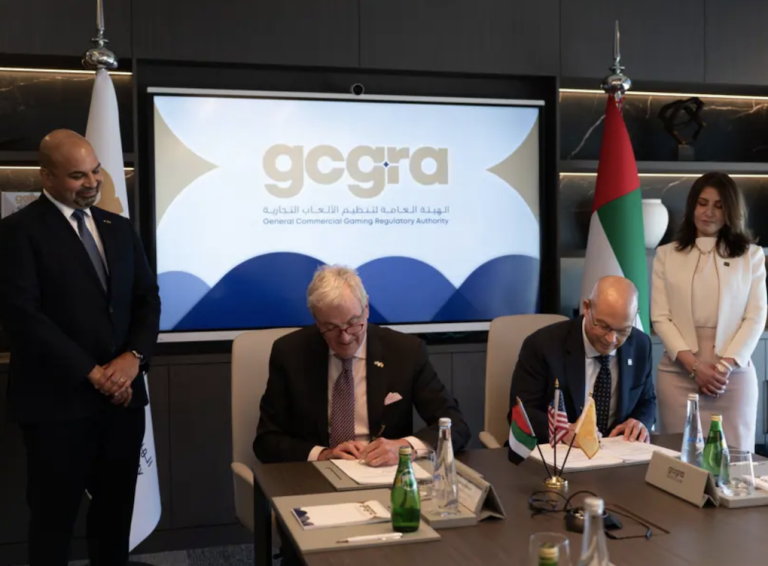
UAE’s GCGRA signs MOU with New Jersey gaming enforcement division

The UAE’s General Commercial Gaming Regulatory Authority (GCGRA) has announced a new MOU with the US state of New Jersey’s gaming enforcement division ‘focused on innovating land- and internet-based gaming’.

The agreement was signed during a visit from a New Jersey economic vision to the nation, encompassing the GCGRA and the New Jersey Department of Law and Public Safety, Division of Gaming Enforcement (DGE).

According to a release, the partnership will have ‘an emphases on cybersecurity, consumer protection and regulatory collaboration’.

Speaking of the MOU, Kevin Mullally, CEO of the GCGRA noted that “Commercial gaming is a cornerstone of our vision for diversified economic growth, significantly contributing to tourism and foreign investment […] This partnership with New Jersey’s DGE aligns cutting-edge technology with modern regulatory frameworks, unlocking economic potential while prioritizing consumer protection and responsible gaming.”

The official furthered that “This MOU will drive technological innovation and regulatory excellence, reinforcing the GCGRA’s position as a premier gaming destination.”

POSC backtracks on plans for e-casino industry entrance

Philippine e-lotto operator Pacific Online Systems Corp (POSC) says it is now “rethinking” its idea of entering the e-casino industry, despite announcing their plans just months ago.

According to reports, POSC’s Chair and Director, Willy Ocier, said that the shift was due to the nation’s government move to further look into Philippine Inland Gaming Operators (PIGOs), after offshore gaming operators (POGOs) were shut down by December 31st, 2024.

Ocier told media in the case of “uncertainty […] we’re not that aggressive on it”.

Back in January, POSC had signed an agreement to acquire a 37.5 percent stake in software and professional service provider HHR Philippines Inc (HHRPI), for some PHP150 million ($2.68 million). HHRPI also holds a license for online gaming under the “Buenas” brand.

Ocier notes that there is strong competition in the market, pointing out giant DigiPlus, which boasts over 40 million users. The executive indicates that currently the company does not plan to increase its stake in HHRPI.

Analysts adjust expectations for Macau’s May GGR and FY25, following April results

Following the release of Macau’s gross gaming revenue results for April, analysts are now weighing their expectations for May and the rest of the year.

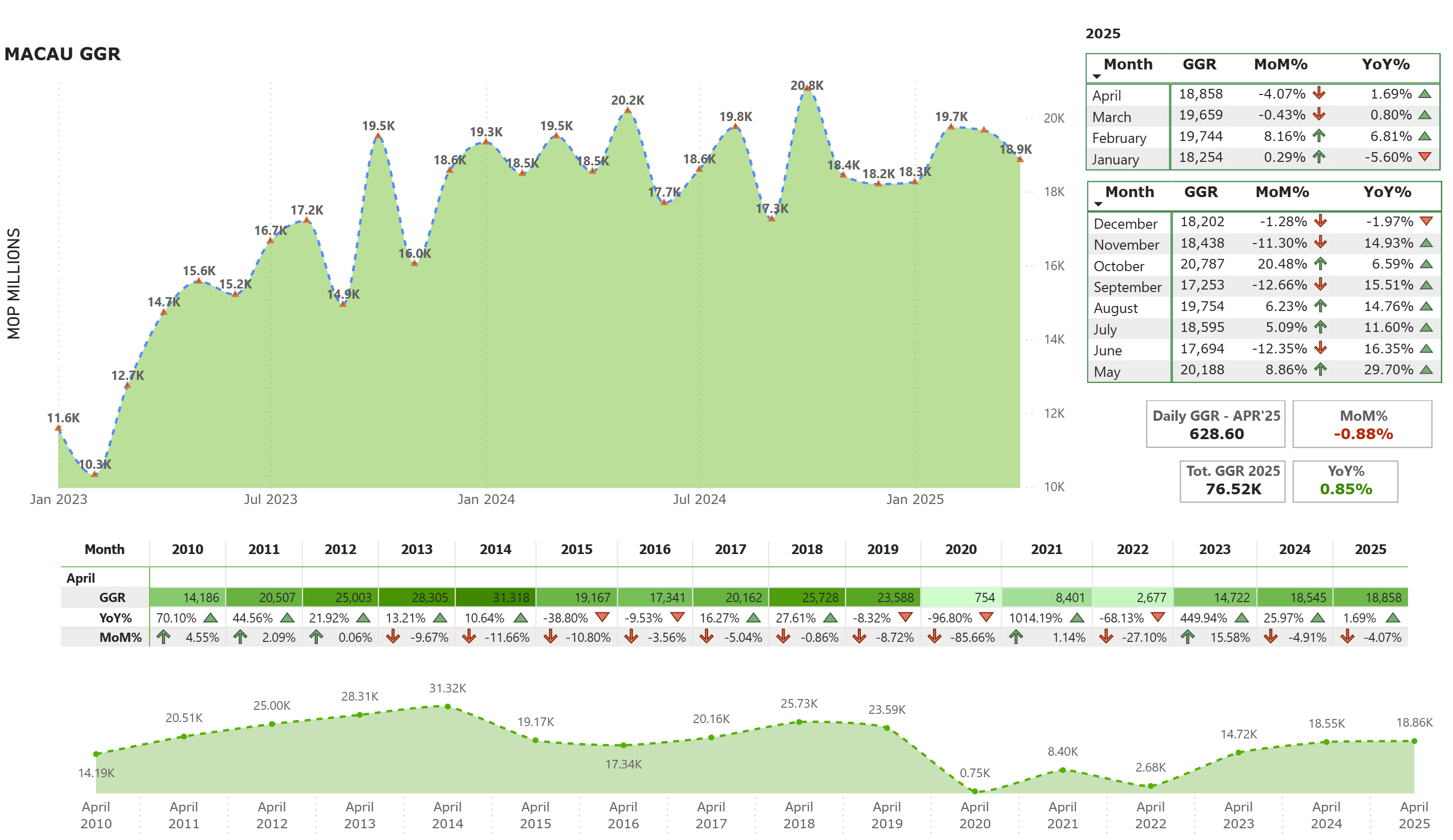
Macau’s GGR tally for April was MOP18.86 billion ($2.35 billion), down by 4.1 percent monthly but up by 1.7 percent yearly.

Macau April GGR totals $2.35B, down 4.1% month-on-month 

Vitaly Umansky, Senior Analyst at Seaport Research Partners, indicates that the new estimates for May GGR ‘may be conservative’, if there is a ‘stronger’ Golden Week. The analyst places May GGR down 1.7 percent yearly and up by 5.2 percent monthly.

This ‘better than expected April result’, coupled with the possibilities for Golden Week contributed to the estimate.

Analysts at Deutsche Bank were slightly less conservative in their estimates for May, with GGR expected to contract by 0.3 percent yearly, to $2.52 billion. They indicated that based on historical data, the figure could fall by up to 1 percent yearly in May.

Looking ahead, analyst Carlo Santarelli notes that 2Q25 GGR forecasts are for a 1.1 percent yearly increase to $7.14 billion, with FY25 expected to also be up by 1.1 percent, to $28.69 billion. FY26 results could increase by 3.5 percent yearly, to $29.69 billion.

Seaports analysis places Macau’s 2025 GGR growth forecast at 3.4 percent, ‘with higher growth in the second half of the year […] driven by increase in marketing efforts by operators and consumer trends in China’.

The group furthers that ‘China stimulus and policy measures are likely to help China’s economy and improve consumer confidence later this year.

Umansky notes that ‘Macau’s premium segment has been strong following recovery from COVID that began in early 2023,’ but cautions that ‘the base mass segment has been stubbornly weaker than anticipated’.

Data from the group indicate that mass GGR is running at about 112 percent of 2019 levels, while VIP is down 26 percent.

‘Within mass, premium is ~45 percent above 2019, while base mass continues to lag, nearly 20 percent below 2019. And, importantly, within base mass, while day-tripper business from HK and Guangdong is likely back to near pre-COVID levels, overnight base mass (destination base mass) has been weak, likely well below 70 percent of pre-Covid levels’.

Looking ahead to 2026/2027, Seaport indicates that expectations are for 7 percent GGR growth ‘but this could be higher on a stronger Chinese economy, materially improved consumer sentiment and any appreciation of the RMB’.

However, the group is expecting a market share shift, with giants Sands and Galaxy gaining share, while MGM and Wynn ‘are likely to be the largest share donors over the next two years’.

DATA.BET enhances mobile betting with Multi Widget innovation

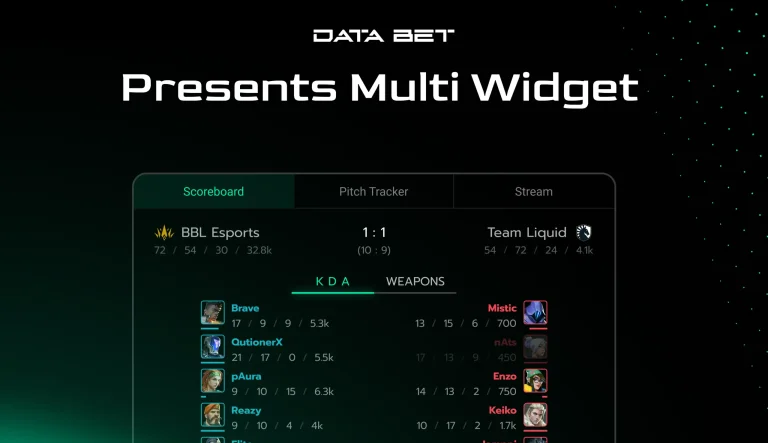
DATA.BET, a leading esports betting solutions provider, has introduced the Multi Widget—a cutting-edge module that seamlessly integrates Scoreboards, Pitch Trackers, and Video Streaming into a single, dynamic product.

Designed explicitly for mobile betting, the Multi Widget enhances the in-play user experience by uniting key engagement features into one seamless and interactive format. 

The new functionality unites all existing DATA.BET widgets offer partners a complete set of interactive tools through one integration. Fully mobile-optimized and easily configurable, the Multi Widget allows operators to adapt the setup with player demands while ensuring fast load times and seamless user interaction.

It also helps partners increase betting activity and improve retention, particularly on mobile, which generates close to 80% of total betting volume and demands the highest standards of speed and usability. Built to enhance the live betting journey, the Multi Widget delivers match updates, stats, and streaming in one place — enabling players to stay engaged and react quickly during dynamic game moments. 

Before the launch of the Multi Widget, DATA.BET had consistently expanded its product offering by introducing individual engagement tools throughout the past year. Scoreboards (delivering live match updates, player statistics, and event tracking), Pitch Trackers (providing 2D visualization of key match actions), and Video Streaming (allowing users to watch match broadcasts directly within the betting interface) were each launched separately to address different aspects of the in-play experience.

Today, all these functionalities are consolidated into one module, available for four main disciplines, with future expansion planned across additional sports.

“The Multi Widget is built to serve the expectations for today’s betting audience — fast, flexible, and mobile-first,” said Rostyslav Likhtin, Head of Product at DATA.BET. “This product reflects our focus on delivering practical tools, especially in mobile, where speed, simplicity, and accessibility are critical.” 

PAGCOR expands oversight of iGaming ecosystem through new accreditation framework

The Philippine gaming industry is undergoing a significant regulatory transformation as the Philippine Amusement and Gaming Corporation (PAGCOR) moves to formally oversee a broad array of business-to-business service providers.

This development marks a historic shift from a previously loosely regulated environment to one defined by structured compliance and standardization.

In a memo dated April 30th, 2025, PAGCOR’s Electronic Gaming Licensing Department (EGLD) announced the forthcoming release of a Regulatory Framework for the Accreditation of Gaming Affiliates and Support Service Providers. For the first time, third-party entities supporting licensed eGaming and iGaming operators—such as payment processors, game content suppliers, KYC solution providers, and customer support vendors—will be subject to direct regulatory accreditation.

Marie Antonette Quiogue, Romulo Law, PAGCOR expands oversight of iGaming ecosystem
Legal expert Tonet Quiogue, founder of Arden Consult

Legal expert Tonet Quiogue, founder of Arden Consult, told Asia Gaming Brief that PAGCOR’s latest policy signals “a significant shift in how support service providers and gaming affiliates will be regulated in the Philippines.”

She noted that although these businesses are integral to the functioning of the gaming ecosystem, they have historically operated without the need for formal registration with PAGCOR. “Previously, these businesses operated without direct accreditation from PAGCOR,” Quiogue explained. “Going forward, all covered entities must comply with defined application procedures, performance requirements, and ongoing regulatory conditions.”

In addition to introducing accreditation, PAGCOR is also redefining the structure of the industry by reclassifying entities previously known as Gaming System Service Providers.

These will now fall under the newly established category of Gaming System Administrators, reflecting the regulator’s intent to clarify and standardize the roles and responsibilities of key B2B participants. This move aims to enhance transparency and create a more structured regulatory environment—ultimately strengthening the integrity of the entire market.

The new framework is expected to include detailed implementation timelines, transition procedures, and compliance rules. Companies that fail to meet these standards risk losing their ability to work with PAGCOR-licensed operators.

Financial requirements will also increase. Entities seeking accreditation will need to pay a non-refundable application or renewal fee and provide a performance cash deposit. While exact figures are outlined in the memorandum, they are expected to be reiterated and expanded upon in the final framework.

Quiogue urged companies not to wait for the final guidelines before taking action. “We strongly encourage all potentially affected companies to assess the scope of their operations and prepare for accreditation requirements. Early planning will be key to avoiding business disruptions and ensuring continued access to the Philippine gaming market,” she advised.

For many service providers—particularly smaller or newer firms—this will require a thorough review of their compliance structures, legal status, and operational readiness to meet PAGCOR’s heightened expectations.

This regulatory expansion is not solely about enforcing rules; it reflects the Philippine government’s growing commitment to cultivating a reputable and well-regulated gaming sector. While the new framework may bring added administrative and financial demands, it also offers greater clarity, professionalism, and investor confidence.

By bringing support services within the formal regulatory perimeter, PAGCOR is sending a clear message: every player in the ecosystem must be accountable and operate to a defined standard.

As the Philippine gaming sector continues to evolve, this oversight model is likely to have far-reaching effects. “This has been in the works for some time—and will have wide-ranging implications for those supporting the regulated ecosystem,” Quiogue noted in her LinkedIn post when she shared the news.

MGM Resorts’ equity commitment for Osaka resort rises to $3B

US gaming operator MGM Resorts International has increased its equity commitment for the upcoming integrated resort in Osaka, Japan to JPY428 billion ($2.96 billion) as the project moves forward following a groundbreaking ceremony held on April 24th, 2025.

Jonathan Halkyard, Chief Financial Officer and Treasurer of MGM Resorts International, revealed the updated investment figures during the company’s first quarter 2025 financial results conference call.

“In Japan, MGM’s equity commitment has increased to JPY428 billion of which we now have remaining about JPY392 billion to invest for our future 43.5 percent ownership stake,” Halkyard stated. “Despite the increase driven by updated spend estimates as we finalized our negotiations with contractors, we still have a high conviction and a high teens percentage return on this project and remain on time to open in 2030.”

The increased commitment represents MGM’s confidence in the Japanese market despite rising costs. According to Halkyard, the company expects to contribute approximately $600 million to $700 million per year over the next four years through 2028.

The Osaka integrated resort represents a significant expansion of MGM’s international footprint. The company is partnering with Japanese financial services group ORIX, with various minority shareholders comprising the remainder of the ownership structure.

Financing for the development includes a JPY530 billion ($3.53 billion) credit facility that will support construction.

The Osaka integrated resort, slated to open in 2030, comes after years of careful planning and negotiations following Japan’s legalization of casino gambling in 2018. According to planning documents, the facility will feature 2,500 hotel rooms, a shopping mall, a 3,500-seat theater, spa and fitness center, convention facilities, and diverse dining and entertainment options. Japanese law limits the gaming floor to 3 percent of the total indoor space.

PAGCOR posts $502M in 1Q25 revenues, net income up 23%

The Philippine Amusement and Gaming Corporation (PAGCOR) reported robust financial results for the first quarter of 2025, with revenues reaching PHP28.07 billion ($502 million), an 11.2 percent increase from PHP25.24 billion ($452 million) in the same period last year.

Gaming operations remained the primary revenue source, generating PHP25.52 billion ($457 million). Electronic Games and E-Bingo led the segment, contributing PHP14.32 billion ($256 million), or 56 percent of total gaming revenue.

Licensed casinos followed with PHP8.32 billion ($149 million), accounting for 32.6 percent, while PAGCOR-operated casinos contributed PHP2.88 billion ($52 million), or 11.31 percent.

The agency also reported improved cost efficiency, with operating expenses reduced by 15.54 percent to PHP6.21 billion ($111 million), down from PHP7.36 billion ($132 million) in the first quarter of 2024. As a result, PAGCOR recorded a net income of PHP4.22 billion ($76 million), marking a 23 percent increase from PHP3.43 billion ($62 million) in the same period last year.

PAGCOR, Philippines

PAGCOR Chairman and CEO Alejandro H. Tengco attributed the strong performance to operational efficiency and strategic reforms. “This solid performance reflects PAGCOR’s commitment to responsible governance and fiscal discipline,” he stated. “The gains we have made in the first quarter will allow us to contribute even more to nation-building for the rest of the year.”

Tengco affirmed that the state gaming agency will continue to innovate and enhance regulatory oversight, ensuring that revenues directly benefit Filipino citizens through nation-building and corporate social responsibility initiatives.

PAGCOR’s contributions to nation-building during the period reached PHP18.9 billion ($338 million), representing a 21.5 percent increase from the PHP15.56 billion ($279 million) recorded in the first quarter of 2024.