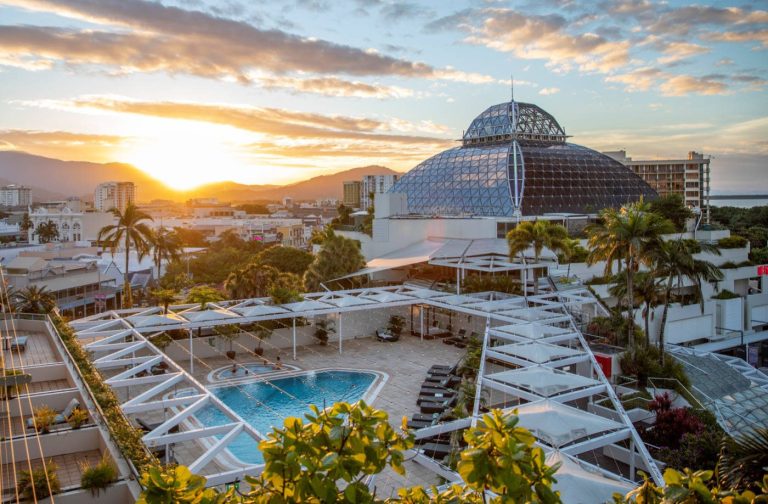
Australia’s Reef Casino operator has received an updated takeover bid from an entity associated with the Morris Group.
According to a Monday filing, with the Australian Securities Exchange, Reef Corporate Services Limited (RCSL), the responsible entity for Reef Casino Trust, received an offer for AU$184.3 million ($120.07 million) – at AU$3.70 ($2.41) per unit in regards to its shares. The proposal also ‘contemplates the acquisition of Casinos Austria International (Cairns) and RCSL’ by another entity associated with the Morris Group.
The group notes that the revised proposal ‘now includes a conditional offer to enter into share purchase agreements in respect of CAIC and RCSL.
In late July, an entity associated with the Morris Group had offered some AU$184 million ($119.88 million) to take over RCSL. This follows a bid by Iris on July 11th, valued at AU$17 million ($116.34 million). The first bid encompassed an ‘off-market cash takeover bid to acquire all of the ordinary units in Reef Casino Trust’.
Despite the new, updated bid from the Morris Group entity, the directors of CRSL ‘main their recommendation of Iris’ offer’.
Hong Kong-listed LET Group is expecting to significantly lower its loss in the first half of this year, as it liberated itself from the loss associated with a former joint venture.
According to a profit warning issued on Monday, the group is expecting to decrease its loss from HK$75.3 million ($9.6 million) in 1H24 to HK$42.8 million ($5.45 million) in 1H25.
The group notes that this was boosted by having cut ties in a joint venture that in 1H24 cost it HK$234.3 million ($29.85 million) in losses.
The group also benefited from a HK$13.4 million ($1.71 million) gain in interest income during the period, as well as net exchange gains of HK$184.7 million ($23.53 million).
The loss reversal stems from the company’s divestment of its interest in Vietnamese integrated resort Hoiana Resort & Golf, now operated by the VMS Group.
Currently LET Group is attempting to also divest its interests in the Tigre de Cristal hotel casino in Vladivostok – a project which has been plagued by the ongoing conflict in the Ukraine.
The group previously indicated that it was now focusing its efforts solely on its Westside City integrated resort project in the Philippines, via its majority stake in Suntrust Resort Holdings.
However, in mid-July the group warned that its current assets and liabilities ‘indicate the existence of a material uncertainty which may cast significant doubt on the Group’s ability to continue as a going concern’.
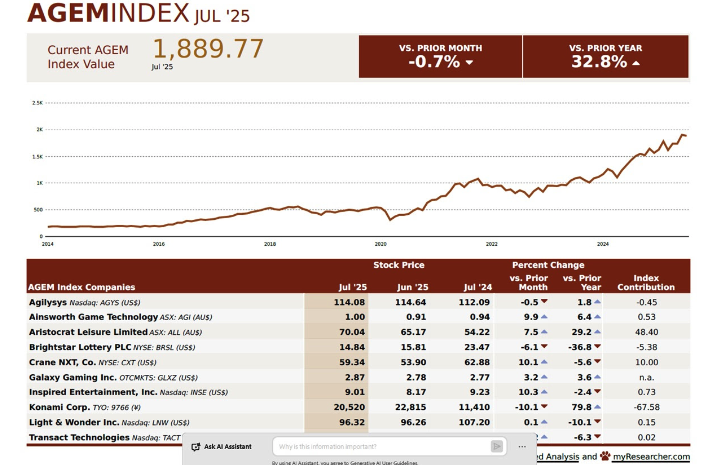
The AGEM Index retracted slightly in July, falling by 0.7 percent from the prior month. Compared to one year ago, the index was up by 32.8 percent.
During the month, seven of the 10 AGEM Index companies reported stock price increases, which resulted in seven positive contributions and three negative contributions to the AGEM Index.
The largest positive contribution to the monthly index was Aristocrat Leisure Limited, whose 7.5 percent increase in stock price led to a 48.4-point gain for the index.
The largest negative contribution to the index was Konami Corp, whose 10.1 percent decrease in stock price resulted in a 67.58 point loss to the AGEM Index.
In August, two of the three major US stock indices increased. The NASDAQ rose by 2 percent month-on-month, while the S&P 500 increased 0.6 percent. Meanwhile, the Dow Jones Industrial Average fell by 2 percent from the prior month.
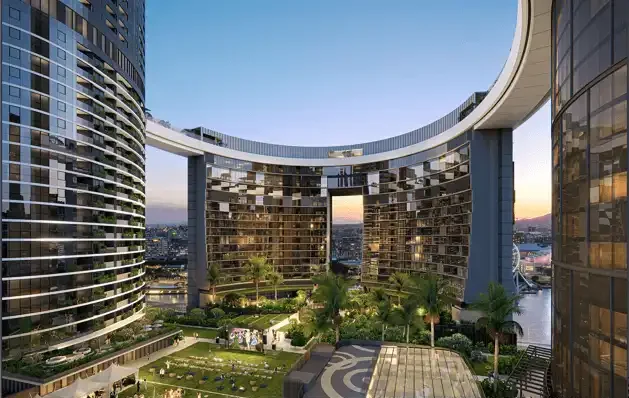
Embattled Australian gaming operator The Star has reportedly revived plans to sell its stake in Queen’s Wharf Brisbane.
According to the Australian Financial Review, the deal is being made with its joint venture partners Chow Tai Fook and Far East Consortium.
This comes after a previous sale agreement was terminated as the parties were unable to agree on key components of the sale. Following the negotiation breakdown, Star was liable to pay some AU$10 million ($6.52 million) to the JV partners, as well as AU$31 million ($20.2 million) before September 5th. The negotiation breakdown also saddled The Star with its portion of debt relating to the project – totaling over AU$700 million in liabilities and AU$350 million ($228.1 million) in development costs.
According to sources cited by the publication, a binding deal regarding the sale has already been reached.
The Star on Tuesday halted trading of its shares on the ASX, pending a ‘further announcement’.
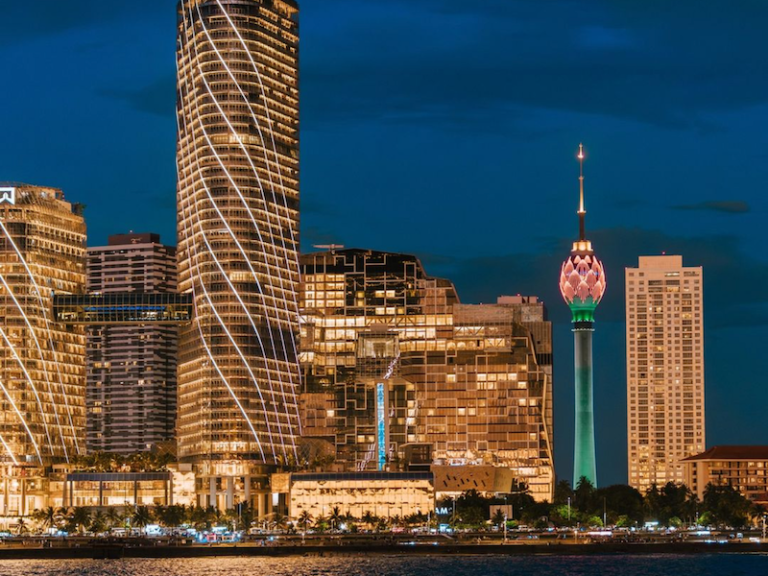
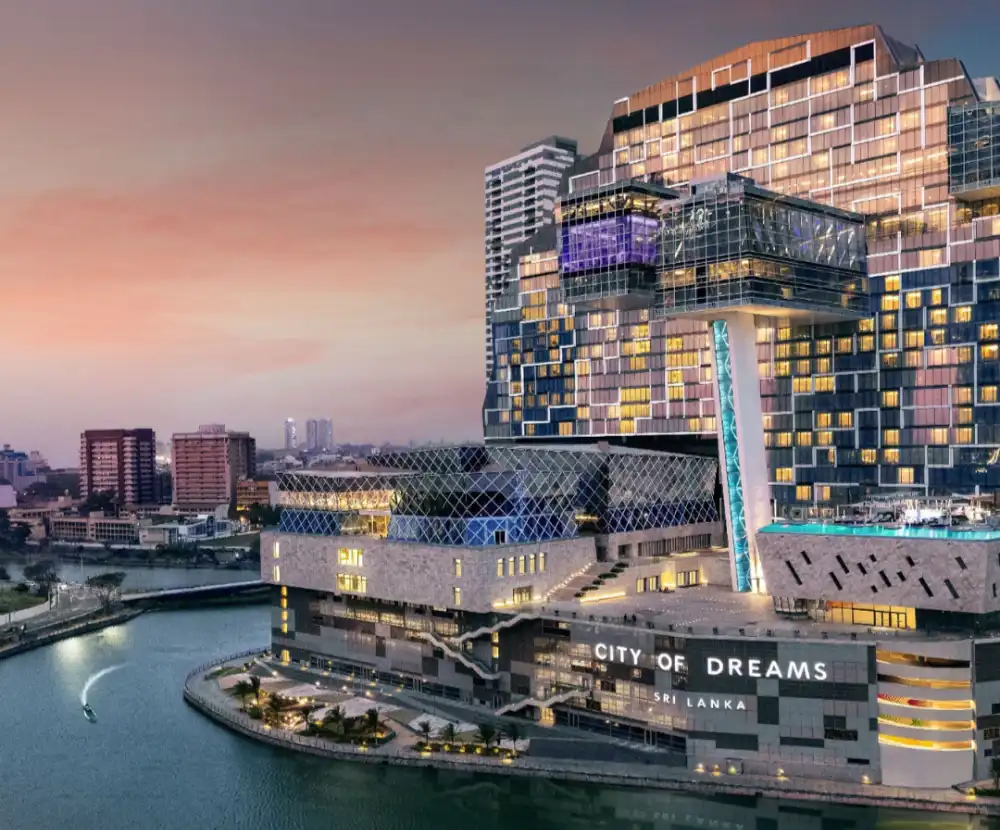
The launch of City of Dreams Sri Lanka, South Asia’s first integrated resort, could transform the island nation into “India’s Macau” — but its success hinges on the government’s ability to balance regulation, ethics, and economic opportunity, according to tourism and hospitality specialist Dharshana Weerakoon.
Dharshana Weerakoon, a specialist in tourism and hospitality
Speaking to AGB, Weerakoon noted that the comparison between Sri Lanka’s potential role for India and Macau’s position for China is “aspirational but not without merit,” pointing to geographic proximity, cultural familiarity, and improving connectivity as key advantages.
“From Chennai or Bangalore, Colombo is closer than Mumbai to Goa,” he said. “With visa simplification and improved flight frequencies, Sri Lanka could indeed become India’s luxury playground—especially for gaming, entertainment, and premium escapes.”
However, he cautioned that replicating Macau’s trajectory would require clear and consistent regulatory frameworks, careful management of public opinion and religious sensitivities, and parallel infrastructure development. “Macau succeeded because of regulatory clarity and consistent policy signals. Sri Lanka will need to emulate that,” he stressed. “Success will depend on whether the government can strike a balance between regulation, ethics, and economic opportunity.”
The $1.2 billion City of Dreams Sri Lanka project officially fully opened on August 2nd, marking the country’s largest-ever private investment and Melco Resorts & Entertainment’s first venture into South Asia. The property is a collaboration between Hong Kong-listed Melco and conglomerate John Keells Holdings.
Chairman Lawrence Ho described the integrated resort as a potential game-changer, telling attendees at the launch that Sri Lanka could become “India’s Macau” as the company targets the lucrative South Asian market. The resort features two hotels with a combined 800 rooms, gaming facilities licensed for 20 years, 17 restaurants and bars, luxury retail outlets, and extensive conference spaces. Its marketing strategy focuses on attracting high-spending tourists from India, the Middle East, Russia, and China.
Shift in tourism model
Weerakoon described the resort’s opening as “a transformative milestone” for Sri Lanka’s tourism sector. “It’s not merely another property opening, but a strategic pivot point for the nation’s tourism positioning,” he said. Traditionally, Sri Lanka has promoted its beaches, tea plantations, and cultural heritage sites, with a focus on longer, lower-yield stays.
By contrast, the integrated resort model is “vertically integrated, high-yield, short-stay, and experience-rich,” drawing on models from Macau and Singapore. “It centralizes premium offerings under one roof—gaming, luxury retail, world-class dining, performances, and VIP hospitality—attracting a very different traveler profile: high-spending, time-constrained, and experience-oriented,” he explained.
Economic potential
The resort’s impact is expected to be measured more in revenue than in visitor volume. “Average Daily Spend and Tourism Receipts per Visitor are the critical metrics here,” Weerakoon noted. Other indicators include per capita spending from key source markets, increases in direct air connectivity and private jet movements, and growth in Colombo’s premium hotel rates.
“If the model works as intended, Sri Lanka will see a shift from low-yield group travel to high-yield independent travelers—high-net-worth individuals and aspirational luxury seekers—especially from India, UAE, and ASEAN markets,” he said.
While there is potential for the integrated resort to create a “self-contained bubble,” Weerakoon believes it could also become a gateway for high-end cultural and adventure tourism. “It could become a feeder system for curated, high-end excursions—artisan tours, private heritage experiences, wildlife safaris—with appropriate partnerships,” he said.
For smaller businesses to benefit, he urged them to upgrade service standards, embrace storytelling, and form strategic alliances. “Cultural tourism doesn’t have to compete—it needs to complement,” he added.
Indian market focus
India remains Sri Lanka’s largest source of visitors, and Weerakoon highlighted several lucrative segments: wedding and MICE travelers seeking high-end venues; short-stay leisure seekers from South India; spiritual pilgrims; and affluent millennials and Gen Z travelers.
“There is a rapidly growing elite class, particularly from Tier-1 cities, accustomed to Dubai, Bangkok, and Singapore standards,” he said. “These travelers are willing to spend on experiences, provided service quality and brand confidence match.”
The primary target for the resort, he suggested, should be ultra-high-net-worth individuals and high-net-worth clients, young affluent professionals, destination gamers and VIP junket clients, and millennial couples and families seeking bundled luxury experiences.
Beyond the integrated resort, Weerakoon recommended developing complementary high-end tourism products, including private island getaways, luxury tea plantation retreats with aviation transfers, African-style wildlife safaris, culinary tourism, and festival-linked travel itineraries. “The golden rule is convenience, privacy, and Instagram-worthiness,” he said.
Risks and challenges
Weerakoon identified several potential obstacles to success: inconsistent policy, overregulation, cultural backlash against gaming, service quality gaps, currency volatility, and infrastructure limitations. “Mitigating these risks requires transparent regulation, robust stakeholder engagement, and investment in human capital,” he advised.
He concluded that City of Dreams Sri Lanka represents a bold new chapter for the nation’s tourism industry, but its long-term impact will depend on how well it is integrated into a broader national tourism strategy. “If leveraged wisely, this could mark Sri Lanka’s ascent into Asia’s premier league of high-value tourism destinations,” he said.
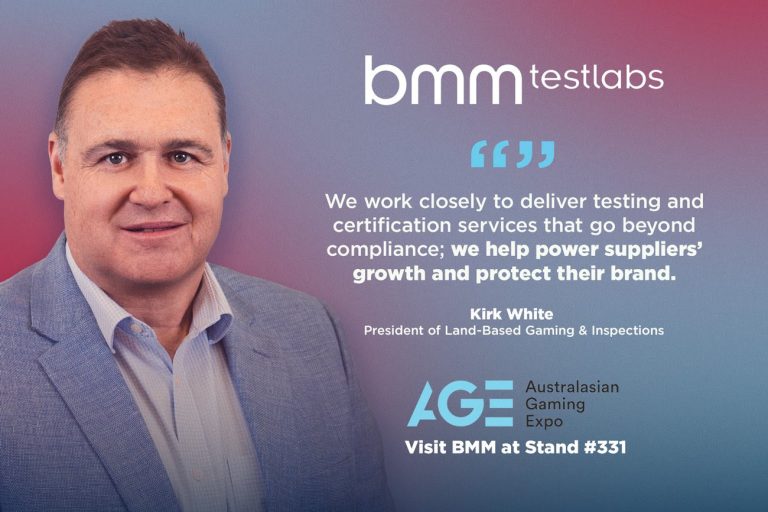
BMM Testlabs, the world’s original gaming test lab and product certification consultancy, today announced that it is exhibiting at the Australasian Gaming Expo (AGE) this week, August 12th-14th, at the ICC Sydney.
BMM will welcome attendees at Stand No. 331 to showcase its industry-leading suite of product compliance testing services, quality assurance testing services, and cybersecurity protection solutions tailored to the Australasian gaming market.
With over four decades of global expertise and strong roots founded in Australia, BMM continues to deliver local insight with global reach, supporting suppliers with land-based and digital product compliance solutions
BMM’s President of Land-Based Gaming & Inspections Kirk White said, “At BMM, we’re proud to combine local knowledge with global strength. Our Australasian teams understand the unique regulatory and market challenges across the region, and we work closely to deliver testing and certification services that go beyond compliance; we help power suppliers’ growth and protect their brand.”
BMM’s experienced teams across Australasia, with offices in Melbourne and Sydney, Australia, as well as Macau, Singapore, and India, are the trusted testing partner of choice in this expansive region. The Company’s expertise spans land-based platforms, games, and systems; lottery testing; and the full spectrum of digital gaming, including iGaming, sports betting, iLottery, and mobile.
Wazdan, the gain-focused developer behind some of the world’s most rewarding casino game experiences, has announced the continued expansion of its highly successful Multidrop network promotion, a core pillar of its Online gaining strategy.
Now live across 16 countries, including key regulated markets in the UK, Italy and Ontario, the campaign continues to deliver exceptional results, with participating operators reporting an average GGR uplift of 65.09 percent.
Multidrop is designed to drive long-term operator growth and player retention. Offering a seamless integration process activated with no additional technical effort, it provides instant in-game rewards fully funded by Wazdan, making it an accessible and low-risk proposition for partners.
With the next wave of activations already underway, operators still have the opportunity to join or re-engage their players through a promotion that consistently delivers results.
Beyond the numbers, Multidrop supports joint marketing communications that increase game visibility and amplify brand recognition, further enhancing its value to Wazdan’s network of partners.
Andrzej Hyla, Chief Commercial Officer at Wazdan, said: “We are incredibly proud of the measurable success Multidrop has delivered, reinforcing our commitment to Online gaining.
“As a fully-supported and zero-cost solution that continues to exceed expectations, it is a perfect example of how we collaborate with operators to drive sustainable results.”
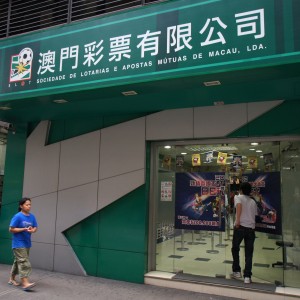
Macau Slot, the city’s sole sports betting operator, says it does not expect Hong Kong’s planned legalization of basketball betting to dent its business, even as competition between the two markets could grow in the future.
“Concerning the possible basketball betting legalization in Hong Kong, we don’t foresee an immediate impact on our results since almost 90 percent of our business comes from local customers,” said Harry Lan, Chief Betting Officer at Macau Slot said on Monday.
Hong Kong’s Financial Secretary Paul Chan announced in February that the city would actively explore regulating basketball betting and had invited the Hong Kong Jockey Club to submit proposals.
The club reportedly intends to create a system similar to its football betting model, with a proposed 50 percent tax rate and a possible launch in 2026. Government projections suggest the measure could generate about HK$1.5 billion (US$193 million) annually in tax revenue by its fourth year.
Lan noted that football remains the dominant betting category in Macau, accounting for around 60 percent of wagers on the company’s platform, with basketball making up the remaining 40 percent. Macau residents and visitors can place bets at physical outlets across the city as well as online and by phone.
Macau Slot, a subsidiary of Sociedade de Turismo e Diversões de Macau (STDM)—which also controls gaming concessionaire SJM—recently had its concession extended until June 5th, 2026. Legislator Angela Leong, co-chairperson and executive director of SJM Holdings, holds a 72 percent stake in the company, according to a September 2024 filing.
The firm’s net profits rose 5.6 percent year-on-year to MOP130.88 million (US$16.2 million) in 2024, the highest since the COVID-19 pandemic, though still below the MOP154.8 million ($19.1 million) posted in 2019.
While Macau Slot’s betting business is steady, its broadcasting partner, M Plus Sports Media Company Limited, is expanding its offerings to boost viewership and engagement. The company announced this week it had secured exclusive rights to air the Premier League and FA Cup in Macau from the 2025/2026 to 2027/2028 seasons.
In partnership with Macau Cable Television, M Plus Sports will deliver live matches through its app and on dedicated TV channels (34, 35, 36, and 37).
“We need some technical support from the TV station in terms of receiving satellite signals and a local studio to produce local commentary. I’m hoping this can double or triple our viewership, complementing the online app,” said Alan Yung, Vice-President of Strategic Partnerships, at a Grand Lisboa launch event.
The broadcaster already airs Italy’s Serie A, Spain’s La Liga, Australia’s A-League, and South Korea’s K League, alongside other sports events.
Yung said customers have high expectations, noting “Customers want everything, especially free of charge, but of course, they need to pay for it. We are looking for more opportunities and matches that can be available to Macau viewers at a reasonable cost.”
The company will also carry the Bundesliga in the coming season, adding to its DFB Pokal coverage. “We select 250 to 300 matches from around the world and broadcast them in Cantonese,” Yung said.
The Premier League and FA Cup are among the most popular football leagues globally, and M Plus will enhance coverage with live commentary in both English and Cantonese, plus news updates and post-match analysis.
Established in 2017, M Plus focuses on broadcasting and livestreaming football and basketball games, and works with Macau Slot on the sports betting side.
Macau’s sports betting market remains regulated under a framework where Macau Slot operates as the sole licensed provider, despite the removal of its exclusivity in 2021—no new competitors have emerged so far.
In a previous interview with AGB, Yung noted that approximately 90 percent of M Plus’ users engaged in sports betting.
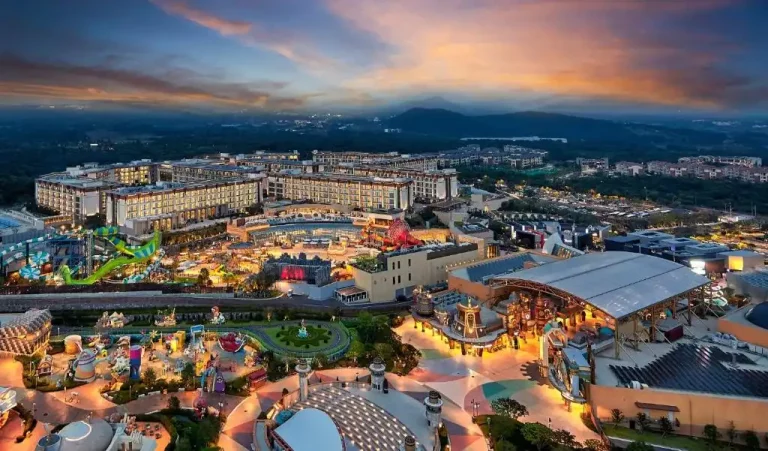
South Korean integrated resort operator Shin Hwa World has announced that it is expecting to see an increase in its loss of up to 12 percent for the first half of the year, amongst drops in its gaming revenue.
According to a Monday filing with the Hong Kong Stock Exchange, Shin Hwa World, operator of the Jeju Shinhwa integrated resort which includes the Landing Casino, noted that there was ‘pressure on room price and dampened customer spending’ from its integrated resort and gaming segment.
It also saw a decrease in fair value of its investment properties compared to the same period in 2024.
The group noted that it is ‘still in the course of assessing the impairment loss on intangible assets’.
This comes after the group reported a 5.4 percent increase in loss for 2024, totaling HK$484.14 million ($65.53 million). This was despite a 3.7 percent yearly increase in consolidated revenue during FY24, to HK$1.07 billion ($137.94 million). Gaming revenue during the period was up by 350 percent, to HK$210.28 million ($27 million).
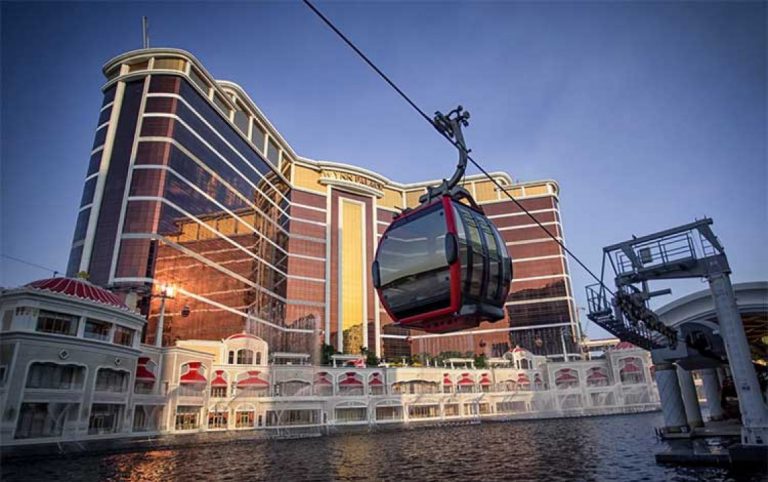
Macau gaming operator Wynn Macau has reduced its average cost of debt to 5 percent as of June 30th, 2025, down from 5.5 percent as of March 31st, 2025.
This improvement primarily stems from lower Hong Kong Interbank Offered Rate (HIBOR) levels in the second quarter of 2025, which reduced the average borrowing cost on its revolving credit facility (RCF) to 3.38 percent from 5.76 percent over the same period. According to an investment memo from CreditSights, a financial services provider under the Fitch Group, this development supports the company’s strategies to manage upcoming debt maturities and potentially reduce leverage.
The memo notes that $903 million of the $1.14 billion drawn on the RCF is HIBOR-based, driving the cost savings. Approximately 80 percent of Wynn Macau’s total debt is fixed-rate, providing stability amid fluctuating interest rates. With an unrestricted cash balance of approximately $1.5 billion, the company is well-positioned to address its $1 billion 5.5 percent WYNMAC 2026 bond, due January 2026. Liquidity is further strengthened by $351 million in available RCF as of June 30th, 2025, with an additional $1 billion increase in borrowing capacity on July 31st, 2025, raising the total undrawn RCF to $1.35 billion.
CreditSights analysts suggest that drawing on the upsized RCF could be a cost-effective option for refinancing the upcoming bond, given its lower cost of approximately 3.38 percent compared to yields on Wynn Macau’s dollar bonds, which range from 5.6 percent to 6 percent. Alternatively, a combination of bond refinancing and repayment, leveraging the company’s ample cash reserves, could help Wynn Macau actively lower its leverage levels.
Financially, the memo estimates that Wynn Macau generated approximately $128 million in free cash flow (FCF) in the second quarter of 2025, based on quarterly capital expenditures (CAPEX) of approximately $70 million and interest expenses of around $56 million. This resulted in an EBITDAR-to-interest coverage ratio of 4.5 times for the quarter. The company has projected an additional $135 million to $215 million in CAPEX for the second half of 2025, following $135 million in the first half. Full-year CAPEX is expected to range from $200 million to $250 million for projects and $70 million to $80 million for maintenance.
Non-casino revenues declined 11 percent year-over-year to $142 million, primarily due to a 23 percent drop in room revenues. Average daily rates (ADRs) at Wynn Palace and Wynn Macau properties fell 27 percent and 9 percent, respectively, though occupancy rates remained robust at 98.7 percent and 99.4 percent.
Consequently, Wynn Macau’s market share decreased to approximately 11.9 percent in the second quarter of 2025, down from 12.3 percent in the first quarter and 12.6 percent in the same period of 2024.