



Macau’s six gaming concessionaires have made measurable progress in expanding non-gaming businesses and supporting economic diversification since the new Gaming Law took effect, but the city’s public finances and employment base remain overwhelmingly dependent on the casino industry, according to an academic study published recently.
The study, titled An Assessment of Macau Gaming Companies’ Social Responsibility Performance in 2023–2024, was authored by Zeng Zhonglu, Huang Ziying, and Zeng Jia and published in Global Gaming & Tourism Research, an academic journal of the Center for Gaming and Tourism Studies at Macao Polytechnic University (UPM). It assesses how the six concessionaires fulfilled their social responsibility obligations during the first two years of the new concession cycle, with a focus on fiscal contributions, employment, and non-gaming development.
According to the research, the six gaming operators paid a combined MOP164 billion ($20.4 billion) in taxes and fees to the Macau SAR government in 2023 and 2024. This accounted for about 82 percent of the government’s recurrent revenue and roughly 76 percent of total public revenue during the same period, underscoring the continued dominance of gaming in Macau’s fiscal structure.
‘The data clearly show that the gaming industry remains the core pillar of public finance and employment in Macau,’ wrote the authors in the study, adding that the overall level of industrial concentration remains high despite ongoing diversification efforts.
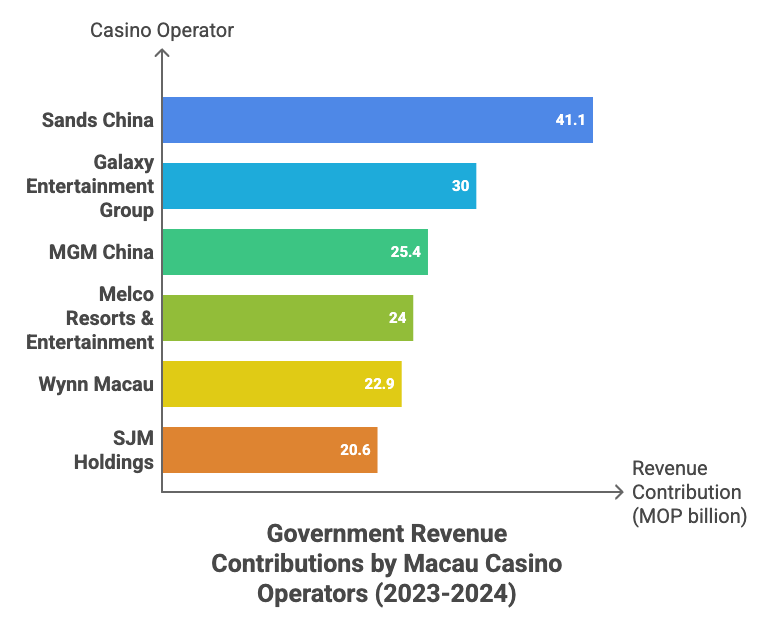
Among the six operators, Sands China was the largest contributor to government revenue during the two-year period, with total payments of MOP41.1 billion ($5.1 billion), representing about 25.1 percent of the industry total. Galaxy Entertainment Group ranked second with MOP30 billion ($3.7 billion), followed by MGM China with MOP25.4 billion ($3.2 billion), Melco Resorts & Entertainment with MOP24 billion ($3 billion), Wynn Macau with MOP22.9 billion ($2.9 billion), and SJM Holdings with MOP20.6 billion ($2.6 billion).
Employment and non-gaming revenue show progress
The study also highlighted the sector’s role as a major employer. On average, the six concessionaires employed nearly 78,000 Macau residents annually in 2023 and 2024, representing about 27.3 percent of the city’s total local workforce. Sands China and SJM Holdings each accounted for roughly a quarter of gaming-related local employment, reinforcing the industry’s importance to household incomes and social stability.
At the same time, the research documented tangible growth in non-gaming activities. Total non-gaming revenue generated by the six concessionaires reached approximately MOP70.8 billion ($8.8 billion) over 2023 and 2024, with meetings, incentives, conventions and exhibitions (MICE), entertainment performances, hotels, and related facilities accounting for the largest shares.
Sands China again led the industry in absolute terms, recording about MOP27.6 billion ($3.4 billion) in non-gaming revenue over the two years, or roughly 39 percent of the industry total. Galaxy followed with MOP12.2 billion ($1.5 billion), while Wynn Macau generated MOP10.6 billion ($1.3 billion). Melco, MGM China, and SJM reported smaller but still significant non-gaming contributions.
‘Non-gaming businesses have already shown substantive growth,’ indicates the study, citing the steady rise in revenue from conventions, entertainment, hotels, and cultural offerings. ‘However, an increase in non-gaming revenue does not mean that Macau’s industrial structure has already undergone a fundamental transformation,’ warn the academics.
The authors emphasized that while non-gaming income is expanding, its scale remains modest relative to gaming, and the city’s fiscal and employment dependence on casinos remains largely unchanged. They warned that diversification should be assessed not only by revenue growth, but also by whether new sectors can develop into independent and sustainable economic pillars.

Investment commitments under the new concession cycle
Beyond revenue and employment, the paper examined concessionaires’ investment commitments under the new contracts. The six operators initially pledged a combined MOP118.8 billion ($14.8 billion) in investment over the 10-year concession period, with more than 90 percent earmarked for non-gaming projects. After Macau’s gross gaming revenue exceeded MOP180 billion ($22.4 billion) in 2023, the contracts triggered an additional 20 percent investment requirement, lifting total committed investment to about MOP140.5 billion ($17.5 billion).
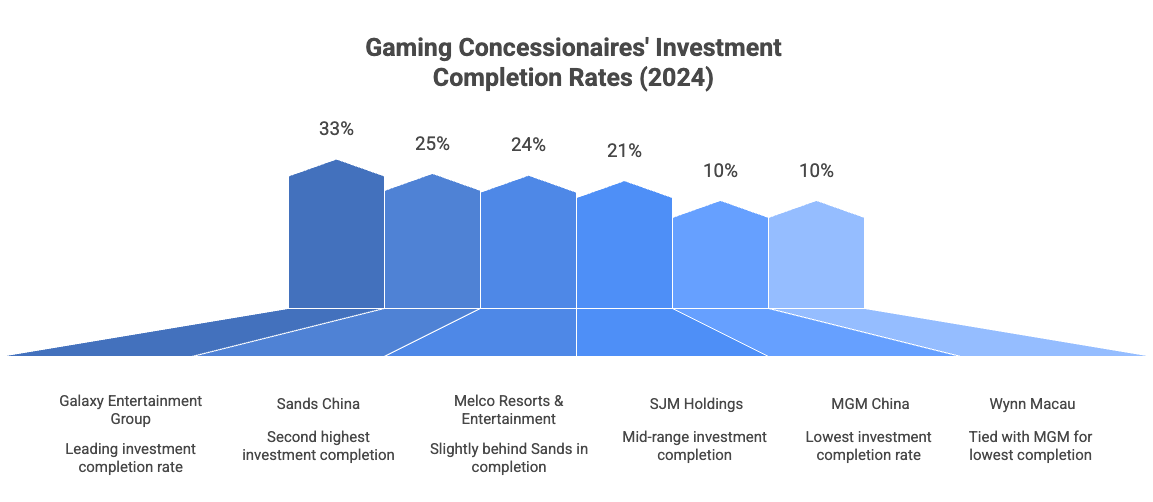
As of the end of 2024, the six gaming concessionaires had completed about 22 percent of the total investment commitments under the new concession contracts. Progress varied among operators, with Galaxy Entertainment Group (GEG) recording the highest completion rate at around 33 percent, followed by Sands China at 25 percent and Melco Resorts & Entertainment at 24 percent. SJM Holdings had completed approximately 21 percent of its pledged investment, while MGM China and Wynn Macau each reported completion rates of about 10 percent.
The study noted that differences in investment progress largely reflect variations in project readiness and implementation timelines. Some concessionaires had projects already under construction before the start of the new concession period, allowing post-2023 spending to be treated as a continuation of existing developments. Others required more time to initiate new projects following the signing of concession contracts, resulting in slower completion ratios.
The researchers cautioned that lower completion rates do not necessarily indicate weaker compliance. Part of the pledged commitments includes spending on overseas promotion, community revitalization, and event programming, which are not classified as capital investment under accounting standards and therefore are not reflected in reported completion figures. As a result, the study said investment progress should be assessed in conjunction with project type and broader economic impact, rather than viewed in isolation.