



Gambling tax rates ‘should ideally be between 10 to 20 percent of GGR in order to retain as large a proportion of gambling within the legal, licensed and controlled market’. That’s according to consultant Martin Purbrick, based upon the Laffer Curve, used to measure ideal tax rates for optimal collection and market sustainability.
In a piece published in the monthly dispatch of the International Federation of Horseracing Authorities (IFHA), Purbrick highlights how ‘Gambling tax is fraught with contradictions because government policy makers seek to reduce gambling harm for consumers but can become reliant upon the taxation revenue’.

Furthermore, increases in taxation have been proven to cause consumers to migrate to the illegal market, facing increased risk, less oversight and opening themselves to higher risks of gambling-related harm.
‘Gambling tax is not an effective policy instrument to discourage consumers from gambling’, notes the author and gaming expert.
Laffer Curve
Purbrick makes use of the Laffer Curve concept – focused on the impact of taxation on work and output. The author notes that the concept ‘has an even more pronounced effect when applied to gambling markets because gambling is highly sensitive to shifts in price (especially sports betting)’. Also, the ability for consumers to shift to illegal offshore gambling platforms when faced with higher price points means that the ‘revenue-maximizing point on the Laffer Curve for gambling tax is likely to be comparatively lower than that for income taxes’.
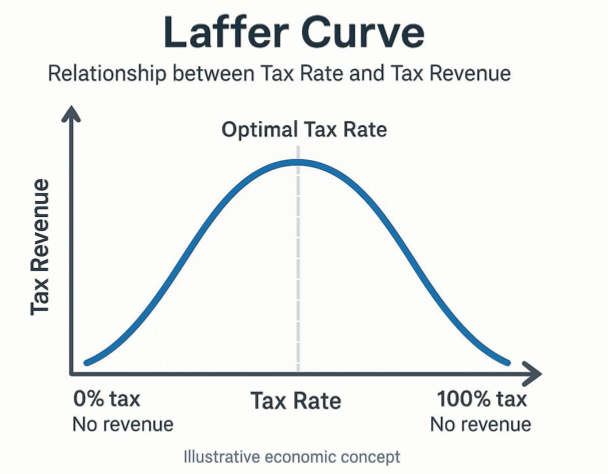
Using the curve, Purbrick highlights that ‘sustainable gambling taxation depends not on maximization but on optimization’.
Can the legal industry compete?
To optimize the legal gambling market, there need to be ‘appropriate products and prices that can outcompete the illegal market’. The operators providing such products, ‘must be allowed to prosper to protect consumers through regulation’.
Given how illegal operators are not subject to tax or regulatory oversight, this has been a long-standing problem, as such operations require lower profit margins, can offer more competitive bonuses, and do not have to go through the regulatory red tape such as KYC (know your customer) and AML/CTF (anti-money laundering and counter-terrorism financing) regulations.
Purbrick notes that there is ‘often an assumption by government policy makers, as well as think tanks advising them, that consumers faced with higher gambling taxes will simply stop gambling’.
That is simply not the case, with consumers willing to shift to the illegal market as the legal market price increase result in ‘lower odds and less chance of winning’. Additionally, ‘licensed operators may also exit the legal market because of lower margins’.
What can be done
Designing an optimal tax system ‘requires building relationships with licensed operators so that the objectives of government policy makers and gambling regulators to protect consumers can be closely managed,’ notes the expert.
“Effective channelization to the legal market is key to success, and the measurement of this should be credible and, if possible, independent from government.”
But there is also the ‘gambling tax revenue trap’, which ‘entails an eventual reliance on income from this form of taxation for purposes not related to the gambling market’.
So, what’s the path?
‘An adaptive gambling tax framework that can respond to changing marketing conditions should also be developed in parallel with effective monitoring and enforcement of the illegal market, which must now be a collaborative international effort’.
Purbrick cites research by Regulus Partners into the Netherlands, which found that “the Laffer Curve as it relates to online gambling tax rates hits somewhere between 25 percent and 30 percent of GGR, after which the Black Market starts to grow exponentially, causing tax yields to fall”.
Purbrick therefore places the ideal gambling tax rate at between 10 and 20 percent of GGR.
What’s in place now
The Asia and APAC regions face varying taxation rates. When looking at online gaming, it is more common for Asian nations to have outlawed the activity entirely.
Nations and jurisdictions such as Singapore, Vietnam, China (including Macau, Hong Kong and Taiwan) and India have all banned online gambling.
The Philippines, by contrast, has aimed to capitalize off regulated online gambling, after undergoing the growing pains suffered during the Philippine Offshore Gaming Operator (POGO) period, which caused public outcry and resulted in the ban of all POGO operations on January 1st of 2025.
Under the Philippine Inland Gaming Operator (PIGO) framework, online gaming operators are charged a 30 percent tax on GGR, while resort-based online gaming operators are charged 25 percent. And experts have argued against calls to further increase taxation on the sector, citing exactly the reasons illustrated by Purbrick using the Laffers Curve.
And while most Asian nations don’t allow online gambling, sports betting has a niche.

In Vietnam, while online gaming is illegal, sports betting is allowed, with a current VND1 million ($38) daily limit, proposed to be increased to VND10 million ($380).
In Hong Kong, sports betting is allowed on football and basketball, subject to a 50 percent tax on profit. Betting on the same sports is allowed in Macau, with operators subject to a ‘rent’ amount, with a base fee of MOP6 million ($746,850) annually and an average rate of between 20 and 25 percent depending on gross revenue. Betting on horse racing and greyhound racing were also previously allowed in the SAR before both racing tracks closed.
For Singapore, sports betting with fixed odds is subject to a 25 percent tax on gross betting profit, rising to 30 percent for totalizator bets such as football pari-mutuals. The 9 percent Goods and Services Tax (GST) paid by customers is excluded from operators’ tax calculation.
Looking at Australia, online casinos gambling is not allowed, but sports betting is taxed on a Point of Consumption (POC) basis, which varies from state to state and ranges from 15 to 25 percent. A federal GST of 10 percent is also paid by operators on total wagers received, minus monetary prizes paid out.
New Zealand follows a similar POC model for sports betting, with TAB NZ holding a monopoly. The operator pays a 10 percent POC charge, a problem gambling levy of 0.74 percent, and a 15 percent GST. The nation is also expanding to online gambling, with a 12 percent gross betting revenue tax (increasing to 16 percent in 2027) and the 15 percent GST.
All of these tax rates are above the ideal range expressed in Purbrick’s analysis, highlighting how intense taxation is on gaming operators in the Asia and Asia-Pacific regions and, potentially, providing more insight for those proposing tax increases on the sector.
As noted in his conclusion: “Gambling tax is often used as a policy lever with the intention of reducing the proportion of consumers engaging in gambling or as a revenue-raising mechanism to fund the treatment of problem gambling. Revenue maximization, for whatever purpose, however, is not the same as market health”.