

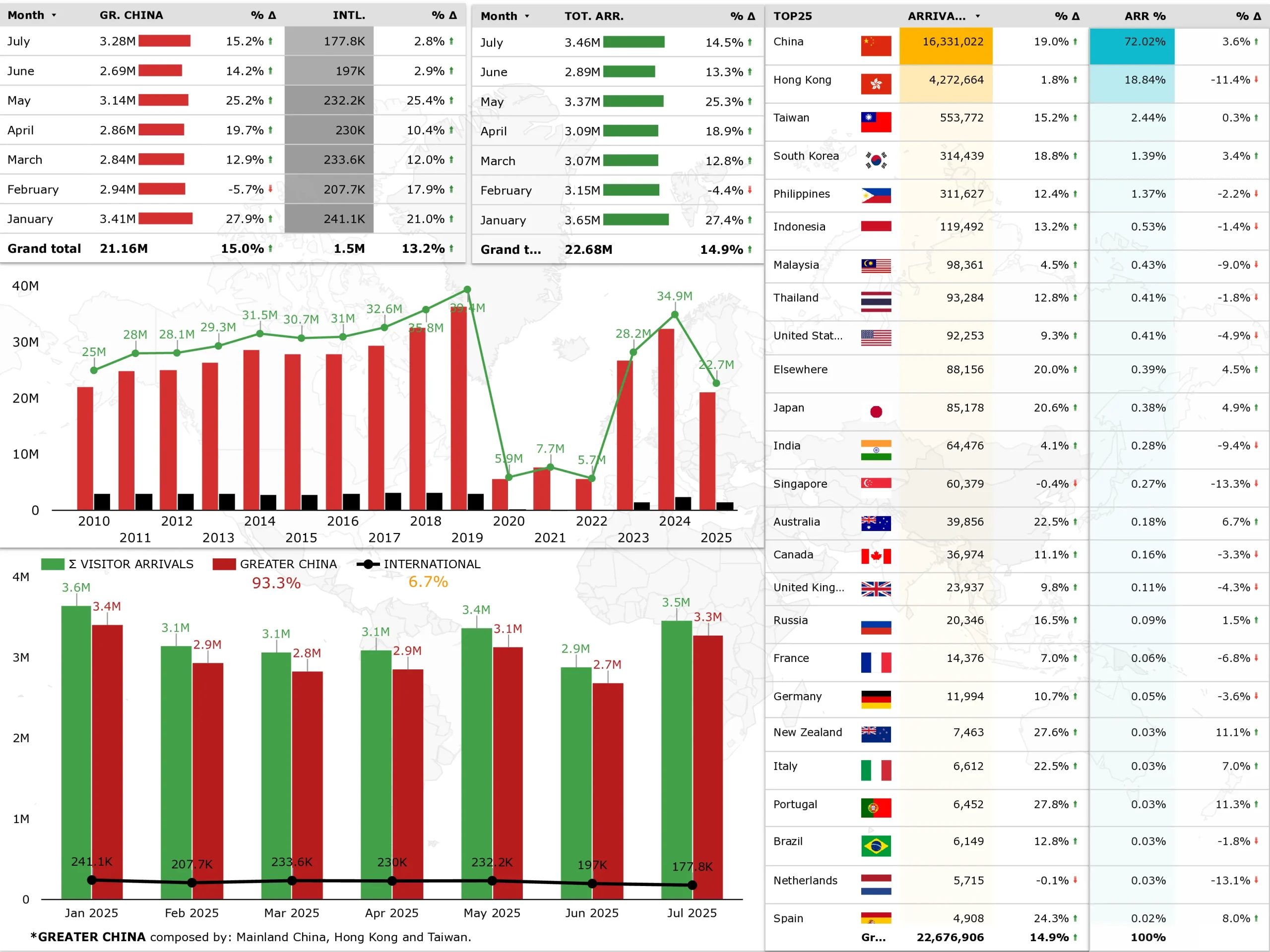
Visitor arrivals to Macau increased by 14.5 percent year-on-year to 3.46 million in July 2025, with mainland Chinese visitation improving, according to data released by the Statistics and Census Service (DSEC).
The robust growth continues a positive trend for the territory’s tourism sector, with total arrivals for the first seven months of 2025 reaching 22.68 million, a 14.9 percent yearly increase.
Mainland Chinese visitors accounted for the largest portion of arrivals, totaling 2.56 million in July—a substantial 17.4 percent increase from the previous year. Within this segment, visitors traveling under the Individual Visit Scheme numbered 1.36 million, a 23.6 percent year-on-year rise. The data reveal strong utilization of various travel programs, with 178,533 visitors arriving under the ‘one trip per week measure’, 56,602 under the ‘multiple-entry measure’, and 8,993 under the ‘tourist group multi-entry measure’.
The Greater Bay Area continues to have strong connectivity to Macau, with visitors from the nine Pearl River Delta cities increasing by 23 percent year-on-year to 1.23 million. This growth was particularly driven by a 56.8 percent surge in visitors from Zhuhai, highlighting the benefits of cross-border integration initiatives.
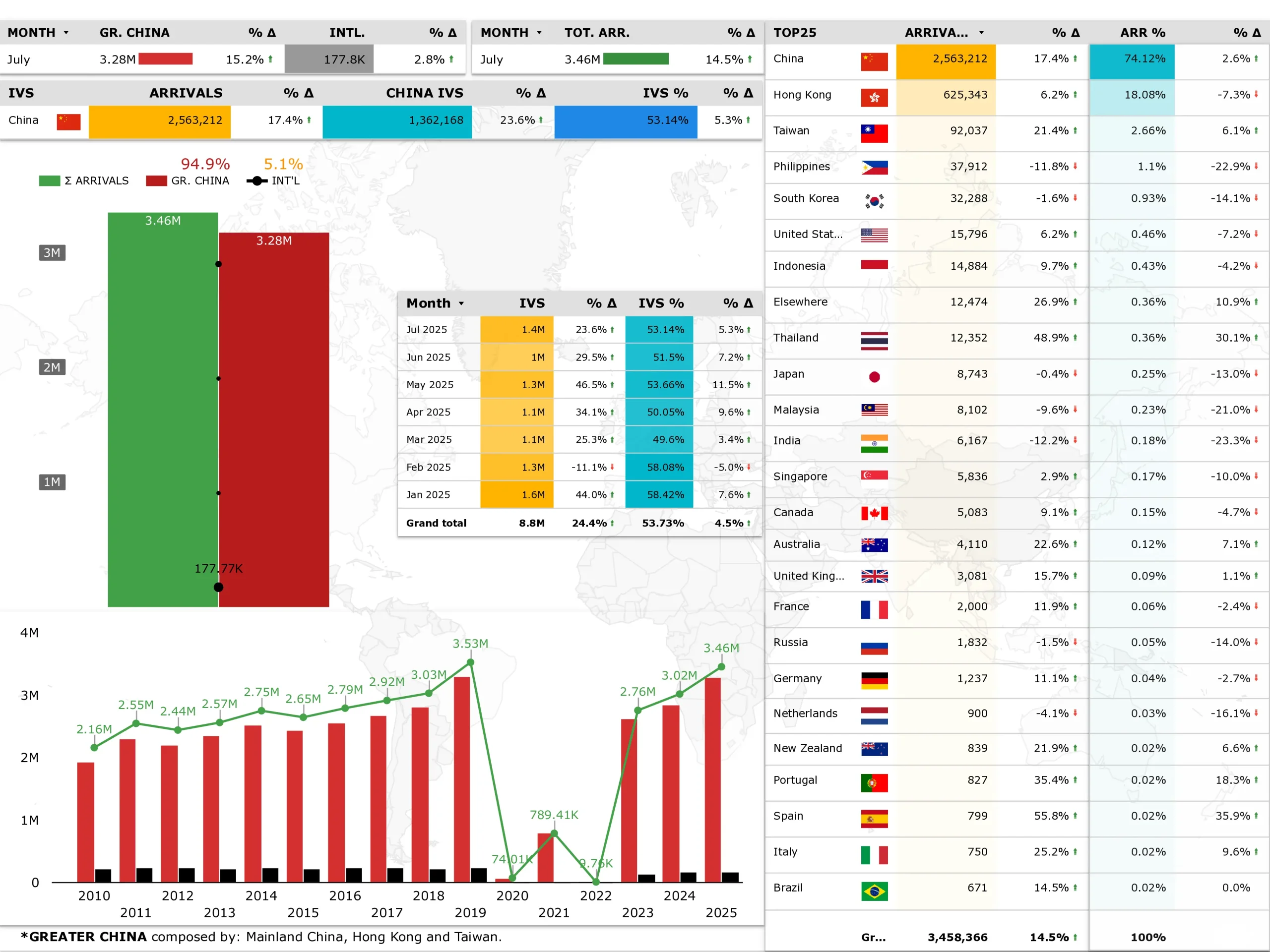
Regional markets showed mixed but generally positive performance. Visitors from Hong Kong totaled 625,343, a 6.2 percent increase, while arrivals from Taiwan reached 92,037, up 21.4 percent year-on-year.
International visitor arrivals totaled 177,774 in July, a modest 2.8 percent increase. Southeast Asian markets presented varied results, with Thailand leading growth at 48.9 percent to 12,352 visitors, followed by Indonesia at 9.7 percent to 14,884 visitors. However, arrivals from the Philippines declined 11.8 percent to 37,912 visitors, and Malaysia dropped 9.6 percent to 8,102 visitors.
The visitor composition breakdown shows that same-day visitors numbered 13.16 million for the seven-month period, surging 25.5 percent year-on-year, while overnight visitors reached 9.51 million, growing at a more moderate 2.8 percent. This pattern suggests strong cross-border day-trip activity while indicating opportunities for extending visitor stays.
Long-haul markets showed resilience, with US visitors increasing 6.2 percent to 15,796, while Northeast Asian markets remained relatively stable with slight declines from South Korea, down 1.6 percent to 32,288, and Japan, down 0.4 percent to 8,743.