

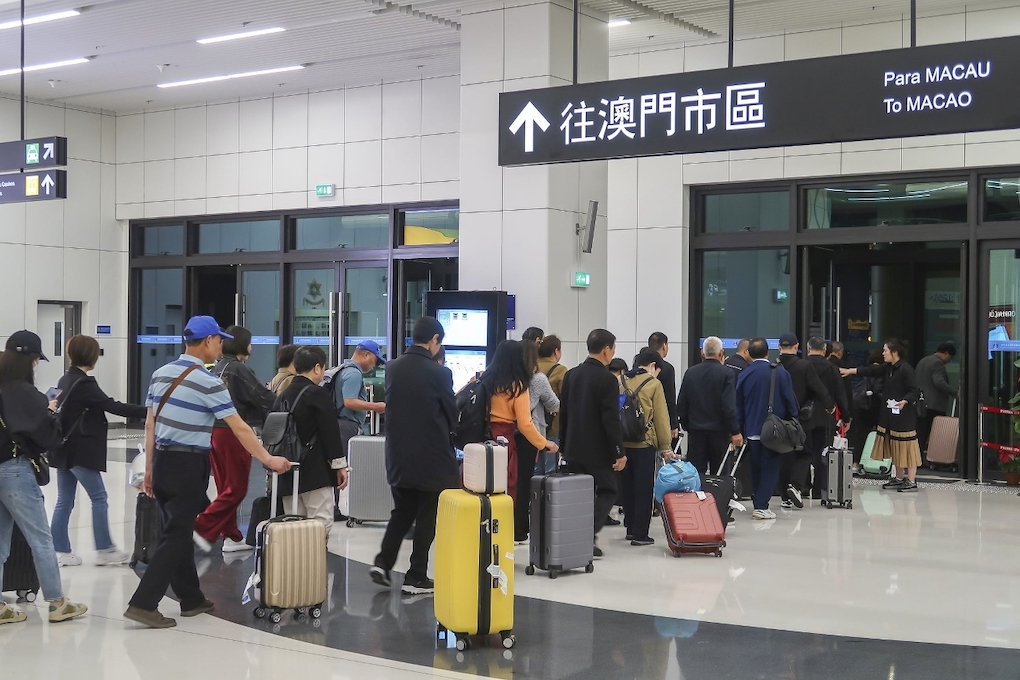

Visitor arrivals to Macau surged by 25.3 percent year-on-year in May to over 3.37 million, driven by strong growth in same-day tourism, according to data from the Statistics and Census Bureau (DSEC).
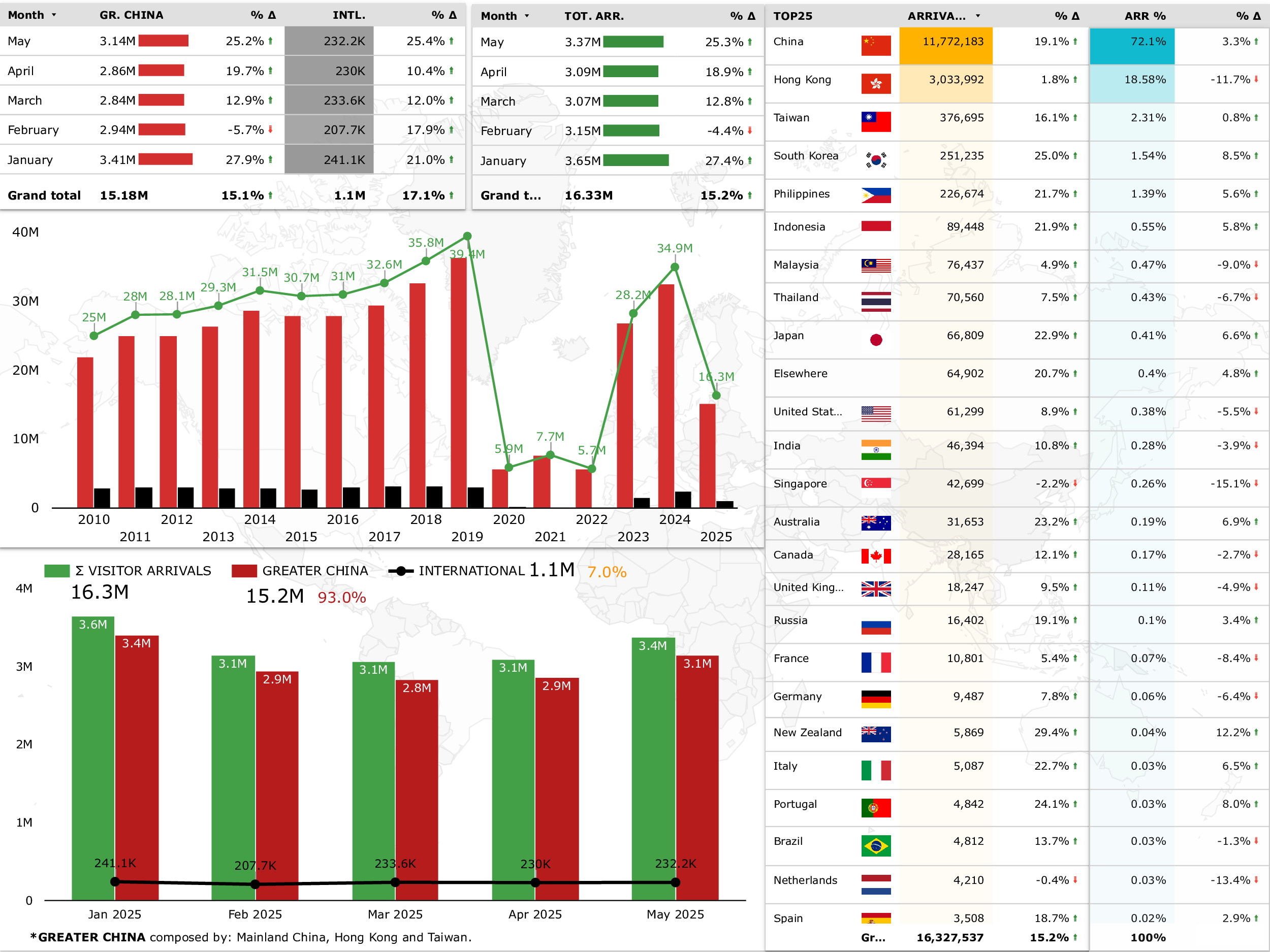
From January to May 2025, total visitor arrivals reached 16.33 million, marking a 15.2 percent rise year-on-year.

Same-day visitors grew 26.4 percent to over 9.57 million, while overnight visitors edged up 2.4 percent to 6.76 million. The average length of stay for all visitors over the five-month period dropped by 0.1 day to 1.1 days. However, the average stay for overnight visitors increased slightly to 2.3 days.
The number of same-day visitors jumped 39.2 percent to nearly 2 million, while overnight visitors rose 9.4 percent to around 1.38 million. However, the average length of stay dropped slightly to 1.1 days, down 0.1 day from a year earlier, reflecting the increased proportion of short-stay travelers. The duration of stay remained unchanged at 0.2 day for same-day visitors and 2.3 days for overnight guests.
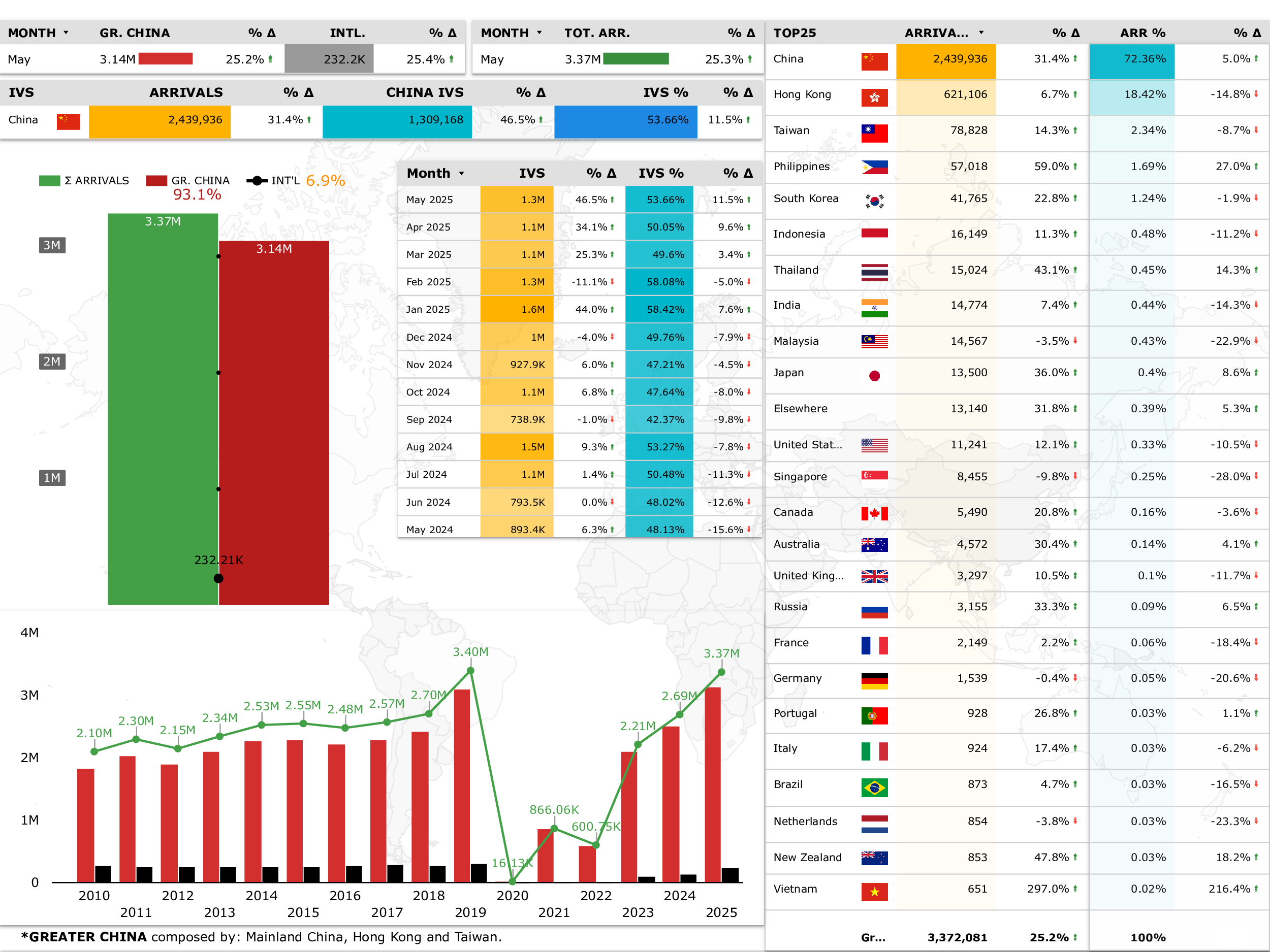
Mainland China remained the largest source market, with arrivals rising 31.4 percent to approximately 2.44 million. Among these, visitors entering under the Individual Visit Scheme rose sharply by 46.5 percent to over 1.3 million.
Notably, 166,602 mainland tourists came under the “one trip per week” policy, while 48,626 and 17,867 entered via the “multiple-entry” and “tourist group multi-entry” schemes respectively.
Visitor numbers from the nine Pearl River Delta cities in the Greater Bay Area soared 42.5 percent to over 1.32 million, spurred by a 66.1 percent increase in arrivals from neighboring Zhuhai. Arrivals from Hong Kong and Taiwan rose 6.7 percent and 14.3 percent, reaching 621,106 and 78,828 respectively.
International tourism also showed solid growth, with overseas arrivals rising 25.6 percent year-on-year to 232,211. Among Southeast Asian markets, the Philippines led with 57,018 visitors, up 59 percent, followed by Thailand (up 43.1 percent) and Indonesia (up 11.3 percent). In contrast, arrivals from Malaysia and Singapore fell by 3.5 percent and 9.8 percent, respectively.
South Asian tourism showed modest gains, with Indian arrivals up 7.4 percent to 14,774. Northeast Asian markets recorded growth. Arrivals from South Korea were up 22.8 percent and from Japan up 36 percent. Long-haul markets also saw gains, as visitors from the United States climbed 12.1 percent to 11,241.
By mode of entry, land checkpoints accounted for the vast majority of arrivals—82.5 percent or nearly 2.78 million—up 32.4 percent year-on-year.
The Hengqin port saw traffic surge by over 70 percent, while arrivals by sea rose 4.5 percent to 347,388, while air arrivals declined 5.9 percent to 243,787.