Indonesia’s National Police have put the public on notice that the 2026 FIFA World Cup will trigger a surge in illegal online gambling, as authorities brace for what they describe as one of the most challenging enforcement periods in recent memory.
Brigadier General Trunoyudo Wisnu Andiko, head of the Public Information Bureau at the National Police’s public relations division, issued the warning at a press conference held at the TVRI building in Jakarta on 7 May, the same venue where the state broadcaster was formalizing its role as official rights holder for the tournament in Indonesia. The timing was deliberate. TVRI’s coverage will reach tens of millions of viewers, and Polri is treating the broadcast footprint as both an asset and a vulnerability.
“We must anticipate the rise of football gambling,” Trunoyudo said in a written statement issued on the 8th of May. “We cannot allow this momentum to be exploited for unlawful activities that could result in public loss.”
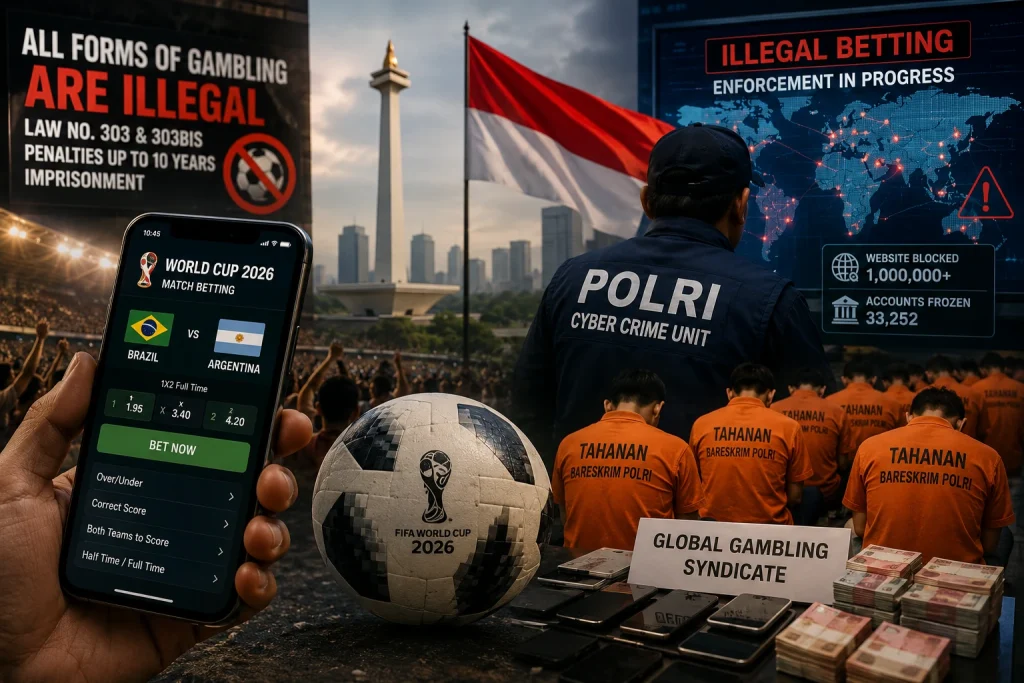
All forms of gambling are illegal in Indonesia under Articles 303 and 303bis of the Penal Code, with penalties extending to five years imprisonment and fines of up to $66,000 for punters, and up to ten years and $660,000 for operators. The country is home to the world’s largest Muslim-majority population, and enforcement has been consistent and, at times, aggressive. Over the past eighteen months alone, authorities have blocked more than a million gambling-related websites and frozen thousands of bank accounts. The Financial Services Authority, OJK, confirmed in March that it had instructed commercial banks to block 33,252 accounts following automated detection of gambling-related transactions. Yet the grey market persists, and football has always been its busiest season.
Soccer is by far the most popular sport in Indonesia, and offshore betting platforms – many of them operating through VPNs, cryptocurrency rails and local e-wallets – have long treated World Cup years as peak acquisition windows. Polri has acknowledged the pattern explicitly. Historical data consistently shows betting volumes spike around major international tournaments, and around games involving the Indonesian national team, which, for the first time, has qualified for the World Cup, adding a layer of national fervor to an already charged environment.

The scale of the underlying market is not in dispute. A study released earlier this year by a US-based payments provider found that 19 percent of people with an interest in the 2026 World Cup intended to place their first-ever online bet during the tournament, a figure that, applied to Indonesia’s enormous and football-obsessed population, points to a significant acquisition opportunity for offshore operators willing to absorb the legal risk. Gambling turnover linked to online platforms reached an estimated 280 trillion rupiah (approximately $16 billion) last year, with an estimated 12 million Indonesians participating in illegal online gambling activity.
The enforcement environment has sharpened considerably in the lead-up to the tournament. On the 9th of May, just days after Trunoyudo’s warning, Indonesian police arrested 321 foreign nationals, predominantly Vietnamese, with significant contingents from China, Myanmar, Laos and Thailand, at a commercial building near Jakarta’s Chinatown. Authorities said the group had been operating at least 75 illegal betting websites, targeting players outside Indonesia, for approximately two months. Of those detained, 275 were formally named as suspects on gambling and money laundering charges carrying a maximum sentence of nine years. Similar operations had previously been dismantled in Surabaya, Bali and Batam, with investigators noting a discernible migration of transnational gambling syndicates from Cambodia and Myanmar, where prior crackdowns had raised operational costs, toward Indonesia.
Communications and Digital Minister Meutya Hafid took a harder line still, pledging zero tolerance for operators targeting minors and committing further government resources to digital monitoring and prosecution. “Criminals now use digital solutions and advanced technology,” she said. “We must massively strengthen the digital services we use to prosecute and monitor them.” Polri is setting up a dedicated complaint channel in cooperation with TVRI, supplementing the existing 110 hotline, and has also warned the public against fraudulent watch-party ticket schemes, a recurring side-racket that emerges around major sporting events.
The crackdown cycle Indonesia finds itself in is not new, but the 2026 World Cup represents a stress test of unusual intensity. The combination of Indonesia’s first-ever World Cup qualification, a 48-team tournament generating more matches and more betting markets than any previous edition, and a government with demonstrated appetite for enforcement creates conditions that offshore operators and their players will need to navigate carefully.