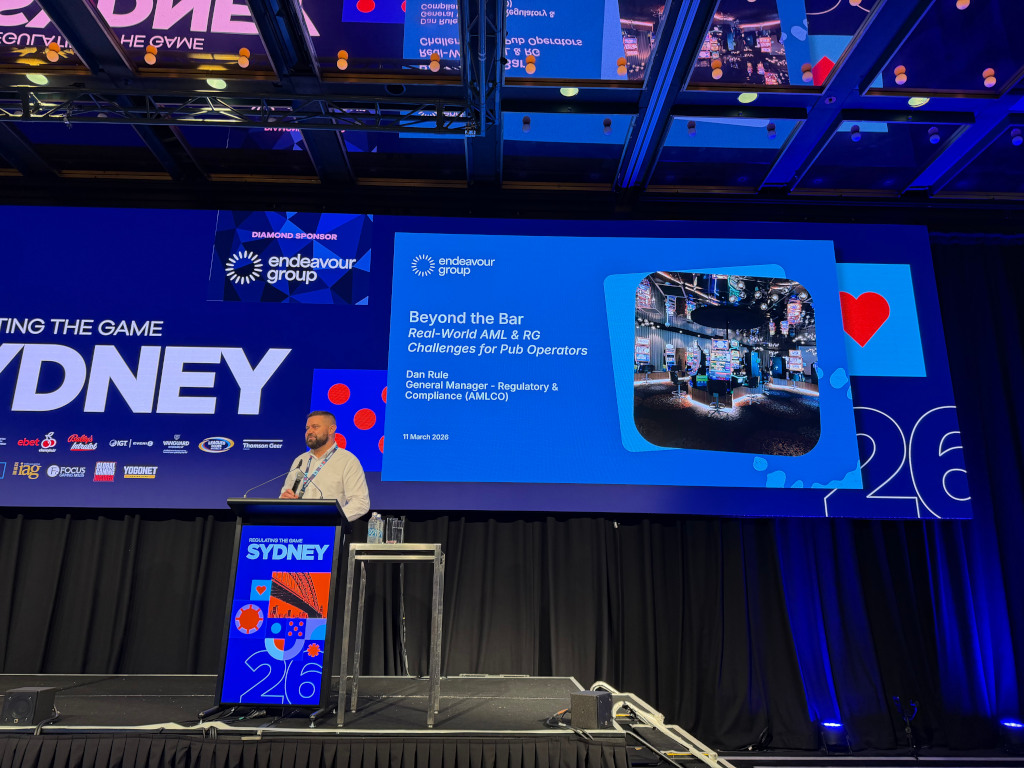
Australia’s pub and club sector is confronting a complex mix of money laundering, social media-driven gambling trends and frontline safety challenges, according to Daniel Rule – General Manager for Regulatory & Compliance at Endeavour Group.
Speaking at the Regulating the Game 2026 conference in Sydney, Rule told delegates that while the industry’s understanding of anti-money laundering (AML) obligations has matured significantly over the past decade, practical enforcement inside gaming venues remains difficult, particularly in environments staffed largely by young hospitality workers.
“Early days when we came to this conference, AML was a new concept for this industry,” Rule said. “Today most people in this room understand it very well. But the real challenge is how you apply those obligations in busy pubs and clubs with frontline staff who are often quite young.”
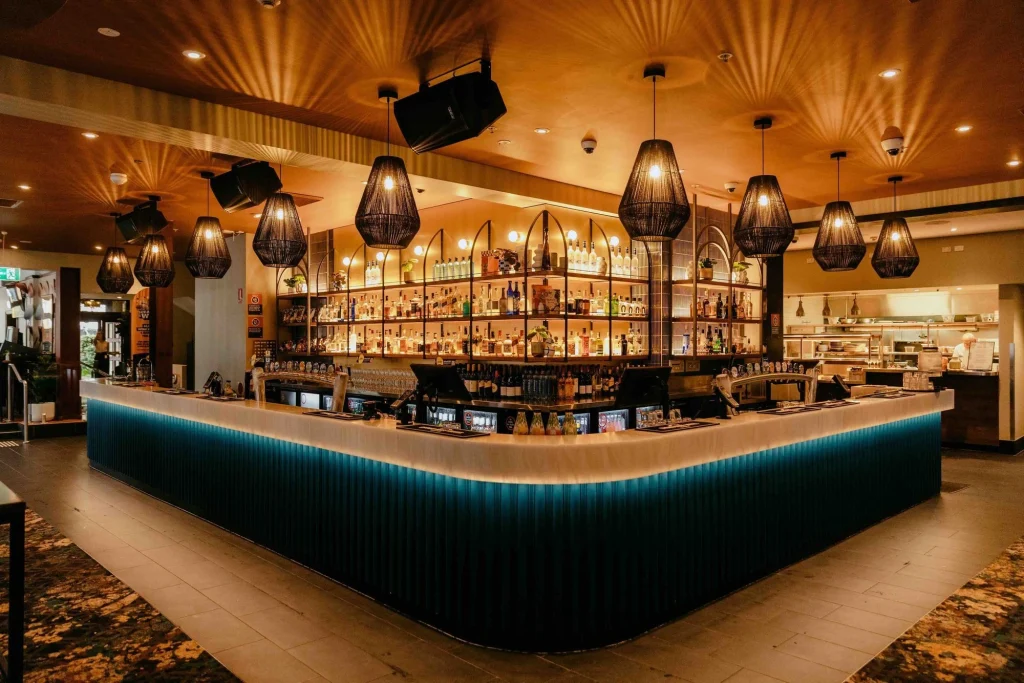
Endeavour Group operates Australia’s largest hotel network, with around 350 pubs across the country, alongside the Dan Murphy’s and BWS retail liquor chains. The hotels division alone employs roughly 10,000 staff, many of them casual workers, highlighting what Rule described as the scale of training and compliance responsibilities faced by operators.
Rule illustrated the evolution of the industry’s compliance culture with a personal anecdote from early in his career working behind the bar in a regional New South Wales pub. At the time, he said, neither AML nor safer gambling concepts were part of day-to-day operations. Yet looking back, he now recognizes behaviors that would today raise serious red flags.
“When I was doing the cash clearances on the gaming machines at the end of the night, you’d see stacks of notes all facing the same direction – $50s, $100s – sometimes sticky,” he recalled. “At the time I just thought these guys had a lot of money.” Those patrons, he said, included members of a bikie (motorcycle) gang operating in the area. “Fast forward 20 years and what I know today would have changed the way I looked at what was happening in that gaming room.”
Training against money laundering tactics
One of the most significant operational challenges facing pub operators is the need to constantly train a transient workforce. Rule noted that traditional compliance training modules lasting 30 to 60 minutes often fail to engage staff who are juggling busy shifts and customer service duties. Instead, Endeavour has begun experimenting with short video training modules delivered through mobile workforce platforms. The clips, typically one to two minutes long, explain specific AML or safer-gaming risks in simple visual terms.
One example used in the presentation showed “bill stuffing,” a common money-laundering typology in gaming venues where a player inserts cash into a machine with little or no play before cashing out a ticket or check to give the funds a legitimate appearance. “When we launched these videos, we saw an immediate uplift in awareness and reporting,” Rule said, referring to increases in unusual activity reports submitted by venue staff.
Another emerging concern is the growing availability of high-quality fake identification. Rule demonstrated how easily such documents can be obtained online, noting that some websites openly advertise counterfeit IDs that can pass certain electronic verification systems. “This isn’t hidden on the dark web,” he said. “You can type it into Google and buy one.” To counter the threat, some venues have introduced simple tools such as ultraviolet lighting to detect security features that counterfeit cards often lack.
Underage gambling on the rise
A particularly worrying trend is what Rule described as a resurgence of gambling interest among younger patrons driven by social media.
During visits to venues across Australia, particularly in Queensland, operators reported gaming rooms filling with newly-legal 18-year-olds on weekend nights. According to Rule, influencers promoting slot machine play on platforms such as Instagram and TikTok are helping to drive the trend. “These accounts can have hundreds of thousands of followers,” he said. “They’re effectively promoting pokies through social media channels that aren’t really regulated.”
To address underage gambling and compliance risks, Endeavour has been experimenting with emerging technologies including age-estimation systems. The technology uses camera analytics to estimate a patron’s age without storing their image, potentially alerting staff when someone entering a gaming room appears underage. Initial trials in Victoria produced mixed results but showed promise when thresholds were calibrated more precisely.
Facial recognition
Rule also highlighted the growing role of facial recognition technology (FRT) in enforcing self-exclusion programs. Historically, many pubs relied on printed photo books of excluded patrons – sometimes containing dozens of pages – which staff were expected to memorize. “Expecting someone on a busy shift to recognize faces from an 80-page folder is unrealistic,” he said.
In venues where FRT has been introduced, alerts can notify staff if a self-excluded individual re-enters the gaming area. Rule recounted one case in which a long-serving staff member successfully intercepted a patron who had previously self-excluded but had changed significantly in appearance over nearly a year. “Without the technology she said she would never have recognized them,” he said. However, he cautioned that privacy concerns remain significant, particularly following regulatory scrutiny of facial recognition deployments in Australian retail environments.
Side bets
Beyond traditional laundering techniques such as bill stuffing, Rule warned of more unusual behavior appearing in gaming rooms. One example involves groups congregating around machines when a player triggers a “gamble feature,” which allows winnings to be multiplied based on a card or color selection.
Members of the group then place side bets among themselves on the outcome, exchanging cash outside the machine rather than through the regulated gaming system. “It raises a lot of questions,” Rule said. “Is it advantage play? Is it cultural behavior? Or is it money laundering? It could be a mix of all three.” Because the transactions occur away from the gaming machine itself, detecting such activity relies heavily on staff observation rather than automated monitoring.
Like many large operators, Endeavour is exploring ways to integrate multiple data sources – from gaming machines and point-of-sale systems to accommodation and restaurant bookings – into unified risk-monitoring platforms. Such systems could allow automated transaction monitoring and behavioral analytics, reducing reliance on frontline staff to detect suspicious activity. However, Rule emphasized that building such infrastructure is expensive and complex. “There’s huge value in bringing that data together,” he said. “But it takes time, effort and a lot of investment to do it properly.”
Frontline risk
Perhaps the most striking part of Rule’s presentation focused on the risks faced by hospitality staff dealing directly with patrons. Unlike online gambling platforms or banking institutions, which can terminate customer relationships remotely, pub employees often interact face-to-face with individuals suspected of wrongdoing. In some cases, incidents can escalate into violence.
Rule showed examples from venues including an altercation that resulted in a stabbing and another involving a patron displaying a firearm. “These are extreme examples,” he said. “But they highlight the reality that our teams operate in.” He stressed that operators must ensure staff are never placed in situations where they feel compelled to confront potentially dangerous individuals.
Ultimately, he argued, regulators and policymakers must consider how compliance expectations intersect with the realities of running community venues. “How do we protect vulnerable people using our machines while also protecting the young staff working in our venues?” Rule said. “That’s the challenge we need to solve together.”