
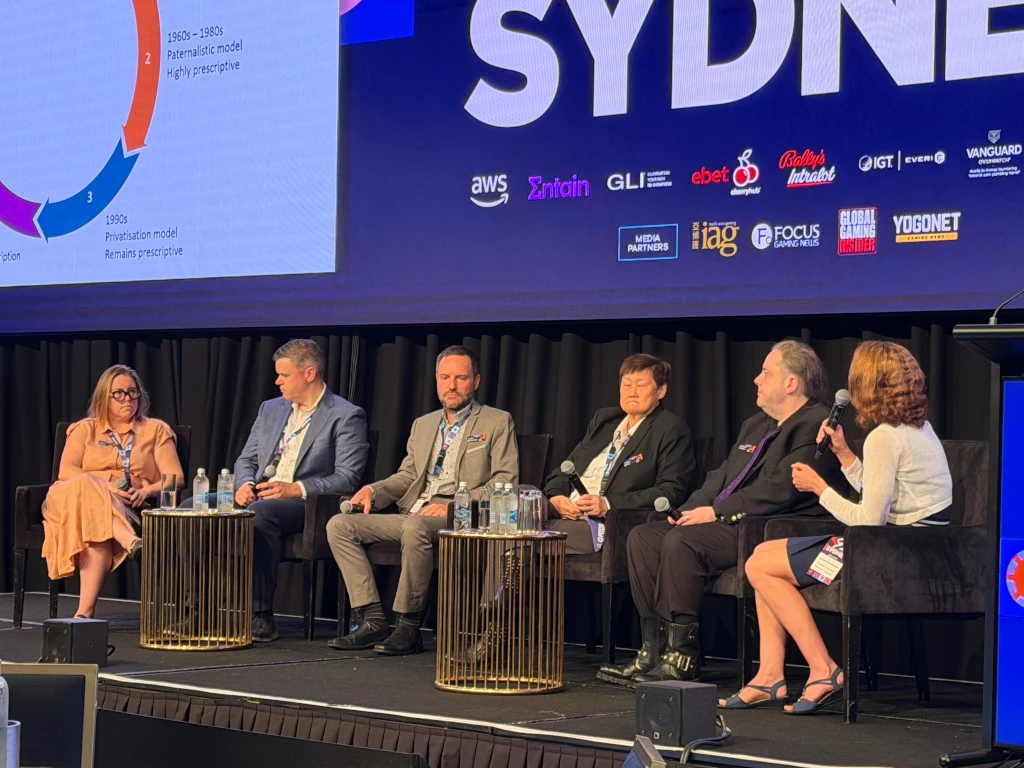
At the Regulating the Game 2026 conference in Sydney this week, a panel of experts gathered to answer a high-stakes question: Is the industry currently “all in” on a sustainable future, or is it time to fold the old models in favor of something radical?
Moderated by Monique Bielanowski of Monandia Consulting, the session moved quickly beyond platitudes to address a harsh reality: a “reactive” policy environment born from a series of high-profile Royal Commissions is fundamentally reshaping the landscape.
Reactive policy
For decades, Australian gambling policy was defined by “incrementalism”: slow, evidence-based tweaks. Linda Woo, former Executive Director of Regulatory Policy, argued that this era is over. “We are now in a reactive policy environment,” Woo stated. “The challenge for the ‘right’ model is that when you regulate in reaction to a crisis, you risk creating unintended consequences that are harder to fix later.” This “pendulum swing” has moved the focus from economic contribution almost entirely to harm and risk management, often at the expense of long-term stability.
Independent economist Dr. Andrew Russell backed this view, noting that policymakers are now pricing in “negative externalities”, the social costs of gambling, more aggressively than ever before. However, he warned of “regulatory theater.”
“The ‘right model’ must be one that is efficacious – actually reducing harm – rather than just looking busy,” Russell remarked. He cautioned that “regulatory fatigue” is a real threat, where operators become so consumed by the sheer volume of compliance paperwork that actual safety innovation falls by the wayside.
Operator viewpoint
From the operator’s perspective, the “right” model is one that follows the consumer, not just the most compliant companies. Joel Williams, GM of Government & Regulatory Affairs at Tabcorp, highlighted a growing disparity: while domestic, licensed operators face increasingly high-friction regulation, “gray market” offshore entities continue to operate with near-zero barriers to entry. “If the ‘right model’ only burdens the most compliant and visible actors, you eventually drive the consumer into the shadows,” Williams warned. He argued for a holistic approach that ensures a level playing field across the entire wagering ecosystem.
Cultural shift
For terrestrial giants like Endeavour Group, the shift is cultural. Nadine Ewing, Head of Safer Gaming, noted that the industry has moved past the “tick-the-box” era. Today, it’s about data-led interventions, facial recognition, and digital player accounts. However, this brings a new friction point: the customer experience. “The right model needs to support the venue in that conversation with the customer, rather than just imposing the rule and leaving us to manage the fallout at the bar,” Ewing said.
Finding the right model
A recurring theme was the move toward “Prescriptive Regulation”, where the regulator dictates the how rather than the what. Mark D’Andrea of Gaming Associates warned that this rigid approach stifles innovation. “When you regulate by checklist, you kill the incentive to find better harm-prevention strategies,” D’Andrea argued. He noted that while Australia is at the vanguard of this trend, it reflects a global decline in trust between regulators and industry – a trust that can only be rebuilt through transparency and measurable outcomes.
Perhaps the most sobering takeaway was the acknowledgment of a “brain drain” and a technical capability gap within regulatory bodies. As the industry discusses AI and complex algorithmic monitoring, Dr. Russell noted that most regulators are still staffed for a “manual world”. The panel concluded that the future “right model” must be a co-regulatory or “embedded” one, where regulators have real-time access to the same data dashboards as operators.