
In the seven days to 20 September, Poland’s iGaming search demand increased 20.6% WoW, according to Blask Index.
A bigger story is that three weeks prior, a payment-blocking mechanism targeting illegal gambling domains suppressed search activity by roughly 40–50% for most of the month, a far more persistent effect than usual, before one major football weekend wiped it out completely.
BLIK, Poland’s mobile payment system, began blocking transactions to domains on the Finance Ministry’s illegal-gambling register on Sept 1. The registry has passed 55,000 domains, growing by roughly 700 a month. Poland’s Blask Index fell 24.8% the week the blocks began.
Daily Blask Index data shows that decline wasn’t a one-week story.
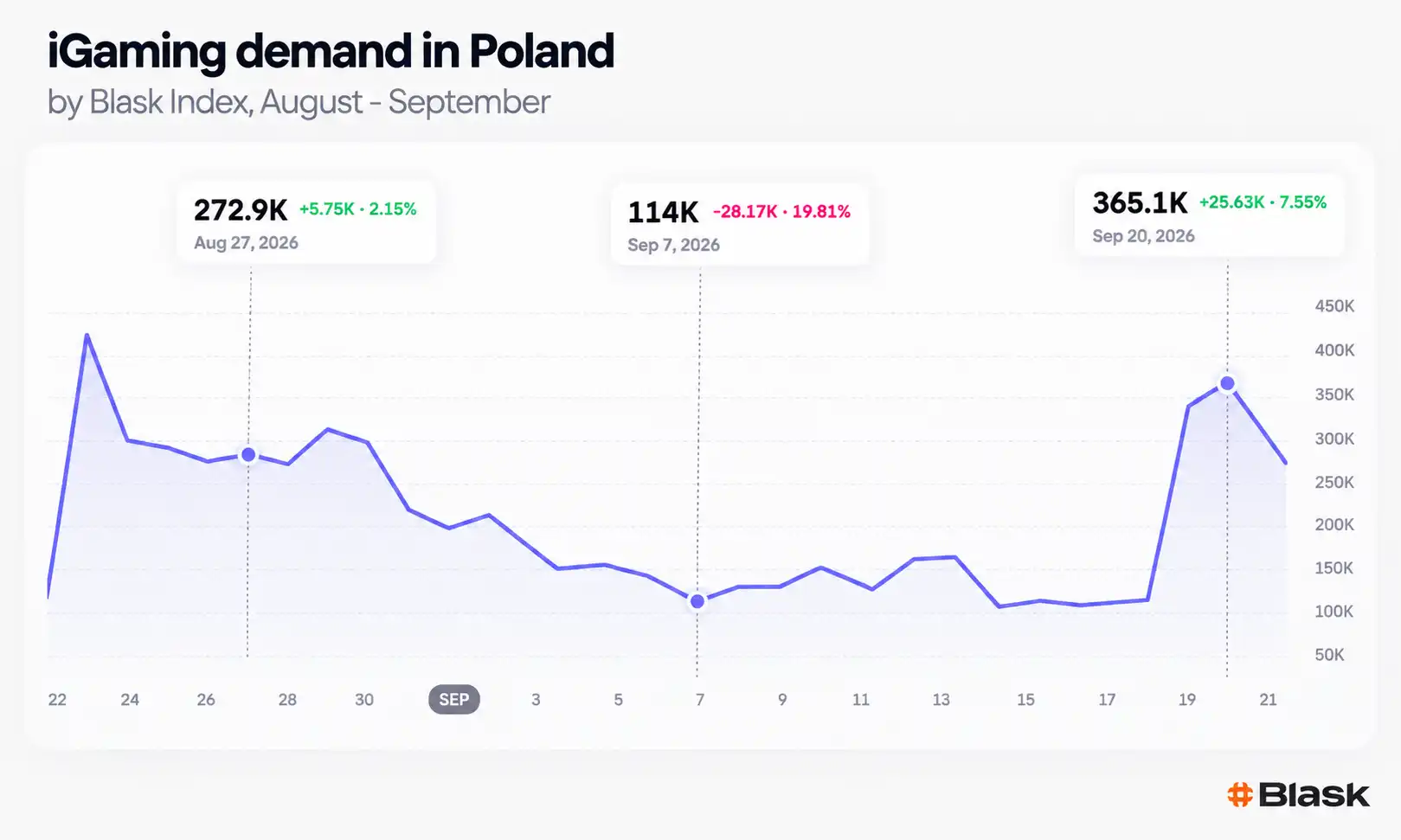
Total daily demand ran roughly 270,000–300,000 in late August, dropped to a sustained band of about 110,000–170,000 for essentially the entire Sept 1–18 period — eighteen days — then jumped to 338,673 on Sept 19 and 364,634 on Sept 20, above the pre-blockade baseline. The rebound lands exactly on PKO BP Ekstraklasa matchday 9, played Sept 18–20, which included Jagiellonia Białystok’s 1–3 loss to Legia Warszawa and Lech Poznań’s 5–1 win over Radomiak.
The three-week persistence is the sharper story here. Enforcement-driven search declines in other markets — a DNS-blocking order in Chile, for instance — have faded within a single week as headline attention moved on.
Poland’s blockade held for nearly a month, consistent with BLIK’s mechanism actually suppressing attention to blocked domains on an ongoing basis rather than just generating a news cycle. It took a single outsized football weekend, not the enforcement losing force on its own, to reverse it.
Blask Index is a real-time measure of market demand volume for iGaming brands in a given country, based on normalized search data. A lower index is consistent with reduced search attention toward illegal-market brands; it does not by itself confirm a change in actual money flow to blocked domains.